

When prisoners are locked up for life, how do they get out?
Lifers in Pennsylvania cannot be paroled, and their other options for seeking release are slim.
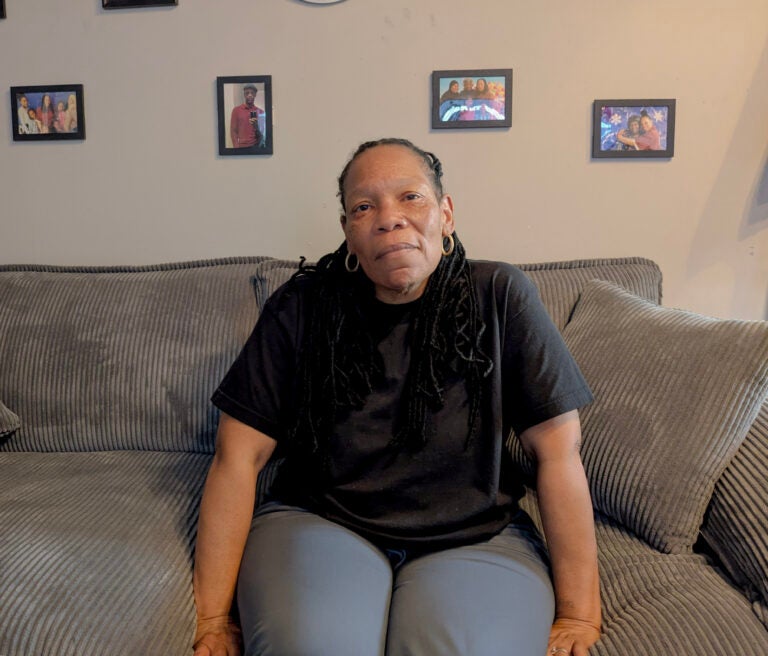
Dannielle Hadley, released from State Correctional Institution Muncy last year, sits in her West Philadelphia home in April 2026. | ASHLEE MOORE
Dannielle Hadley remembers the moment a superintendent knocked on her cell door at Muncy State Correctional Institution last year.
“She said, ‘I think you should sit down,'” Hadley said. “She read the paper to me and said that Governor Shapiro signed my paper, and I was commuted.”
Hadley first walked through Muncy’s gates roughly 38 years ago. She was a 23-year-old sentenced to life without parole for first-degree murder. She said she was scared and had no idea what would happen next. Her role in the crime was handing the man who would later commit the murder handcuffs to restrain the victim.
Nearly four decades later, Pennsylvania commuted the life sentences of two women, Hadley and Marie Scott, on the same day.
Hadley’s release was the rare result of a nearly two-decade process by her lawyers and advocates to get her out of prison. In Pennsylvania, people serving life sentences cannot be paroled, so unless an inmate’s conviction or sentence is overturned in court, the only two legal exits from prison are commutation—a sentence reduction approved by the governor—and compassionate release, a medical provision for inmates with less than a year to live.
For thousands of people serving “death by incarceration” sentences in the state, these two pathways represent the difference between dying inside and coming home, said Rupalee Rashatwar, a staff attorney at the Abolitionist Law Center.
“They’re the only two vehicles that currently exist,” Rashatwar said. “And they just don’t give meaningful pathways for freedom.”
Pennsylvania holds one of the largest life-without-parole populations in the country, with more than 5,000 inmates, according to The Sentencing Project. Though the state Supreme Court recently struck down mandatory life without parole sentences for second-degree murder, Pennsylvania still requires it for first-degree murder, one of the driving forces of its large population of lifers.
Pennsylvania’s compassionate release law was established in 2009. This pathway requires a person to have a terminal diagnosis with less than one year to live and confirmation from their treating physician. The individual must also arrange their own end-of-life care—either at a nursing facility or a family member’s home—from inside a prison. Some have died waiting for hearings.
“It is nearly impossible to do that all from inside,” Rashatwar said. “It requires the help of not only an attorney, but it requires the goodwill of providers in the community.”
Commutation requires an application to the Pennsylvania Board of Pardons, followed by a merit hearing, a public hearing before the board, and a signature from the governor. The process can take years. In the past 50 years, only 17 women serving life have been granted commutation.
“It’s not a transparent process,” Rashatwar said. “It’s a political process. And it’s one that’s nearly impossible to succeed and navigate.”
Rashatwar has seen inmates in their late 80s with clean disciplinary records or those whose release was publicly supported by victims’ families have their petitions rejected, she said.
“There are a lot of reasons why someone’s sentence is not ultimately commuted that never really get fully communicated to the person who’s seeking their commutation application,” Rashatwar said.
The Board of Pardons is made up of five members, including the lieutenant governor; the attorney general; a victim of a crime; a corrections expert; and a doctor of medicine, psychiatrist, or psychologist. Those sentenced to life must receive a majority vote of the board to have a public hearing, and a unanimous vote to have their application recommended to the governor.
“The commutation process is a lengthy one,” said Lt. Gov. Austin Davis, who chairs the Board of Pardons. “We’re deciding whether someone has earned clemency, and that’s a very subjective process by design. We also have to weigh the applicant’s petition against the testimony of those who were impacted by their crime and quite frankly, it’s really a delicate balance.”
During her time at Muncy, Hadley was a mentor to the younger women, worked as a facilitator for a mental health program, and volunteered as a hospice worker.
Hadley applied for commutation three times. Her first application, filed around 2009, was a long shot she submitted at the encouragement of other incarcerated women. The second, filed in 2016, was denied in 2019—a blow made even harder as her aging mother waited for her to come home.
“It hurt more because I know that it hurt them,” Hadley said. “Their hopes were so high, and when they said no, it just hurt.”
Hadley said the denial notices offered no reason, and she does not believe the process treats each case on its own terms.
“I don’t think that they individualize each application,” she said. “When the word ‘lifer’ comes across the desk, the first thing they think is murder. And with that thought in mind, it’s hard to see anything else.”
Her third attempt at commutation came in 2022.
“It was just a calm, and I don’t know why that was,” Hadley said. “I always say that it was God holding my heart, just keeping me still.”
Ten days before her commutation was granted in 2025, her mother died.
Hadley, 62, is a mother of two sons, has nine grandchildren, and a great-grandchild. Spending most of her life in prison has left her disabled. She has had four back surgeries and needs a walker to get around. She is now living with her fiancé in West Philadelphia.
She said she still does not fully understand why her case succeeded when so many others have not.
“I give it to God,” Hadley said. “Because there are women there who have done just as much and more.”
About the women still inside, Hadley asked people on the outside to look closer.
“See us individually,” she said. “Don’t see our crime. Don’t see that 23-year-old. See the women that we’ve grown into.”
WHYY is your source for fact-based, in-depth journalism and information. As a nonprofit organization, we rely on financial support from readers like you. Please give today.