
‘Hurts us to the core’: Institutions tell Philadelphia’s history of slavery amid Trump censorship threat at President’s House Site
As the Trump administration moves to take down panels on slavery at Independence Mall, local institutions are affirming their dedication to telling a full history.
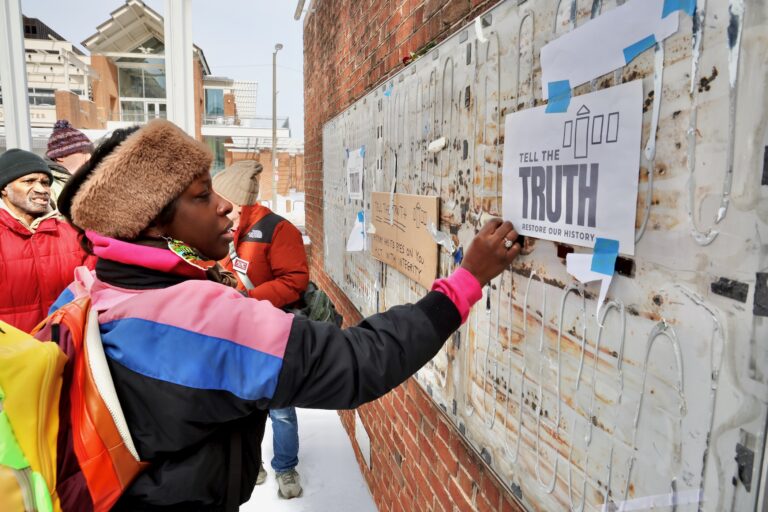
File: Protesters, including Alyssa Bigbee of Philadelphia, tape signs to a wall at the President's House site on Independence Mall, where an exhibition about slavery at the nation's first presidential residence was taken down in January. (Emma Lee/WHYY)
From Philly and the Pa. suburbs to South Jersey and Delaware, what would you like WHYY News to cover? Let us know!
With America’s 250th anniversary rapidly approaching, all eyes are on Philadelphia. As tourists visit national landmarks of freedom, a question remains: How did the institution of slavery prevail in a country founded on the notion that “All men are created equal?”
Historical and cultural institutions across Philadelphia are telling the stories of the enslaved Africans, whose bondage contradicted the nation’s founding principles. These institutions, ranging from historic houses to contemporary museums, are narrating the history of enslaved people through exhibitions, storytelling and reenactments.
Emma Hart, a professor and researcher of early American history at the University of Pennsylvania, said individuals can’t fully understand early America without discussing the role slavery played in it.
“It’s not a complete history of the period when slavery existed if you are not talking about enslaved individuals and their experiences in the institution of slavery,” Hart said.
A city built on bondage
The first enslaved Africans arrived in the Delaware River Valley, which was settled by Swedish colonists as early as 1639. The slave trade continued through William Penn’s acquisition of Pennsylvania in 1681, and the first ship of enslaved people after Penn’s arrival — the Isabella — docked in Philadelphia in 1684.
Slavery in Philadelphia operated differently than in the South, said Stephanye Watts, community engagement coordinator for Historic Germantown. Enslaved people in Philadelphia lived inside homes rather than outside shacks, and also shared public spaces with the city’s population of free Black people. They were used for physical labor such as carpentry, shoemaking and domestic work.
“On the eve of the American Revolution, there’s about 2.5 million people living in British North America, and … there [were] approximately 500,000 people of African descent,” said Adrienne Whaley, director of education and community engagement at The Museum of the American Revolution. “That’s one out of every five people.”
The morality of slavery was questioned by early Pennsylvanians, such as the Germantown Quakers. Pennsylvania’s Gradual Abolition Act of 1780 declared children born to enslaved people after 1780 free people, provided they labored for their mothers’ masters for 28 years.
However, this law didn’t apply to slaveowners who lived in other states, such as George Washington, who lived with nine enslaved people at his Philadelphia property, now a historic location called the President’s House Site.
“It was a very complicated time for people who were enslaved, because your freedom was at your doorstep, you know, thinking about how many people were coming here in order to escape slavery in the South,” Watts said. “But it still wouldn’t be in your grasp if that was not the desire of who you were enslaved to at that time.”
‘Taken away’: The battle over censorship
The President’s House Site, which features plaques detailing the lives of nine enslaved people held by Washington during his presidency in Philadelphia, came under scrutiny from the Trump administration. The exhibit was flagged under a March 2025 executive order, “Restoring Truth and Sanity to American History.” National Park Service workers removed the displays on Jan. 22 before a federal judge later ordered the exhibit restored.
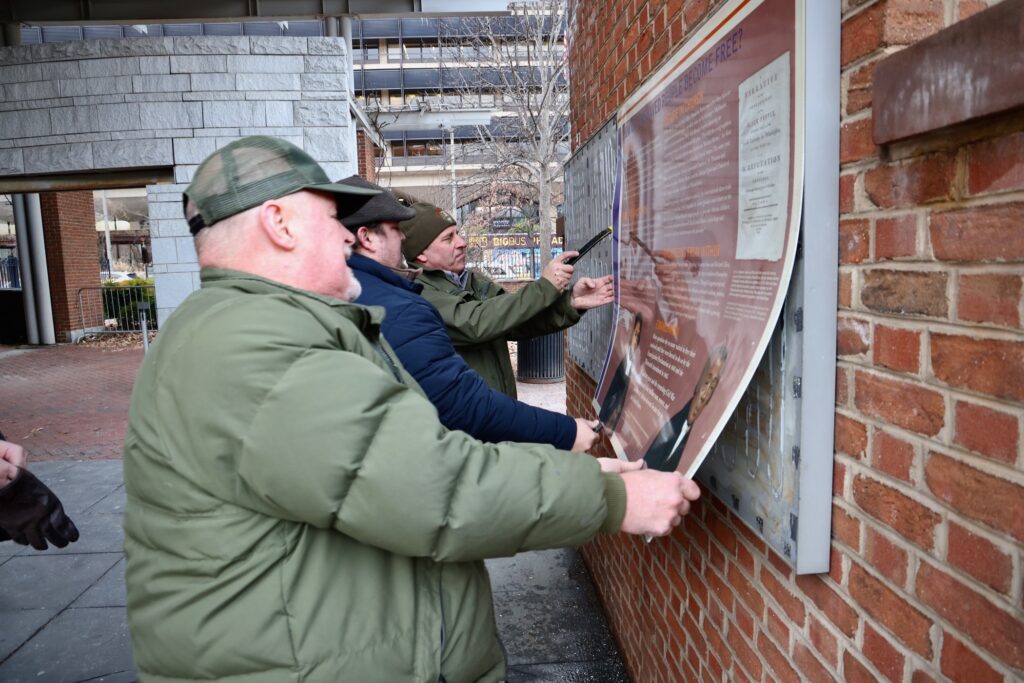
The battle was at a standstill until U.S. District Judge Angel Kelley issued a preliminary injunction on June 12 to restore the panels. On June 18, the 3rd Circuit Court of Appeals ruled in favor of the Trump administration, declaring that Philadelphia lacks power over the exhibits at the site.
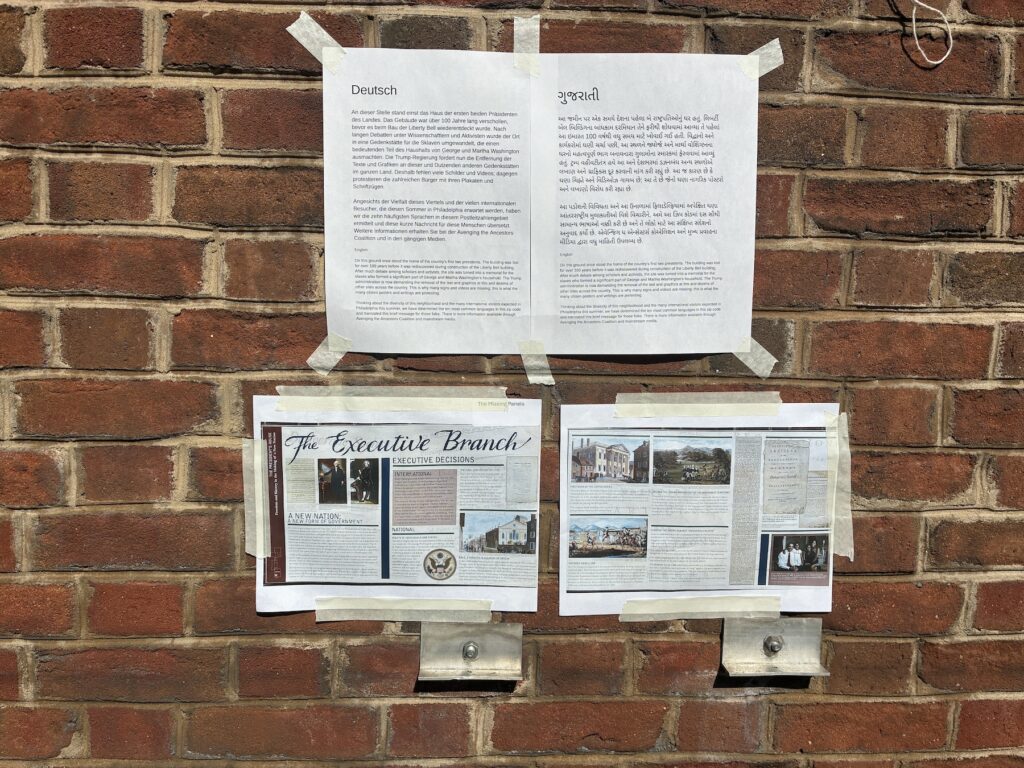
As of June 17, printed photos of the removed exhibits had been taped under the empty panels. Accompanying them are unsigned paper notices detailing the Trump administration’s actions and explaining the exhibits’ relevance in various languages.
“Thinking about the diversity of this neighborhood and the many international visitors expected in Philadelphia this summer, we have determined the ten most common languages in this zip code and translated this brief message for those folks,” the signs state.
To some Philadelphia residents, this censorship is personal. Gwen Ragsdale, co-curator of the Lest We Forget Slavery Museum in Germantown, and her husband, J. Justin Ragsdale, have spent decades collecting artifacts related to slavery, such as shackles, whips and branding irons.
One of these artifacts — a shackle that may have been worn by J. Justin Ragsdale’s great-uncle Bub — is depicted on a panel about the timeline of slavery. The panel was removed and is no longer present at the President’s House Site. A photo of the panel has been taped up in its absence.
“The fact that it was taken away really hurts us to the core, and we take it personally,” Gwen Ragsdale said.
Related Content
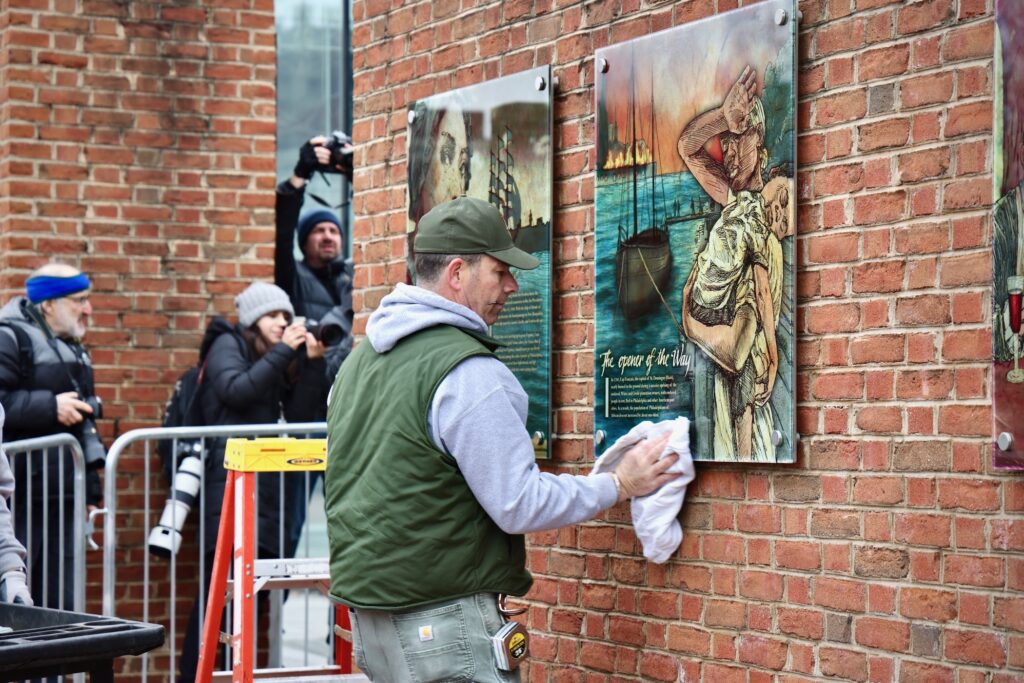
Philadelphia’s slavery exhibit is being restored at the President’s House
“This is the American people fighting back and saying we will not accept this,” said one Independence Mall visitor. “Will not allow history to be rewritten.”
8 months ago
Filling in the gaps
Philadelphia’s historical sites, cultural destinations and museums keep conversations about slavery alive in different ways. For The Lest We Forget Museum of Slavery, the only museum in the Philadelphia region dedicated to slavery artifacts, that means inviting visitors to engage with history firsthand through guided tours.
“I provide a guided tour, which provides a review of slavery from capture to emancipation and beyond,” Gwen Ragsdale said. “We start at slavery, and we actually walk around the museum, starting with the first shackle, which is Uncle Bub’s shackle, and other shackles.”
Exhibitions at The African American Museum in Philadelphia also detail the history of slavery. “Audacious Freedom: African Americans in Philadelphia 1776-1876” is a permanent exhibition that illustrates the lives of free and enslaved people over the century following the nation’s founding. The museum also has a new video exhibit on Ona Judge made in partnership with the Ona Judge Coalition. Judge was an enslaved woman who escaped from the Washington, D.C. household and fled to freedom in New Hampshire.
Black Americans are at the heart of the story of the nation’s founding, even if they aren’t always talked about, said Morgan Lloyd, programming coordinator at The African American Museum in Philadelphia.
“We should also include those who are often overlooked in that narrative, not only so that other people can feel included, but to also emphasize the fact that Philadelphia, and thus this nation at its inception, has always had a diverse narrative and unique perspectives,” Lloyd said.
Another museum that includes enslaved people in its history exhibitions is The Museum of the American Revolution. However, the histories are presented more broadly, with stories of marginalized people woven throughout diverse exhibits so viewers can understand how oppressed groups fit into the context of American history.
“No one person, no one family, no one group made America,” Whaley said. “It was always intersecting lines, and we think it’s important to show that.”
Historical sites serve as evidence of slavery’s presence in their own ways. At Stenton, the former house of James Logan, the founder of the University of Pennsylvania and former mayor of Philadelphia, visitors can hear the story of Dinah, a formerly enslaved woman, from historical reenactor Irma Gardner-Watson. Oral historians claim that Dinah stopped British soldiers from burning down the estate in 1777.
“I want my freedom, and I want it now,” Gardner-Watson, acting as Dinah, said to a crowd. “I want to be able to come and go when I get ready. I want to wear the clothes that I want to wear. I want to have some time when I have time.”
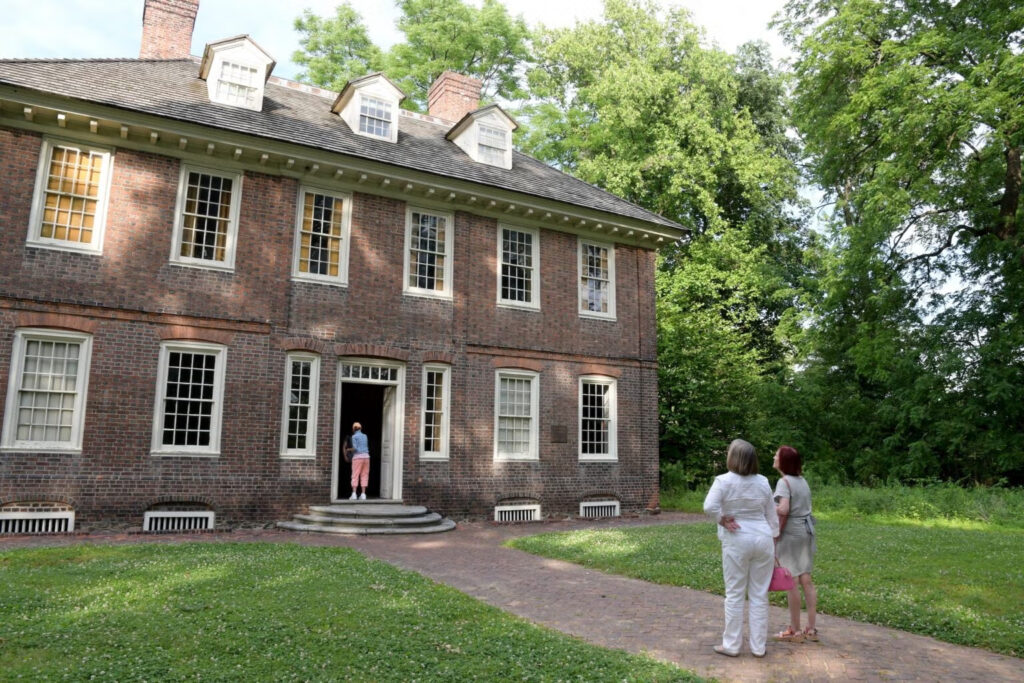
Stenton features a monument dedicated to Dinah, who lived and worked at the site before being freed in 1776. Watts, who works with Stenton, said Dinah’s memorial is important because it highlights the history of slavery in the North, including the role some Quakers played as enslavers, despite their later association with abolition.
“It just really shows that racism, white supremacy, all that stuff transcends state lines, transcends boundaries,” Watts said. “And that’s history that we all need to be very clear about.”
‘These stories help them to see themselves in history’
The legacy of enslaved people in Philadelphia reaches to today, with stories of slavery and freedom resonating deeply with city residents and out-of-town visitors.
Gwen Ragsdale said the history of slavery isn’t just for people of African descent to learn, but for everyone. The Lest We Forget Museum of Slavery draws visitors from overseas, such as a group from Germany that comes annually.
“People want to know,” Gwen Ragsdale said. “They want to know this history, and they want their children to know this history.”
She added that people can become overcome with emotion when viewing artifacts from slavery, often bursting into tears.
“I have tissue boxes that I always have handy,” she said. “I have to hand a tissue box to a person because they just become overcome by the stories that I tell them.”
Whaley said people of African descent have told her that the Museum of the American Revolution’s exhibits have helped them understand that the American Revolution is a story for them, too.
“It’s so beautiful to know that they can now see themselves as a part of the ongoing revolution,” Whaley said.
Gwen Ragsdale said she is dedicated to telling the history of slavery because it will never go away and can’t be erased.
“I’m not going to stop, because as long as people want to know and learn about it, I’m here to tell it, and other people like me are willing to tell them as well,” she said.

Get daily updates from WHYY News!
WHYY is your source for fact-based, in-depth journalism and information. As a nonprofit organization, we rely on financial support from readers like you. Please give today.
Part of the series
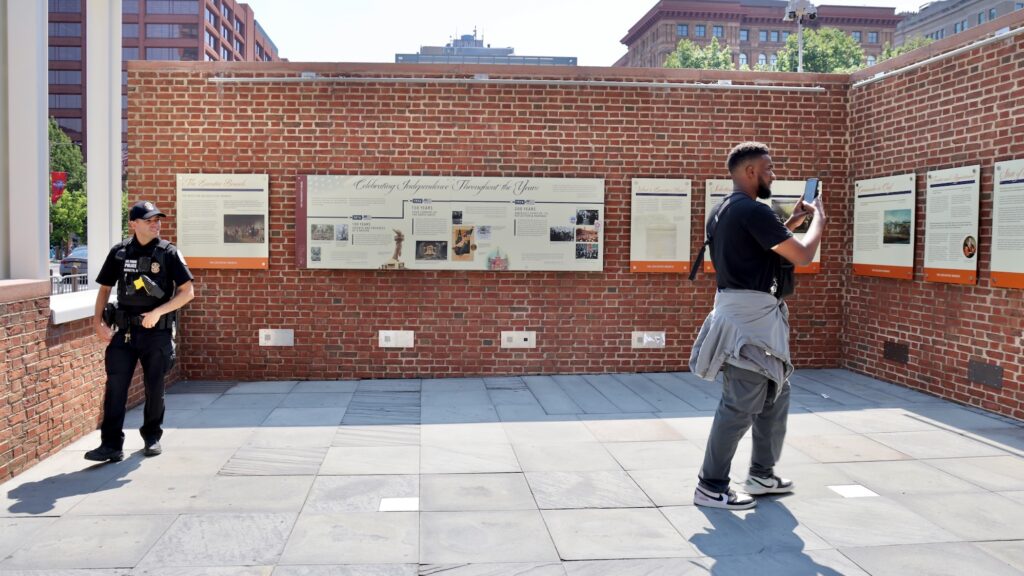
The city and activists have vowed to continue the legal fight to restore the original panels that focused on the nine enslaved people held by George Washington at the site.
3 months ago
Listen 1:08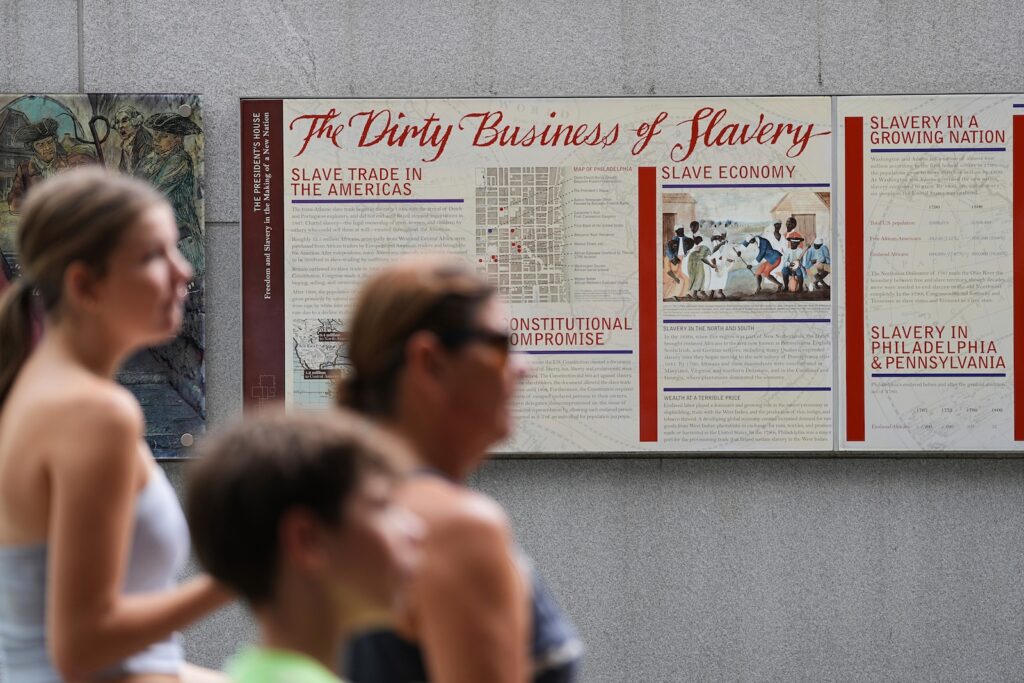
Court blocks National Park Service plans to replace slavery exhibit at President’s House Site
Advocates for the site say the new renderings diminish references to slavery and whitewash American history. A federal court stopped any further changes.
6 months ago
Philadelphia’s slavery exhibit is being restored at the President’s House
“This is the American people fighting back and saying we will not accept this,” said one Independence Mall visitor. “Will not allow history to be rewritten.”
8 months ago