
Anxiety and hope as women lifers await legislative action on 2nd degree murder
Women convicted of felony murder are awaiting answers after the state supreme court ruled their mandatory sentences unconstitutional.
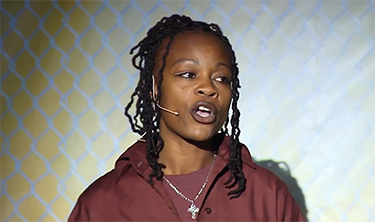
Tameka Flowers, 51, has been incarcerated for 31 years and is one of 23 women at State Correctional Institution Muncy who may be impacted by the Supreme Court of Pennsylvania’s ruling on second degree murder. | COURTESY TEDX TALKS
Beth Markman, who has been incarcerated for 26 years, said she’s trying to focus on the present and not set herself up for disappointment as she and others await the news of what will happen with their second degree murder convictions.
“I always hold onto hope and I’m grateful for any opportunity for what I didn’t have before, a chance to leave prison regardless of the time, but the uncertainty is stressful,” Markman, 60, said.
Markman is one of 23 women at State Correctional Institution Muncy in Lycoming, Pennsylvania, who is serving a life sentence without possibility of parole for second degree murder, a sentence the state supreme court ruled as unconstitutional in March. The court’s decision affected all convictions going forward but left it to the state legislature to decide by July 24 how it would impact past convictions, leaving Markman and more than 1,100 others in the state in limbo.
Louisa Reyes, 22, was sentenced to 40 years to life for a crime committed when she was 14. Though the court’s decision concerns mandatory life-without-parole sentences, Reyes spends many nights lying awake, reliving moments from her life as she wrestles with the uncertainty of her future, she said.
“I’m really struggling,” Reyes said. “The uncertainty, the not knowing, is affecting my sleeping, eating, and how I go about my day.”
A bill authored by Senate Republicans, which passed the chamber on June 25, would impose a minimum sentence of 35 years for second degree murder except in cases where the defendant meets a strict set of guidelines proving they had no intention, knowledge or participation in the murder itself, in which case they could be sentenced to between 10 or 40 years. The bill still allows for life sentences in certain cases.
A competing bill in the Democrat-led house caps sentences at 50 years and expands eligibility for parole after 25 years based on the defendant’s culpability in the crime and consideration of public and victim safety. That bill remains in committee.
“’I’m not sure if these laws will apply to me, and even if they do, if it will change anything,” Reyes said. “I’m trying not to think about it constantly, but the stress is coming out in other ways.”
If lawmakers cannot reach a consensus, the fate of those convicted of second degree murder will go back to the court system for resentencing. The uncertainty for the women is exacerbated by limited access to information.
“I feel like there is a lack of information, even conflicting information,” said Tequilla Fields, 53, who has served 21 years in prison for second degree murder charges stemming from a crime she committed when she was 18. “No one seems to know what’s really going on, not even the people outside. That makes it hard to know what to believe.”
Fields said the mandatory minimum of 35 years imposed by the Senate-led bill is too harsh.
“Thirty-five years? It doesn’t seem fair, right, or logical– it doesn’t make any sense,” Fields said. ”It’s too much time for someone who had no intention to kill anyone, or who didn’t kill someone at all. I do not trust the justice system at all. They don’t care about us. We’re not human beings to them.”
Tameka Flowers, 51, who has been incarcerated for 31 years for second degree murder, said a minimum sentence of 35 years serves the same function as a life-without-parole sentence.
‘It is a blessing to have the opportunity to leave prison, but a minimum sentence of 35 is still a death sentence for most,” said Flowers, “They’re trying to sentence people as if they had the intent to kill when they didn’t.”
Despite her anxiety over her own release, Reyes said she understands the reasoning behind the Senate bill’s 35-year minimum.
“At the end of the day, we have to understand that a life was taken while we were there, even if we didn’t do it,” said Reyes. ”It’s a life sentence for them.”
Markman said she was also thinking about her victim and their family.
“It’s hard for me to know that I might get a second chance at life, regardless of how many years from now it may be, but they will not be.” Markman said.
If lawmakers do not pass a bill by the deadline, judges will have wide latitude to impose new sentences. Some women at SCI Muncy are concerned that this scenario will result in further sentencing disparities.
“My main worry is if a bill isn’t passed and people are kicked back to their counties for resentencing,” Markman said. “Judges will be able to sentence people however they want to, and some counties are harsher than others.”
Flowers said smaller, rural counties will most likely impose harsh sentences while more liberal cities like Philadelphia will impose more lenient sentences.
“The judges and attorneys will have to really dig into people’s lives prior to prison, figuring out who we were then and why we made the decisions we made,“ Flowers said. “I feel like a lot of us might get resentenced to the same about of time.”
Despite their concerns about how the state Supreme Court ruling will be applied, women serving second degree sentences at SCI Muncy are hopeful that they will soon have a meaningful opportunity to be released, viewing it as a chance to contribute to society.
”This means everything to me, and I will not waste the chance I am given,” Markman said. “I am determined to make the most of it by making a positive difference and helping other people. If I can help one person who is going through a similar situation to what I was, it will all be worth it. I have to do something to give back.”
While the state legislature determines its next steps, the community of women at Muncy are hopeful that politicians will agree that everyone is more than the worst decisions they’ve made.
”We are not who we were two, three, and four decades ago,” Flowers said. ”We were women who were abused, used, put down, and beat down. And yet, we have survived and found ourselves. We’ve learned how to aid others. We just want the opportunity to show society that we will be an asset to any community we are a part of. We want to show that change is real.”
Jamie Silvonek is a senior reporter for the Prison Journalism Project. She has also written for The Juvenile Justice Information Exchange, George Washington University’s Women in Beyond the Global, and numerous social justice zines. She is the author of Marginal Verse, a book of poetry published by Game Over Books in 2025. At 14, she was sentenced to 35 years to life at SCI Muncy.
WHYY is your source for fact-based, in-depth journalism and information. As a nonprofit organization, we rely on financial support from readers like you. Please give today.