
Freedom
The fourth episode of “Dying on the Inside: Women Lifers at Muncy Prison” examines the limited pathways for women sentenced to life to leave prison.
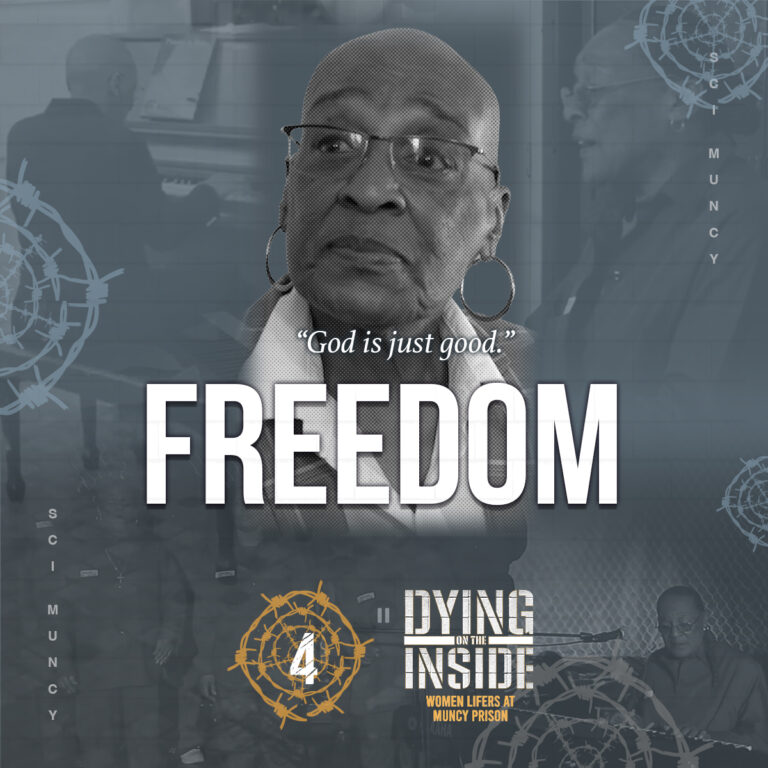
Naomi Blount-Wilson represented one of the rare cases of women lifers having their sentence commuted in Pennsylvania. | Illustration by Sheldon Sneed Designs
For women lifers in Pennsylvania, it is nearly impossible to get out of prison. The process of having their sentence commuted is long, political and requires unanimous approval by the Board of Pardons. Only 17 women serving life in Pennsylvania had been granted commutation in the last half-century. Naomi Blount-Wilson, a former lifer at State Correctional Institution Muncy, had her sentence commuted in 2019. She initially used her time to reconnect with her son and sing professionally. Then, she learned she had cancer. For inmates unsuccessful at seeking commutation, their other choice is compassionate release, intended for terminally ill inmates with less than a year to live. Theresa Battles received compassionate release in 2017 after being diagnosed with Stage 4 cancer. Advocates say the limited options for release make the reality of a life sentence “death by incarceration.”
-
Transcript
[music]
Cherri Gregg, narrating: I spent so much time talking to women serving life sentences inside of State Correctional Institution Muncy, that I was thrilled to get the chance to speak to one who had come home.
Cherri: Okay, how old are you, Ms. Naomi?
Naomi Blount-Wilson: I’m 74.
Cherri, narrating: Naomi Blount-Wilson was sentenced to life in 1982 for a murder that evidence later showed was committed by her partner. In 2019, after serving 37 years in prison, the Pennsylvania Board of Pardons did a rare thing. They commuted Naomi’s sentence.
Naomi: God is just good.
Cherri, narrating: Naomi’s first two years of freedom were wonderful. She reconnected with her son, worked in advocacy for other people in prison, and started singing professionally. But then, she learned she had cancer.
Naomi: We were doing a performance in New York, and I had some Chinese food. And so on the way back home, I’m thinking I have food poisoning. I go to the hospital, they tested me, took my blood work, did everything, and the doctors came back and told me that I had two cancers, that I had breast cancer and lung cancer.
Cherri: Wow. What stage?
Naomi: Three.
Cherri, narrating: She tells me she believes the cancer had been there when she was in prison.
Naomi: I was in stage three, and stage three just doesn’t happen overnight. And with me being on the inside, so many of my sisters on the inside, was diagnosed with cancer. And if they had LIFE, such as me, L-I-F-E on their paperwork, then the hospitals really didn’t want to do too much for us as far as expensive medication, because they knew we were going to die there anyway.
[music]
Cherri, narrating: I’m Cherri Gregg, I’m a journalist and radio host at WHYY. This is Dying on the Inside: Women Lifers at Muncy Prison. A podcast that looks at the national crisis of our aging prison population, and its incredibly high cost. Welcome to Episode 4: Freedom.
Cherri, narrating: I visited Naomi in the bright, suburban home she shares with her son in South Jersey. The cancer treatments have left her thin. She’s lost all of her hair. But she is radiant. She wears a sharp pink, pinstriped suit and crisp white shirt. And as we sit around her dining room table, she tells me about her time at Muncy.
[music]
Naomi: I worked in the staff dining room, and the officers would literally snap their fingers, and that meant come get my tray, come dump my tray.
Cherri, narrating: It was her first job at Muncy, but she wasn’t having it.
Naomi: I’ll never forget when the lady told me, she said, You don’t want to dump trays, she said, But I’ll put you outside, make you pick up cigarette butts. And I said, I’d rather pick up the cigarette butts behind one of my peers than to dump a tray for an officer.
Cherri, narrating: They put her on grounds duty. She’d work for many years in maintenance.
Naomi: I worked around asbestos, I worked, you know, with lead paint. And I knew that they weren’t really, like, giving us the gear that we needed to have to work in those spots.
Cherri, narrating: I later confirmed that inmates at Muncy were exposed to asbestos. And then, there was the water.
Naomi: The water was tasting really like iron, like metal. The water taste horrible. And, sometimes when you go to the bathroom, just the first water that comes out would come out, like, yucky.
Cherri, narrating: Naomi says inside, the women took action.
Naomi: Somebody had taken some water and put it in a little plastic thing, and they sent it out with an officer. And that’s how they found out that something was wrong with the water. And for months they had trucks come in and bring, you know, water for us to drink. Because that water was just contaminated. And no telling how long we were even drinking that for, you know, no telling what was in the water.
Cherri, narrating: Naomi says if she felt sick, it wasn’t her decision whether she’d be seen. And if she was, an infirmary visit came with a cost.
Naomi: If they choose to see me, then I have to pay a sick call fee and pay for the medications that they give me. Literally walk in $5 for sick call. And then after you pay your $5 for sick call, it depends on how many medications you get that, your bill might be $35, $40 when you walk out of sick call.
Cherri: How much did you earn every week?
Naomi: Well, I made $0.42 an hour. Because of the job that I did and my boss was very kind, I might make, like, $90, $100 and something dollars, you know, for the month.
Cherri, narrating: She says she wasn’t surprised by the diagnosis many of her fellow lifers were given.
Naomi: You know, didn’t take a rocket scientist to know that all those people that were with life sentences were dying of cancer.
[music]
Cherri, narrating: While she was inside, Naomi led a choir of her fellow lifers and she wrote music.
Naomi, singing: When I was just a young child, I had all the things that any child could want. A beautiful house, beautiful parents, but most of all we had the love of God.
Cherri, narrating: Naomi grew up in North Philadelphia. Her parents bought her a piano when she was eight. By fifteen, she says, she had a record deal. Music was her life.
Naomi, singing: And as I grew older, I began to run away from home. Not realizing that my mama and papa were strict only because they wanted what was best for me. I started smoking cigarettes, smoking marijuana, drinking alcohol, and then I would stay out all night long.
But then I made one of the biggest mistakes of my life. Taking a needle filled with heroin and sticking it in my arms. Not knowing then that that one shot would someday make me prison-bound.Naomi: I used to be a drug addict. I used to drink excessively .
Cherri, narrating: By 1982, Naomi had a young son—and a severe drug problem.
[music]
Naomi Blount-Wilson: Brenda and I were in her apartment.
Cherri, narrating: Brenda Baker was Naomi’s girlfriend.
Naomi: We were shooting dope. We were getting high.
Cherri, narrating: The couple started arguing, and went outside. A man passed by and laughed at the pair.
Naomi: And right away she jumped off of the step and jumped in his face and asked him what in the fuck was so funny? And that’s when he went in his pocket, pulled out his knife, and he stabbed her. So now when he stabs her—of course, this is my girl, right? And I’m like, Well, I got to help her do something, I’m not just gonna let this man just stab her and he’s gonna get away with it. So we walked back to her apartment, where she gets a knife and I get a hammer, and we come outside.
Cherri, narrating: They go out in search of the man.
Naomi: The man is walking down the middle of the street. In my own way, I was hoping that he was gone, but I had to show face for her and—
Cherri, narrating: A bus passes, so he doesn’t hear them as they jump him from behind. Naomi says Brenda starts to stab him.
Naomi: I’m standing over her and I tell her, That’s enough. And when I said that’s enough, she stopped and got up off of him and the man walked away. But he must have collapsed like a block away from where he was stabbed, and, and he died.
Cherri: I don’t understand how you got first degree murder when you did not strike this person.
Naomi: Because she said that I—I killed the man. That’s how. The judge, knowing that we were both two lesbians, Black, poor. He gave us both life. He didn’t know who was lying, who was telling the truth.
Cherri, narrating: Naomi’s parents took in her son.
Naomi: My mother’s like, We’re there for you. You know, we’ll support you. You need to, go and tell the truth. The truth is gonna set you free. You can’t keep lying, trying to protect that girl. They were very big support for me until their end.
Cherri, narrating: Forensic reports showed Brenda committed the murder, not Naomi, but for years, that evidence was not enough to get her out of prison. After all, Naomi’s sentence was life without parole.
Rupalee Rashatwar: A lot of what we’re looking at and what’s happening at SCI Muncy and a lot of prisons is a result of harsh sentencing laws and policies where we’re not actually looking at how we’re treating people and there’s no legal right to redemption.
Cherri, narrating: Rupalee Rashatwar is a Staff Attorney at the Abolitionist Law Center. It’s a nonprofit law firm that litigates and organizes around mass incarceration. She spoke at Sheena’s book launch last episode.
Rupalee: I think part of the reason why it’s so bleak and so sad is that in Pennsylvania, which is a state which is out of step with a lot of other jurisdictions, I think most other states, you at least have a right to petition a body for parole. You have a right to say at some point, I’m not who I was at 19, I’m now maybe 50 years old, maybe 70 years old and I’m changed. I’ve taken advantage of these programs and I should have a right to be back with my family.
Cherri, narrating: In the last half-century, only 17 women serving life had been granted commutation in Pennsylvania. The only other way out for people reaching the end of a life sentence, is something called compassionate release. The law allows terminally ill people to go home for end-of-life care, but Rupalee says in practice it’s a race against the clock.
Rupalee: You’re meeting with your doctor and your doctor says, Okay, here’s this aggressive kind of chemotherapy you should pursue. If that treatment you’re pursuing is gonna extend your life beyond a year, you’re confronted with some crazy decision that in order to be released and finally find your way back in the community, you have to give up hope and let yourself die or be succumbed to this, like, cancer illness.
Cherri, narrating: Rupalee tells me the hardest thing is to get a doctor to agree that there is no hope for survival. And then there is the desperate push to get them home in time to die.
Rupalee: We’ve had others where people have passed away before we could bring a case or while a case was pending.
[music, midroll]
Voiceover: At Klein College of Media and Communication, at Temple University, we believe the best way to learn it is to live it. From day one, students get real world experience in sports media, journalism, communication, production, PR, advertising, and more. Guided by industry pros and fueled by Philly’s energy, Klein prepares you to lead in media and communication. Learn more at klein.temple.edu.
[music]
Theresa Battles: Inmate, inmate 0-0-8-3-0-9. I’ve been incarcerated for 27 years. My name is Theresa Battles. I’m from Norton, New Jersey—
Cherri, narrating: Theresa Battles got her freedom through compassionate release in 2017, after serving 31 years of a life sentence for conspiracy to murder and aggravated assault.
At Muncy, Theresa was like a second mom to Sameerah Shabazz. Sameerah was a teen when she was incarcerated at Muncy and became close with Theresa.Sameerah Shabazz: A lot of folks knew her as Jamila, was my bonus mom. Her and I just formed, developed a different bond, a deeper bond, more of like a mother-daughter kind of bond.
[music]
Cherri, narrating: They stayed in touch even after Sameerah got out, and Sameerah recalls that when Theresa became ill, she was spending $10, $15 a week to see the prison doctors, a huge amount when you consider the average range of prison pay is between $0.13 and $0.52 cents an hour. And despite the doctor visits, Theresa just was not getting better.
Sameerah: She passed out in the institution. She reached out to me to let me know what had been going on.
Cherri, narrating: Theresa was then diagnosed with stage 4 cancer. Sameerah says she became her power of attorney to try and manage her health care. When she visited after the cancer diagnosis, she was shocked.
Sameerah: Her nails, her nail beds were dark, her ankles, her legs were visibly swollen. She was visibly dark. Her hair had, you know, fallen out. She said that it was from the chemo and the combination of chemo and radiation. They were given aggressive forms of chemo because it was stage four.
Cherri, narrating: Sameerah says she knew she had to figure out a way to get Theresa home.
Sameerah: I started researching, what could I do? Commutation, I knew, was a long shot because of the process and it was so stringent. And at that time, folks weren’t getting commutations.
Cherri, narrating: She got Theresa an attorney who filed for compassionate release, which allows terminally ill people in prison to go home. She knew it would be a difficult process but it was Theresa’s only option.
Sameerah: He filed a motion in Philadelphia in the Court of Common Pleas and the motion was granted. She was released in November of 2016 to a nursing home, Friend’s Hospice in Westchester, Pennsylvania, and she lived free for 46 days.
Cherri: What were those 46 days like?
Sameerah: Amazing. Every day she was able to get round the clock visitors. Her daughter, her biological daughter, she had been incarcerated since her daughter, Naimah, was three years old. So it was the first time Naimah experienced her Mom outside of prison. She got to cook for her Mom in the kitchen at the nursing home. She was able to visit whenever she want because she was on hospice so she had 24-hour visiting.
Cherri, narrating: Theresa’s end of life was filled with companionship and love.
Sameerah: So we could go, we could stay the night, we could play cards with her, we could listen to music. She would do her hair because her hair had come out so she would put these wigs on and it was just 46 days of dignity and compassion.
Cherri, narrating: But being released on compassionate release means no matter what, there can be no intervention to save your life.
Sameerah: And she had to sign a form, she had to sign a waiver, basically saying if you did anything to save your life or stop yourself from dying, you would have to return to prison.
Cherri, narrating: But Theresa wanted to die free.
Sameerah: She felt like, I’ve been in captivity for 31 years. If I live a week free—She didn’t want to die, in her words, I don’t wanna die in captivity. I don’t wanna die in prison, I don’t wanna die in the infirmary by myself, away from my family and my friends. That was how I was able to come to terms with—I felt like it wasn’t enough time. And once she transitioned, I realized it was the perfect time.
Cherri, narrating: Despite decades of incarceration, Sameerah says Theresa did so much to help others and never let her circumstances break her spirit.
[music]
Sameerah: I’m telling you, her spirit, you would have never thought she was incarcerated for 31 years. You would have just never, you would have never believed it. Her spirit was very calm. She was always writing, always helpful. She always was crocheting somebody a blanket, always, Oh, let me help you with your resume. She was an excellent writer, she created a board game about the consequences for young adults. She kept immaculate journals. She would just write about the different experiences and the things that she would like to see changed and she understood that people have to be punished when they break the law. She understood that, but she didn’t understand that the punishment had to be so cruel.
Cherri, narrating: Rupalee says a life in prison sentence is really the wrong wording when it comes to the fate of these individuals.
Rupalee: It’s a death sentence. It’s a death by incarceration sentence. And there’s so much attention that’s given to the death penalty. There’s so many resources that are given. Special lawyers, special protections at trial. And I think when we’re looking at women who are serving these quote unquote “life sentences,” you have to think about this, like these people are sentenced to death, right? And what does that mean to be, for some-for the government to say, you’re beyond redemption.
Cherri, narrating: If you’re not dying, the only other avenue to release is through commutation, which again, is rare.
Rupalee: The only way to really petition for relief from your sentence is through the appeals process. So just for some context about how difficult it is to actually have your life sentence commuted, it’s like an extremely political process, very difficult.
Cherri, narrating: Naomi Blount-Wilson applied for commutation five times. In 2019, her request was granted.
Lieutenant Governor John Fetterman [archival]: Case number three, Naomi Blount. Ms. Grayson?
Marsha Grayson: Yes.
Lt. Gov. Fetterman: Dr. Williams?
Dr. John P. Williams: Yes.
Lt. Gov. Fetterman: Mr. Gubernick?
Harris Gubernick: Yes.
Lt. Gov. Fetterman: General Shapiro?
Attorney General Josh Shapiro: Yes.
Lt. Gov. Fetterman: Governor?
Governor Tom Wolf: Yes.
[applause]
Cherri, narrating: Naomi credits then-Lieutenant Governor, now U.S. Senator John Fetterman for her release.
Senator John Fetterman: Naomi was one of the brightest and one of the strongest argument for this kinds of redemption and compassion.
Cherri, narrating: Fetterman told my producer Yvonne that Naomi was an eloquent ambassador for why aging inmates should be released. During her time in prison she got her GED, earned an associate’s degree in business and a paralegal certificate. She was a mentor, led the Muncy choir, and kept writing songs.
Yvonne Latty: She said you really championed her and without you, she would probably have died in prison.
Sen. Fetterman: Why, why do you need to die in prison? You know, after you’ve paid 40 or 50 years there, I mean, is there a value just to be marched out in a pine box, you know? Or shouldn’t we have a path for redemption for a mistake that you made when you were a teenager or incredibly young?
[music]
Cherri, narrating: After Naomi’s release, she worked for Fetterman as a commutation specialist and helped ten other lifers get out.
Sen. Fetterman: I believe in redemption. And then she was one of the finest examples. And I effectively gave her the job to be an example of that. And she could get out and share her story. And she could also help other fellow inmates about how the process is and how difficult and arduous it is. I get emotional just even—to think about it, it’s like, you know, I just, I wish she had more time on the outside.
Cherri, narrating: Eight months after I spoke with Naomi, in her pink suit, in her sunny kitchen, she died.
[music]
Pastor: On March the 7th, 2025, Naomi entered rest and crossed over to be with the Lord. She was born on May the 1st, 1950, at Jefferson Hospital in Philadelphia, Pennsylvania to the late Richard and Hester Wilson…
Cherri, narrating: More than a hundred people gathered at Bethel Deliverance International Church to say goodbye. Lavender flowers draped her coffin.
Pastor: Naomi spent 37 years in prison. However, even in confinement she remained determined and resilient.
[applause]
Naomi, singing: Never will forget, the ones I cried with. Oh, we were so close, just like family. Never will forget, looking over the mountain. Oh, we would wish that was where we could be. I never will forget…
Cherri, narrating: For the past four episodes of this podcast, I’ve shared with you what I have found at Muncy. And in the next episode of Dying on the Inside: Women Lifers at Muncy Prison, we are going to look at solutions, what could happen.
[music]
Representative Rick Krajewski: These are people who frankly are in pretty poor health. And it’s just a question of, do we want to be responsible for their deaths? And as someone who is a public legislator and someone who, you know, believes in compassion, I can’t abide by that.
Roxanne Horrell: We do have over 1,000 people inside PA prisons right now who are serving a sentence that’s unconstitutional.
Movita Johnson-Harrell: If we can believe in accountability, then we also have to believe in redemption.
Cherri, narrating: Dying on the Inside: Women Lifers at Muncy Prison is a production of Create.Genius.Media and Temple University Klein College’s Logan Center for Urban Investigative Reporting.
I’m Cherri Gregg, Executive Producer and Host.
Executive Producer, Producer, and Script Writer is Yvonne Latty, the Director of The Logan Center.
The Podcast Editor is Audrey Quinn.
Sound design, scoring, mixing, and mastering by Michelle Macklem.
Our Data Editor is Colin Evans.
Associate Producer is Natalie Reitz.
Our Community Impact Producer is LaTonya Myers.
Original Music by Theodore Damascus Merz and Jarvis Cain.
Our Podcast Art is by Tracy Agostarola.
Our Production Assistants are Leila Oyeku and Caroline Keane.
Thanks to B.L. Shirelle, the co-Executive Director of FREER Records, the first non-profit record label for currently and formerly incarcerated artists, and the Blount-Wilson family, for use of Naomi’s music.
Funding support comes from The People’s Media Fund, Women’s International Media Foundation, Jonathan Logan Family Foundation, The Lenfest Institute for Journalism, Eppchez Yo-Sí Yes, and Temple University’s Klein College of Media and Communication.
Thanks to WHYY’S Head of Digital Studios Tom Grahsler and Audio General Manager Joan Isabella.
And to the Dean of Klein College, David Boardman.
We are also grateful to Jack Klotz of Klein College’s Media and Production Department and Audio & Live Entertainment Major, Amanda Stankiewicz, Danielle Martinez and Stephanie McClellan.
Please rate and review wherever you are listening and hit us up on social media @dyingontheinsidepodcast. We would love to hear from you.
collapse
And check out our stories on mass incarceration issues and solutions at whyy.org/dyingontheinside. Please join in this conversation.
This podcast is presented by WHYY. And thanks for listening.
WHYY is your source for fact-based, in-depth journalism and information. As a nonprofit organization, we rely on financial support from readers like you. Please give today.