
Bonus Episode One: WHYY
A panel of advocates, a lawmaker and a former Muncy lifer discussed the Pennsylvania Supreme Court’s ruling on second degree murder sentencing.
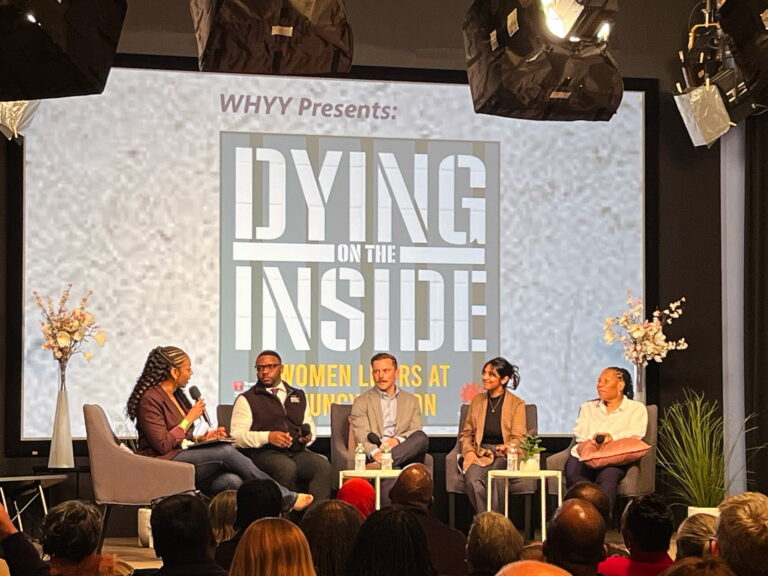
A panel discussed the implications of the Pennsylvania Supreme Court’s ruling on second degree murder sentencing at WHYY’s studios on April 22, 2026. | MARGO LATTY
-
Episode Transcript
Cherri Gregg: This is a bonus episode of Dying on the Inside: Women Lifers at Muncy Prison. I’m Cherri Gregg, Host and co-Executive Producer of the podcast.
On March 26th of this year, the Pennsylvania Supreme Court issued a landmark ruling. The court found that mandatory life without parole sentences for second degree murder violate Pennsylvania’s constitutional ban on cruel punishment. The case centered on Derek Lee, a man serving life without parole for his role in a 2014 robbery in Pittsburgh. It ended in murder but Lee was not the shooter.
The decision could have major implications for more than one thousand people serving life sentences across Pennsylvania—many of whom have already spent decades behind bars.On April 22nd, as we launched Dying on the Inside at WHYY, we convened a panel of advocates, lawmakers, and people directly impacted by long-term incarceration to discuss that ruling—and the broader questions it raises about justice, accountability, aging, and redemption. Here’s that conversation. It starts with co-Executive Producer and Writer Yvonne Latty reading a letter from Sylvia Boykin, who is featured in the podcast.
[music]
Yvonne Latty: Before I pass this on to Cherri, Sylvia Boykin sent some thoughts to help us ground the conversation that Cherri’s gonna have. And so here’s what Sylvia asked me to tell you:
“Good evening, everyone, and thank you for coming to such an important event. Aging and dying in a prison is not meant to be. My name is Sylvia Boykin. I am 69 years old and been in Muncy 34 years. My health is not good, and getting someone to help you is like near impossible. You are disrespected, mistreated, locked in a room, alone in medical housing. This place was not designed for people aging and dying, and we longed for home to see family in our last days.
You don’t know my story. Staring out the window, thinking of home, seeing my daughters, grandchildren and great grandchildren, all of us together on a beach, having a cookout. I daydream all the time of being with my children. I have a big family. And here on your last days, they wanna let two people in at a time to visit with you. The whole family should be allowed in, leaving this world around the ones you love. This place is not my home. Just writing this makes my heart hurt. One dark day in life don’t define us.” Thank you.
[applause]
Cherri Gregg: Good evening, everybody. How y’all doing? Yvonne almost made me cry. And hearing Sylvia’s voice brought tears to my eyes. And what you just heard is not narration. It is not analysis. It is a woman living this reality right now. Sylvia Boykin has spent more than three decades at SCI Muncy and what she describes, difficulty getting care, isolation, the longing to be with family at the end of life. It’s not unique to her. It is what we heard again and again in this reporting. And to be clear, no one is saying that people should not be held accountable. The question is, what do we do after decades? When people grow old, when they grow sick, when they are no longer the same person who entered the system.
So as Yvonne Latty said, my name is Cherri Gregg, let me ask you something as we transition to this panel by a show of hands. How many of you have ever really thought about what happens to someone serving a life sentence when they grow old or seriously ill in prison by a show of hands? So quite a few. But there’s quite a few of you who did not think about that. And I was one of those people a few years ago until this issue was brought to my attention. And that’s why we’re here tonight, because this conversation centers on a very difficult question: what should justice look like when a long prison sentence meets old age, frailty, and illness?
And so this panel that we’re about to have, it’s an extension of our reporting. And our goal is to connect what you just heard from Sylvia and what you’ll be hearing in the podcast to the bigger issue: what’s happening inside prisons, what the law says, what the system does and what may change next because Pennsylvania is at a crossroads right now. Just weeks ago, the Pennsylvania Supreme Court ruled that mandatory life without parole for second degree murder is unconstitutional. Shout out to the Abolitionist Law Center. I saw some of the lawyers in the back.
[applause]
People worked really, really hard on this. People have been working on this for years. Families of incarcerated people have been advocating for decades for this. And so I don’t want to undercut any of the work that has been done for a very long time. And for now, that decision applies to just one case, but it could ultimately impact hundreds of people. Across the state, many of whom have already served decades. So tonight we’re gonna explore what that means through lived experience, through data, through law, and through policy. And so now I’m gonna introduce our panel.
First, we have Dannielle Hadley, who spent nearly 40 years incarcerated before earning her freedom through commutation. And while she was inside she became a mentor, a peer specialist, supporting other women, navigating life and aging behind bars. I wanna welcome you, Dannielle, to our panel.
[applause]
And as we help Dannielle come up, I’m going to continue to introduce our panelists. We have Rupalee Rashatwar, a staff attorney, with the Abolitionist Law Center, focusing on prison litigation, compassionate release, and post-conviction advocacy. And I just mentioned that the Abolitionist Law Center represented Derek Lee in the groundbreaking case before the Pennsylvania Supreme Court. We also have Noah Barth, the Prison Monitoring Director for the Pennsylvania Prison Society. He oversees efforts to document conditions inside prisons across the Commonwealth. And last but not least, we have a policymaker who is here. We have State Representative Andre Carroll, who represents the 201st District in Philadelphia. And he serves on the House Judiciary Committee, where sentencing and parole policy are being actively debated. We’ll allow them to deepen their connection to this work as we continue, but thank you all for being here today.
[applause]
Representative Andre Carroll: Thank you for having us.
Cherri Gregg: Everybody’s mic work?
Rupalee Rashatwar: I think so.
Dannielle Hadley: Hello.
Noah Barth: Thank you for having us.
Cherri: So, Rupalee, I want to start with you because a lot is happening right now or has happened in this moment. The Pennsylvania Supreme Court ruled that mandatory life without parole for second degree murder is unconstitutional in the case of Derek Lee. And so I want you to, in plain terms, tell us what did the court decide and why it matters?
Rupalee: Thank you. I also just first want to shout out so many people who were a part of this big victory. There were so many iterations of it, so many ways it was filed. And it’s the result of just so much organizing for decades. And so we’re really excited about it. And so what the decision actually means affects people who are sentenced to death by incarceration, which is what we call life without parole sentence. For anyone sentenced to second degree or felony murder. And now I think it’s important to just define what felony murder is for people who don’t know. So if an individual accompanied someone and assisted in the commission of an underlying felony, then they can be sentenced for second degree murder. So if we’re thinking about an example, say, I think the very common example that gets used as someone is the driver of a vehicle, they intended to engage in a burglary. A burglary happened, and there was another person who was the shooter in that case. Under the law in Pennsylvania prior to this case, both the shooter and the person who was the driver would receive the same sentence, which was a life without parole sentence.
And so what happened and what the result of this case is, is it said that the Pennsylvania Constitution affords more rights than the federal Constitution under the cruel punishments clause. And so colloquially, you guys might know that the U.S. Constitution says that there’s a bar against cruel and unusual punishment. That’s the Eighth Amendment that says that’s not allowed. Now the Pennsylvania Constitution says that cruel punishments are not allowed, and so what this ruling says is that for the first time since the Pennsylvania constitution was in effect since 1790, that the Pennsylvania constitution affords more protections. What that means is that all the people who are serving a sentence of life without parole or death by incarceration for felony murder right now are serving an unconstitutional sentence. And that’s more than 1,000 people.Cherri: Wow. That’s a pretty big deal, pretty big deal. So who does this actually affect? So who would be impacted and who would not be impacted?
Rupalee: So the opinion was very clear that this decision doesn’t impact people who are sentenced to first degree murder. So it affects people who are sentenced to second degree murder and I think there’s an open question of what can happen with this law now that we have this understanding of our state constitution. I’m sure there’s gonna be other applications. Also anyone who was sentenced to murder prior to 1974 when we had a different murder statute could potentially be impacted by this. So I think the most important thing to note, though, is that the Pennsylvania Supreme Court said in this case that the current sentencing structure is unconstitutional. But it stayed the decision for 120 days.
Cherri: Yeah.
Rupalee: So what that means is that the legislature has 120 days to figure out what the remedy is gonna be. How they’re going to deal with 1,000 people who are currently serving this sentence and so even for Derek Lee right now we have to wait until that 120 days elapses to figure out what the next steps are gonna be.
Cherri: So there’s a lot of things that are unresolved right now.
Rupalee: Absolutely, there’s a lot of open questions. When we’re thinking about what’s not resolved and we don’t know whether or not people are gonna be entitled to re-sentencings, we don’t know if this is gonna go straight to the parole board. There’s a thousand people who are impacted, at least about 500 from Philadelphia. We don’t know who they’re going to consider first. We don’t know exactly what criteria are gonna to be considered when determining what sentence someone should be entitled to, so we don’t know if they’re gonna just look to their culpability, what interaction they had with whatever crime it was that committed, or if they are gonna look to also how they’ve changed over time. So there’s a lot of open questions about what can happen right now.
Cherri: Yeah. Thank you for that. And so that’s the legal framework that we’re dealing with right now. But law on paper and life inside of prison is very different. And so Dannielle, I want to bring you into the conversation because you lived at Muncy for a very long time. And when you heard Sylvia’s words, what she was talking about, you hear this change that is happening in the law. What resonates with you right now? And use your microphone.
Dannielle: Up until June of last year, I was living the same way that she was living, in pain, and not a lot of help from staff. But because of the time that I’ve spent there, I have family there, so on a lot of levels I was well taken care of, as far as being able to get to appointments and things like that, and just making sure that I was okay on a daily basis. But for a lot of people, they don’t have that. And if you get older and you get carted down to the—
Cherri: And I’m going to ask you to use your—
Dannielle: If you get carted—when you get carted down to the infirmary it just all goes downhill from there. It’s not a good place to be.
Cherri: You spent nearly four decades in prison. What toll did it take on you, physically and emotionally, to spend that much time in prison?
Dannielle: Well, as you can see, physically I am disabled because of the lack of medical care. They don’t do preventative medication. They wait until it’s the last alternative before they do what they need to do to help you. So because they waited so long, I’ve had four back surgeries. And the last back surgery that I had did not do what it was supposed to. The rod that’s on my spine is detaching from my spine and causing me to have issues with my neck and my left side.Cherri: And Dannielle, I mean, you were one of the people who fell under the second degree murder. No, because you had first degree with conspiracy.
Dannielle: I had first degree with conspiracy.
Cherri: But you did not take a life.
Dannielle: No, I did not.
Cherri: And so you have always said that you felt that you should do time. I want you to try to help us understand accountability and how you see it now.
Dannielle: At 23, I didn’t have an appreciation for anyone’s life, not even my own. When growing into the woman that I’ve become, I can see how precious life is and what it means not just to me but to my family members. So if it means that much to me and my family members, I could only imagine what it means to the victims of people who were hurt through some type of crime. I lived with that for a long time, not understanding what they may have felt. But once I got the understanding, I realized that life is precious, regardless of whose it is. And for someone to just take it for granted, it’s just, it’s unthinkable. When I think about back to who I was then, sometimes I don’t know who she was. But I do know I appreciate it now. And I’m thankful for it, thankful.
Cherri: Yeah, thank you for that. I want to sort of bring you into the conversation, Representative Carroll, you hear what Dannielle had to say. We hear where the law currently stands. And you’re on the Judiciary Committee, where lawmakers are wrestling with these issues right now. We’re wrestling with the issues of accountability, justice for victims. Dannielle talked about she understands, and it took her a while to understand that, but she understands now. What does holding all those truths and balancing all those truths look like when you’re trying to make big decisions about next steps and could impact hundreds and hundreds of lives here in Pennsylvania?
Rep Carroll: Yeah, thank you for that. First and foremost, I want to say welcome home, Dannielle, and thank you so much for sharing your story and being a voice for folks who are on the other side of the wall.
[applause]
I want to thank you, Cherri, for bringing this conversation and giving it a platform. So thank you for that.
Cherri: Absolutely.
Rep Carroll: I am-also, too, want to center my comments on the fact that before I ever ran for office, I was an organizer. I don’t hold a law degree. I didn’t take that path. And I think that being in the state leg as an organizer and a person who operates from lived experience is very unique. It adds value to the conversation. Most of my colleagues who sit on the Judiciary Committee and argue these arguments, they’re arguing from a legal standpoint. And what I try to do my best is listen to people who’s been impacted by the issues and use their stories as a way to make laws. And it’s stories like Dannielle that deeply do impact me and keep me up. I would mention just last year, one of the first round tables, I was a part of—Celeste Trusty who’s in the audience with us tonight-
Cherri: Yes, Celeste.
Rep Carroll: I wanna thank her for her work. She put together one of a very unique roundtable, which was held inside of a facility. We were at Coal Township. And one of the things I’ve recognized was that that is a facility full of males, but it was really imperative that we included a woman’s voice. And there was a woman that was zoomed in, into the conversation. And it’s those stories that really deeply inform my commitment to making sure that the votes that I cast are in line with the reality of folks who are living on the other side of the walls. I’ll mention that I am very-one of very few lawmakers who’s visit more correctional facilities than amusement parks. I very often am at some kind of correctional facility. For the last eight years, I’ve been a volunteer for an organization that works with juveniles here on State Road. And since being a lawmaker, I’ve made it my duty to make sure I try to visit as many SCIs across the state.
So, you know, to answer, to wrap up the answer, but in this unique opportunity, because what we’re seeing right now is not the usual, right? We’re seeing a Supreme Court in this Commonwealth say publicly and on paper that the sentencing that’s been given to 5,000 people across the state is unconstitutional. 1,200 of whom fall underneath of this felony murder statute. So it’s challenging the conscience of us, but also challenging us to restructure some of the guidelines that people with life has been impacted by.Cherri: Yeah, and when you think about it, I mean, in your mind, what does public safety look like when we’re talking about people who are older and people who are seriously ill? And I’ll mention this story, and you’ll hear about it in the podcast, but Yvonne Latty and I, we actually met a woman who was incarcerated who had deep dementia, did not know where she was, who she was, what day it was. And here she is behind bars. And so, I wonder when you think about what public safety looks like balancing some of those many considerations, your thoughts on that?
Rep Carroll: Yeah, absolutely. So there’s a few takes on this. So recently I just introduced a bill that would reduce the age for expungement. And right now currently in the state of Pennsylvania for low level crimes, the age is 70. So a person has not only be beyond the retirement age, they have to age five more years before the state would allow you to petition the courts to then get an expungement for low-level crimes. Like these are not crimes that has resulted even in a death. So the bill that I have would try to eradicate senior poverty and take it down to 65. But the other thing, too, is that we have to attack this issue on another level because compassionate release is also not on the books here in Pennsylvania. So a person like Dannielle who is aging in prison and experiencing medical needs, we would allow them to unfortunately die in prison. And the other part of that, too is that when people do time, it’s not just the individuals, also their families. So when a person has been in jail for 40 years, I imagine how old is the mother, the father, and the siblings? And you know, also, you know, there’s a young man right now that I’ve been talking to and his parents are aging. Like they’re aging, they’re seniors. And they can’t travel three and a half hours to visit their own child. But when I talk to, unfortunately, the Department of Corrections and I make the case of like, we need to move this person closer to home, that’s not a qualifying excuse right now. To get people closer to their family.
Cherri: A lot of things to think about.
Rep Carroll: Exactly.
Cherri: Representative Carroll, thank you for that. Noah, I want to bring you into the conversation. Widen the lens. I mean, we heard what Rep. Carroll said. We heard Dannielle’s experience. In your work visiting prisons across the Commonwealth. How typical is some of the things we heard Dannielle talk about in your visits and in your conversations with men and women in the system?
Noah: Yeah, it’s unfortunately common. We have over 2,000 people serving life sentences who are over the age of 55 in our state. And I say 55 because that’s typically what’s considered geriatric for prison because of the aging impact just being in prison has on you, the rate at which it accelerates decline in the human body. Just a couple weeks ago, I was at SCI Phoenix. It’s our largest state prison, just an hour north of the city. And one of the people I met with there has been inside for 52 years.
Cherri: Wow.
Noah: He’s done 52 years, he’s in a wheelchair, he’s diabetic. He now has stage three liver cancer. And he’s been waiting over six months to get an eye exam because he’s having vision issues in one of his eyes. And the logic of that situation, it evades me. There’s certainly no public safety reason that that gentleman should still be in prison. Yeah, and like I said, we have thousands of people in similar situations all across our state.
Cherri: And let me follow up with you, Noah. I mean, what are prisons required to do? And where are the gaps? Because you think, do they have to make sure that you have the eye exam as soon as you experience eye problems? Or is there a window where it’s not neglect? Just give us the standard of care and then where those gaps exist.
Noah: I mean, that’s the million dollar question, right? I mean if you look at it in spirit, the prisons writ large are responsible for the safety, health, and well-being of the people in their custody, full stop, right? They have taken them out of their community, they have, I shouldn’t say they, the court system, the larger criminal justice system, has removed them from their home and community and said here’s where you’re gonna live and we control every aspect of your life. And so to me, that makes it very clear. I mean, for starters, they should be giving them enough food. Every person I talk to says they don’t get fed enough consistently. County jail, state prison, that’s a regular complaint. And so they’re forced to buy commissary, right? They’re forced to buy enough food.
Basic medical care should be there. But regular mammograms don’t happen, colonoscopies, pap smears, regular routine things that we think are basics don’t happen. I have to get my teeth cleaned twice a year or my mouth falls apart. That doesn’t happen in prison, you know? So they have their policies and rules and it’s not to say that it’s completely derelict but the number one complaint we consistently receive at our organization is related to medical care. Delays, denial, or inappropriate care. And people have to fight and fight and write grievance after grievance. Organizations like the Abolitionist Law Center have to file lawsuits sometimes, right? And then it becomes a point of contention and debate and lawsuit and conversation. And a lot of times, and I should say this also, I’ve met a number of correctional officers and administrators who are trying to do the right thing, right? I don’t want to paint this like there’s nobody out there who cares and isn’t doing their job. But it’s people’s lives.
CHerri: Yeah.
Noah: And there’s, yeah, go ahead.
Cherri: And I follow up because I know that SCI Muncy had to build a new infirmary. They even have hospice there, something that prisons weren’t necessarily designed to have a hospice wing at an infirmary. And so I want to, because a lot of times people, you know, they’re like, oh, people did this thing. They should be incarcerated. But for other folks, cost is something that they can wrap their head around. This is expensive when you talk about providing high level care to large numbers of people who are geriatric.
Noah: I mean, we have two state prisons that are for-more hospitals. I believe that the average annual cost of keeping someone at SCI Laurel Highlands is over $100,000 a year that we’re paying to keep these folks who frankly should be home, right? The DOC just opened a second dialysis unit at another prison because there’s that many people who need kidney dialysis in the system. They recently, a couple years ago, opened a special unit for neurodivergent individuals, which is wonderful, but now there’s a wait list to even get in it. Because there’s so many people that are neurodivergent that we’re locking up in prison and that they’re not equipped to meet their needs.
The other thing though is, we can look at the budget, right? I believe it’s 3.4 billion with a B that we spend on the Department of Corrections and that doesn’t include county jails, right? That’s just the state prison system. But there’s also the cost to the community, right? We as a society spend untold dollars on prisons. You know, when you disrupt families and communities, when you take wage earners out of their community, right? That has a downstream impact to their families and the people they live around. But it’s also very expensive to have a loved one in prison. You know, I mentioned commissary. It is not unusual for people to spend the full $100 a month limit on commissary. The cost it takes to get out, to travel, to visit loved ones, to put, you know, money for their phone time. If you need to see a medical professional inside of a state prison, there’s a five dollar copay.Cherri: Yeah.
Now, you might say, okay, $5, but the average salaries are $0.23 to $0.42 an hour. So you do the math, and it’s a barrier to care. And it means you’ve gotta have someone on the outside who’s maybe making some other choices with their budget in order to make sure you’re taken care of. But we also know that people in prison disproportionately come from low-income families and under-invested neighborhoods. And these are people who, making a $5 co-pay or putting money on the books for that, that there may be a trade-off for them there, right? That may not be like, oh, no big deal necessarily, right? And so it can be expensive, it can be stressful. Financial stress adds all kinds of problems to people’s lives, I think we all know that these days. So yeah, it’s very expensive.
Cherri: And that’s a whole ripple effect.
[music, midroll]
Voiceover: At Klein College of Media and Communication, at Temple University, we believe the best way to learn it is to live it. From day one, students get real world experience in sports media, journalism, communication, production, PR, advertising, and more. Guided by industry pros and fueled by Philly’s energy, Klein prepares you to lead in media and communication. Learn more at klein.temple.edu.
Cherri: And so I want to bring you back into the conversation, Rupalee, because there are pathways to getting out. And Rep Carroll kind of, like, foreshadowed that, talking about, and I’m thinking compassionate release. I’m thinking opportunities through commutation, in which Dannielle was able to experience. How easy or hard is it to access? I mean, especially when you’re dealing with all the things that Noah just talked about, you have individuals who lack access to funding and lawyers and all those things.
Rupalee: Yeah, I mean, I think the reason why this conversation is so important is cause when we’re talking about people who are serving these death by incarceration sentences, life without parole sentences, there is no other way to petition for relief other than through the commutation process, which is when you get the governor to grant clemency. And for someone who’s serving a life sentence, that’s commuting your sentence to parole or through getting compassionate release. And we have 5,000 people serving the sentence, and the reality is both of those avenues are so difficult to navigate. You know, I would just push back slightly, I think, Representative Carroll, you were talking about compassionate release in the state, and our firm has done maybe 20 cases so I can talk a lot about what it looks like, and it is the furthest thing from compassionate.
Cherri: Break it down.
Rupalee: The law as it’s drafted requires that individuals in prison be within one year of dying, that their treating physicians say that. And it doesn’t entitle people to counsel. You know, I think that’s a big barrier. And it doesn’t necessarily require the DOC to help at all with doing any planning to get someone connected to a nursing facility to get them any kind of care in the community.
And so, in effect, this law has been on the books since 2009. Maybe only about 70 people have been able to access relief under the law, because it’s so narrowly drafted. And a lot of people aren’t given a death date like that. We heard-we would just hear a very, very common refrain that people would be complaining for so many years about some symptom to the prison infirmary. They wouldn’t get checked out. And by the time it got checked out, they would find out that the headache they had was now stage four cancer. And we’ve represented a lot of people under those kinds of circumstances where it’s bittersweet, you’re able to access some relief. But by that point, you’re so sick. So it’s very difficult for people to actually access relief under compassionate release.
Different jurisdictions-in terms of counties, you have to go to your sentencing judge and the county where you were convicted and petitioned for relief. Some counties don’t treat it like an emergency and people pass away before they can get to court.
Cherri: Yeah.
Rupalee: And what I’ll say about commutation is that it is a very difficult and political process I know you can speak to a lot better than I can. But what I’ll say is that from the time you apply, it might take, now, it’s three to five years until your application gets processed. And because of changes to the way the commutation process operates, it requires enough votes at a merit stage to then get to a public hearing, and then it requires a unanimous vote. And part of the board of the five people who are on our board of pardons, two of them are politically elected, which makes it a very political process. And I think a reality is that a lot of politicians are afraid of acknowledging the realities that aging people need to be out of prison. They’re afraid that something might happen. And so there’s been so many people who should be able to get relief through that process who haven’t been able to access it. So it’s extremely difficult. It’s political. It’s not transparent. Oftentimes people are denied, they have no reason why, and it might take three to five years for another commutation application to get heard before the board. So it’s very difficult, it’s very difficult.
Cherri: And Dannielle, you were able to go through the process. What was it like for you?
Dannielle: Well this was the third time—
Cherri: And use your mic.
Dannielle: This was the third time applying, the first time was in 2009, the second time was in 2016, and the third was in 2021? It was 21.
Cherri: And so this time you got out in 2025, last year in June?
Dannielle: Right.
Cherri: That was from your 2021 application?
Dannielle: Yes.
Cherri: Wow.
Dannielle: It takes anywhere from, like she said, from three to five years. And like she said, first you have to go through a merit hearing, and you need at least three votes in order to be considered for a public hearing. And then after you have the three votes, if you’re lucky enough to get the three votes, then you go in front of the pardons board. And like she said, they have to vote unanimously. And you get to sit in front of them then and they can see you as a person and not just read an application on paper and make a decision from that.
Cherri: And what do you think made the difference this third time?
Dannielle: The Lord.
[applause]
That’s it, because there are so many other people like myself who worked hard and who spent decade after decade, women much older than myself, who are suffering. Excuse me, I’m sorry. [crying] Who deserve it just as much, and if not more, than I do.
Cherri: Yeah.
Dannielle: And so it had to be in the hand of God. And also, I think my mom as well. My mom, she fought for me every single day.
Cherri: Yeah.
Dannielle: And she passed away, like, 12 days before I was, was commuted.
Cherri: Sorry for your loss. I’m sorry for your loss. And by the way, Dannielle is very blessed because you have so many family members who have supported you, your children—
Dannielle: Yes, my children, my aunt, my cousins.
[applause]
My cousins, my aunts, uncles, and that makes a difference too. It makes all the difference in the world on how you’re treated in prison as well, too. Because my family was not going to sit by and allow them just to treat me any type of way. So if they know that you have somebody supporting you, who’s willing to call, who’s willing to drive up there, then they’re gonna do a little bit more than they would do for the next person. Not to say that they would just lickety-split or, you know, did what they were supposed to do. They did not. It took me having to call home, my family and mostly my aunt. Had my cousin Kier calling them and you know—
Cherri: You had people advocating for you.
Dannielle: Yeah, you know what I mean? They needed to do what they needed to do.
Cherri: Yeah, you had people advocating for you. So Representative Carroll, you hear all this. What sort of stands out to you? Because the legislature, the committee you’re on is being watched right now, the Judiciary Committee in the House. There are bills that have been pending. Tell us what’s on the table right now that could provide some relief to families. You know, Rupalee talked about, you know, compassionate release. There’s an effort now that passed through the House that would loosen, and it’s medical release and not just compassionate release, it would change things. What have you seen? What is pending? What’s on the table right now?
Rep Carroll: Thank you for that. So first, to address the last part of your question, shout outs to Representative Krajewski, who represents the 488th legislative district in southwest West Philly, it’s actually his bill that we voted on. So that’s a bill that we passed this session that would grant medical release.
Also, I want to say shout outs to Chairwoman Morgan Cephas, who also has a dignity in women-incarcerated women’s bill where she worked with Mike Jones, Representative Jones, to be able to advocate for incarcerated woman who are experiencing pregnancy and, you know, giving them some kind of dignity.
Most recently, the thing that’s highlighted in the Judiciary Committee is HB 443, which is the bill that was introduced last year, before, while we were awaiting the Derek Lee decision. Chairman Briggs introduced a bill that would allow folks right now that’s under the felony murder statute to-to be able to have consideration and then re-sentenced through our judicial process. So that is the bill that we’re currently working on. It was-it was on the table to be voted on two weeks ago and then when I walked into the room to vote on the bill, just extremely excited to be able to cast my vote, I found out that we were going to go over the bill. If you don’t know what going over the bill means, that we’re going to skip over that for a vote. So we’re still in the discussion phase of the bill. And we, yesterday, had our committee call about what we’re gonna vote on next week. And unfortunately, it’s not on the table right now, but we are looking forward to trying to get that for a vote and very soon, because we recognize that we only have to July 24th before we would have to send this back to the courts for them to make a decision.
Cherri: So I want to talk about the sticking points, because I know there has been a lot of push. Celeste Trusty has been talking about this. I was on a call that the Abolitionist Law Center, FAMM, a lot of advocates were talking about this idea of 25 years. And how many years people would have to do before they could even be considered, right, for parole. So what are some of the sticking points? What are you hearing? What have been the reasons why people have sort of been stalling on this topic and won’t push it forward? What are the big issues?
Rep Carroll: There’s a few points of contention, right? One of the things is, I ran for office because my predecessor was supporting mandatory minimums. I have made a public commitment and I will not vote for a mandatory minimum. That is just not the way I believe that we should apply justice.
The other thing too is that right now, when we talk about culpability, one of the other factors that a lot of my colleagues believe that we should be able to do is evaluate people and their progress. If a person’s been in jail for four decades, if a person been in jail for one decade, that is enough time for us to say, what is the progress that this individual has made? And we should be judging them according to that. And as Dannielle spoke about, a lot of the times we judge people on the basis of the crime that they’re accused of and on a rap sheet, literally looking at a paper. We have to humanize people. So those are two things.
The other thing for me and a couple of my other colleagues is retroactivity. Making sure that whenever we get this bill on the books, which I’m hopeful that we will get done and we do our jobs and don’t send it back to the courts, is that we’re making sure that we retroact this law, that everyone will be available that’s currently under the felony murder statute.
Cherri: Yeah. And so there’s, there’s three big—
Rep Carroll: There’s a lot to talk about.
Cherri: There’s a lot of talking points. 120 days, do you think you’re gonna make it?
Rep Carroll: I’m hopeful.
Cherri: Yeah.
Rep Carroll: I’m hopeful. I really, really do believe in the leadership of Chairman Briggs. I truly believe when he says that he’s committed to making sure that we do the right thing. And the right thing isn’t just passing the bill. The right thing is making sure that the bill that we pass is a win for people, a win for justice, and a win for families.
Cherri: And Rupalee, I’m gonna ask you to jump back in because if the legislature can’t get this done, and I know Rep. Carroll, you hopeful, but July 25th comes and then nothing’s done, okay? Does it go back to the courts? What does that mean?
Rupalee: Yeah, exactly. So essentially what would happen is the court would have to weigh in on the question of retroactivity. Likely through another case that would come up, the court will have to determine whether or not the relief that they’re giving to Derek Lee they would look back and give to others. So that would mean that for the 1,000 plus people serving that sentence, they would have to file something in the courts, and the court would have to answer all those questions. So I think a lot of people are prepared for that possibility in talking about what it would look like from jurisdiction to jurisdiction, but it would have get resolved by the courts.
Cherri: And we’re about to open it up to questions from our audience in just a moment. Noah, I wonder, you’ve been in the prisons. You’ve seen what people are living with. I know Rep Carroll is hopeful. But Rupalee talked about what the result could be. And Dannielle has experienced it herself. And so what are some things, some reforms, that could happen, realistically, to sort of make sure people make it if they have to wait?
Noah: Could happen or should happen?
Cherri: You can give me some coulds and some shoulds.
Noah: I’m gonna start with the shoulds, because that’s a little easier. I mean, first off, this is a huge development, it’s really exciting. I believe, and I think a lot of people in this room probably believe, there shouldn’t be a such thing as life without parole for anyone, full stop, right? Sure, not second degree murder, but not first degree murder not anything. The very idea that we’re gonna warehouse someone to the end of their life, and say you have no chance of redemption, you have no place in society anymore, I think that’s deeply problematic. So, you know. Maybe it’s one step at a time, but to my colleague right next to me right here, maybe that’s the next hurdle.
But in terms of what can help people get through, I think part of it, at the beginning, you asked for a show of hands, how many people have thought deeply about what it’s like to be elderly in a prison, right? And you’re saying you hadn’t thought about it. I think, part of the thing with prisons is they’re so closed off. They’re so out of sight, out of mind for so many people that we fail to realize there are complete societies, there are completely ecosystems, right? There’s spiritual development, there’s love, there’s family, there’s work and vocation. All these aspects of our daily lives that we think about, those are questions to be answered in a prison context, too, and prisons are not designed for humans, right, they’re designed for security, for closing down, and not these things. It’s getting people through, I mean, for starters, more programming, more programming availability to everyone, not only people pre-release, right? We know that on the outside, we know the value of education isn’t just to the individual, but to their community, right? So educational activities and other programming should be broadly available. Better healthcare, more readily available. There’s a shortage of nurses, it’s a problem. I don’t know how you fix that one, honestly, but it needs to be fixed, period. More access to basic due process. You know, the grievance system, the internal mechanisms within the prison, the idea that people have to fight tooth and nail for basic health care and things, you know.
So a lot of it is around also the culture of control. Family visits. Since COVID, there have been severe restrictions on family visiting inside of state prisons and we know that has a major impact on people’s, you know, psychic, emotional well-being, right? Family connection. Connection to loved ones, being able to see your children. I mean, a lot of these barriers that have been brought up in the name of, you know, 2020 was a crazy year and we had to change our routine a little bit. But at this point, there’s no justification for it in my mind. In every prison, Muncy is actually the one exception of state prisons, interestingly. In all the rest of them, the dining halls are closed and you have to eat your meals in your cell. And think about that. That’s, you know, a room maybe a third the size of this stage with another human being in a toilet. And that’s where you eat your meals, right? The lack of dignity, the lack of opportunity for community and sharing a meal that’s so fundamental. That’s something they could do tomorrow if they really wanted to. They could open those dining halls back up.
Cherri: So there are some low-hanging fruit there.
Noah: There’s a lot of it.
Cherri: That could be done. And I’m about to open it up to questions, but I wanted to sort of end on a note of where we can talk to this audience. A lot of these folks here may not have known about this issue, may not have given it deep thought. There’s probably a lot of people in community that when they hear about it, and any time we brought this up, people will be like, huh. They had literally not given this issue a thought.
And so, what is one thing you want this audience or people who hear this podcast or learn about this issue, what do you want them to understand about aging in prison or long-term incarceration that they might not have understood before? And Noah, we’ll go to you, Rupalee, Rep Carroll, and we’ll end with Dannielle.
Noah: That’s a big question. I mean, I think the first thing that occurs to me is, you know, if this, if people listening to this podcast, if this strikes them, it strikes a chord for them and they’re thinking about it and they’re worried about it, which is great. I just want to remind them that, you know the experience of older individuals inside of prison, that’s sort of the leading edge of this, right? These are people who physically and/or mentally, depending on how they’re aging, may have exceptionally hard time with the realities of prison. But everyone does.
And so, I mean, we need to change the situation for our elders, but I think we need to change it for all our neighbors inside of prison. And this, hopefully, is a window to think about all these other bigger questions and issues with how we handle criminal justice in this country and in this state, because it doesn’t have to be this way, it is a choice.
[applause]
Cherri: Rupalee?
Rupalee: I would add to that, dying in a cage is cruel. And after seeing and hearing about so many people who are trying to get care and struggling with it, I can definitively say every release mechanism that exists now for so many people serving these life sentences, I mean, they’re inadequate. They’re not working. We need meaningful pathways to release. And we need more people, I think to be talking about this, putting pressure on legislators to actually do something about this and really create change because honestly we can fight for change in the judiciary but what we really need is massive policy change to get a lot of people out.
[applause]
Cherri: And I want, Rep. Carroll, before we give it to Dannielle to close it out and open it up to questions, I want you to give your one thing. But I also know that you, victims, we didn’t go into detail here about victims and their feelings about this. But you, as an elected person, have to hear from all of that. You have to consider all of that. So what is the one thing you want people to know on all sides of the aisle as you think about this issue and you go back to the negotiation table with the House Judiciary Committee.
Rep Carroll: Yeah, so, you know, I live in my community. The same house which my grandmother raised me in is the house that I own now. I live on the same block that I played on as a kid. I haven’t moved. It’s the same neighborhood. The same gunshots that my neighbor hear, I hear the same gun shots. I recognize that we have threats of dangers in our community. The thing that I also recognize that I am no safer because someone died in jail. What we have to recognize is that true justice is not punishing one to death. True justice is rehabilitation. And a part of rehabilitation is an assessment of that person. You can’t assess a dead person. We call those autopsies.
So in this moment for me, I’ve been to Muncy several times. And when I ran for office the first time in 2022, I had a campaign manager, Steph, who had an aunt, who’s currently still located at Muncy. And this woman has been at Muncy for over 30 years. And I’ve had a chance to get a chance to know her story, listen to her hopes, her dreams, and to recognize that she’s a completely different person today than she was when the crime was committed. We must give people opportunities. We are not just allowing people to die, but we’re also hurting ourselves. We mentioned how much we’re spending on incarceration, how much—we already exist in a state where the minimum wage is below $8. We’re also prohibiting people the opportunity to contribute. I did a report a few years ago where we’re spending $20 million annually to keep people connected by phone with their families. In an affordability crisis right now, there is so many other things we can be spending our money on. Gas is at $5 right now. We have a due diligence and a commitment to people to make this a better-there’s no way we live in a state where the—second degree murder and first degree murder both have the same sentencing guidelines. A person who doesn’t have an intent to kill, but only an intent to commit a crime that results in a death can get the same sentence as a person who has the intent to commit a murder.Cherri: Yeah.
Rep Carroll: That’s unconscionable.
Cherri: Thank you for that.
[applause]
And, before we open up to questions, Dannielle, I want to tell people, what is one thing that you hope folks who may not have looked at this issue, people in this audience who may not have heard about this, what one thing you hope that they take away?
Dannielle: That people change. 30, 40 years, nobody’s the same as they was at that time, inside or out. So just a second chance, give people a chance. That’s all, give them a chance and you’ll see. Sometimes those are the better folks than your neighbors.
Cherri: All right, well, thank you very much. Can we give a round of applause to our panelists, Dannielle Hadley, Rupalee Rashatwar, Noah Barth, and State Representative Andre Carroll?
[applause]
Thanks for listening to this episode of Dying on The Inside: Women Lifers at Muncy Prison, held and originally recorded at WHYY in Philadelphia.
[music]
Dying on the Inside is a production of Create.Genius.Media and Temple University Klein College’s Logan Center for Urban Investigative Reporting.
I’m Cherri Gregg, Executive Producer and Host.
The podcast’s Executive Producer, Producer, and Script Writer is Yvonne Latty, the Director of The Logan Center.
This bonus episode was produced by Natalie Reitz
Original music and additional mixing and mastering by Theodore Damascus Merz and Jarvis Cain.Our Podcast Art is by Tracy Agostarola.
Funding support comes from The People’s Media Fund, Women’s International Media Foundation, Jonathan Logan Family Foundation, The Lenfest Institute for Journalism, Eppchez Yo-Sí Yes, and Temple University’s Klein College of Media and Communication.
Thanks to WHYY’s Head of Digital Studios Tom Grahsler and Audio General Manager Joan Isabella.
Thanks to WHYY for hosting the event, and with special thanks to WHYY Community Relations Specialist Yvette Sizer, Producer Paige Murray-Bessler and Engineers Paul Parmalee and Benjamin Kall.
Please rate and review wherever you are listening and hit us up on social media, our handle is @dyingontheinsidepodcast. We would absolutely love to hear from you.
And check out our stories on mass incarceration issues and solutions at whyy.org/dyingontheinside. And join in this conversation.
This podcast is presented by WHYY. Thanks for listening.
collapse
The Pennsylvania Supreme Court ruled in March that mandatory life without parole sentences for second degree murder are unconstitutional. The decision not only impacts those with future sentences but the more than one thousand people serving life sentences for second degree murder across Pennsylvania, many of whom have already spent decades behind bars. The “Dying On The Inside: Women Lifers at Muncy Prison” team convened a panel to discuss the ruling and the themes of the podcast at WHYY’s studios in Philadelphia on April 22, 2026. The panel, moderated by podcast host Cherri Gregg, featured Dannielle Hadley, a former lifer at State Correctional Institution Muncy whose sentence was commuted last year; Rupalee Rashatwar, a staff attorney with the Abolitionist Law Center; Noah Barth, the Prison Monitoring Director for the Pennsylvania Prison Society; and State Representative Andre Carroll, who represents the 201st District in Philadelphia.
WHYY is your source for fact-based, in-depth journalism and information. As a nonprofit organization, we rely on financial support from readers like you. Please give today.