
Bonus Episode Five: The Clock Runs Out on Harrisburg
State Rep. Andre D. Carroll discussed the circumstances leading to the Pennsylvania General Assembly failing to pass new sentencing guidelines for second degree murder.
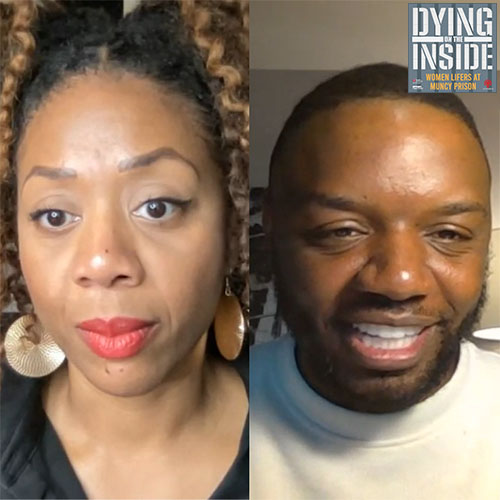
Cherri Gregg, the host of “Dying on the Inside: Women Lifers at Muncy Prison” speaks with Pennsylvania State Rep. Andre D. Carroll about the Pennsylvania General Assembly missing its deadline to rewrite sentencing guidelines for second degree murder convictions. | COURTESY LOGAN CENTER FOR URBAN INVESTIGATIVE REPORTING
On July 24th, 2026, the Pennsylvania General Assembly missed the deadline set by the state Supreme Court to rewrite the mandatory life without parole sentencing guidelines for second degree murder convictions. In March, the Supreme Court ruled mandatory life without parole sentences for second degree murder to be unconstitutional and gave lawmakers 120 days to create alternative sentencing guidelines. Now that the 120 days have passed without any new bills, the futures of the 1,100 people serving unconstitutional sentences are uncertain.
Cherri Gregg spoke with State Representative Andre D. Carroll, member of the Pennsylvania House Judiciary Committee and one of the co-sponsors of HB 1042, one of two bills passed by state legislation to provide sentencing guidance for second degree murder convictions. Carroll discussed where negotiations failed, if and how a bill could be passed, and what happens if the legislature can’t pass new sentencing guidelines.
-
Episode Transcript
[music]
Cherri Gregg, narrating: Back in March, the Pennsylvania Supreme Court made a landmark decision. It ruled that Pennsylvania’s mandatory life-without-parole sentence for second degree murder is unconstitutional. The Court gave lawmakers 120 days, that is until July 24, 2026, to come up with a new sentencing framework—one that could affect more than 1,100 people currently serving those sentences.
That deadline came, and it went. The Senate passed one bill. The House passed another. But the two chambers could not agree, thus failing to meet the deadline set by the Pennsylvania high court. So now what?
[music]
What happens to the more than 1,100 people whose sentences are now in question? What happens to the victims’ families who have been waiting for answers? And if lawmakers couldn’t get this done in four months, is there any reason to believe that they will get it done before the session ends at the close of this year?
In this episode, I sit down with State Representative Andre Carroll, he’s a member of the Pennsylvania House Judiciary Committee and one of the co-sponsors behind HB 1042– the bill that was passed by the state house. We talk about why negotiations broke down, what separated the House and Senate, whether he believes a deal is still possible, and what happens if the legislature never reaches one.
I’m Cherri Gregg, host and co-executive producer of Dying on the Inside: Women Lifers at Muncy Prison. And this is Bonus Episode Five: The Clock Runs Out on Harrisburg.
Cherri Gregg: Representative Andre Carroll, welcome to the bonus episode of Dying on the Inside podcast. Thanks for being here.Representative Andre Carroll: Thank you so much, Cherri. It’s an honor.
Cherri: I want to fast forward because we are at a place where the state Senate and the state House were unable to pass a bill. And I wonder how we got to this position where the two houses and the general assembly were unable to reach an agreement. How would you assess that?
Rep. Carroll: The Senate had their own interests. And the Senate right now in Pennsylvania is controlled by Republicans and the state house here in Pennsylvania is controlled by Democrats. And we had our own perspective of what we thought it should be. So, you know, the Republican-led Senate came up with SB 1400, which, you, know, many of us thought was a little extreme. And then we had House Bill 1042, which encompassed things like vocational opportunities, encompassed medical release and also guidelines around second degree felony murder.
Cherri: And so let’s nail in because Senate Bill 1400 was passed a few weeks ago. And if you could just break down what Senate Bill 1400 would have provided and then the differences with House Bill 1042.
Rep. Carroll: Yeah, so SB 1400 did a few things, right? The first thing, when it came to the standard sentencing range, it would mandate that folks incarcerated underneath the statute would have to serve 35 years at a minimum. That was the minimum to life. That would be the range, right? When it came to culpability cases and retroactivity, those cases could be re-sentenced as low as 10 years. It did allow for that. The other thing too, when it came to individuals who would be 70 years old. So if you had been underneath the statue and you have reached 70 years old, you would have to serve at least 20 years before they would even allow the parole board to take you up for probation. So those were the three standards that they had around this particular standard.
Cherri: Yeah, and what did you think when that bill was sent to the House Judiciary Committee?
Rep. Carroll: Absolutely not, being honest, I was like, absolutely not.
Cherri: And what was it about Senate Bill 1400 that you were like totally against?
Rep. Carroll: I know, you know, women who were just a girlfriend. Or the friend, a friend of an individual who decided to go a commit a crime that led to the death of a person. And because they provided the ride, now this person would have to do 35 years. I just think that that’s insane. It doesn’t allow enough flexibility. Like, look, I think many of us have concerns around the judicial process, right? This is a part of the process and as a lawmaker, I’m a separate branch than what judges are, right? We don’t serve in the same capacity. And then we’re gonna put faith into the judicial process. We have to allow them to have determining opportunity and wiggle room to be specific about the cases before them. And if you’re putting up blanket 35 years, I just don’t think that that’s fair. 35 years could make the difference in a woman becoming a mother, you know, a person becoming a parent, I would just say in general. And that’s a concern for me.
You know, as a person who didn’t have a father for the first 20 years of my life because he was incarcerated and my father didn’t kill anybody, right? My father was incarcerated for things that we’re starting to legalize today, but because that was the law in 1991 when he was incarcerated, you know, my dad spent 20 years in prison. I guess, so through my lived experience, I don’t see that as just or justice.
Cherri: Yeah, and I hear that. And before we go into the House Bill 1042, I do wanna ask, you’re on the House Judiciary Committee.
Rep. Carroll: I am.
Cherri: And just so folks, orient folks to what that means and what your role is on this committee.
Rep. Carroll: Yeah, so each committee in the State House, we have about 15, right? Because it was Democrat-led, so we’re the majority, so we get more members on each committee than the Republican Party does. So right now, we have about 15 Democrats on each committee, and we have about 13 Republicans on each committee, so there’s about 28 members on the Judiciary Committee. And Judiciary Committee is the committee in which a lot of criminal justice or any bills relating to law [unclear] come through this particular committee.
Cherri: And so this bill that came through with felony murder was basically assigned to that committee. So you guys got Senate Bill 1400. What was your role? Was there like, tell us about it? Because people don’t know. So lift the hood a little bit. Were there multiple meetings about this? When did y’all start talking about the Supreme Court ruling and decide to really start digging into what was asked of you?
Rep. Carroll: It wasn’t something that just magically appeared in front of us. Um, when I first got elected to the state House, it was, I came in on a special, which was September of 2024. At that time, I had already been hearing that there was a possibility that there was going to be some kind of verdict in the appeal for the Derek Lee case. And my chairman, Tim Briggs, out of Montgomery County, he’s the chairman for the Judiciary Committee. He had a bill that was-actually had a lot of input from advocates across the Commonwealth, and this was HB 443. So earlier this year, after the ruling had came down from the Pennsylvania Supreme Court, that was the original bill that we wanted to put forth. And that bill would have, you know, met the standards of what we believe would have been able to give people an opportunity.
And, you know, one of the things I campaigned on when I ran was that, you know, I wouldn’t vote on mandatory minimums. I don’t believe mandatory minimums make us safe and mandatory minimums take away the opportunity for judges to make their own decisions in cases that may not fit the standard for what that charge may be, right? So 443 was the original conversation. We were going to vote on 443 right before we had that judiciary committee meeting, they decided to go over the bill, so we never voted on that bill. So, then we were in limbo for a while. We were allowing conversations to take place. We wanted to see where the Senate would land before we—started to move the needle on where we wanted to go, right? We knew where we wanted to be but we went-because we don’t control the senate and it’s led by Republicans, we needed to get them to the table and for a while Republicans wasn’t even willing to have the conversation about it.
Cherri: Senate Republicans were not willing to even talk to you, talk to the Democrats about this framework that the Pennsylvania Supreme Court wanted you to create.
Rep. Carroll: No, they didn’t. They didn’t want to have the conversation and we knew, we all knew, we only had four months to get this done. And I can honestly say, like, I didn’t hear anything from that side of the building, which is led by Republicans until maybe a month before the deadline.
Cherri: Yeah. And so what was the chasm? What separated you all? Because you, what did the Democrats, 443 was the bill that you guys were kind of floating in committee. What was the difference? What were the big sticking points between where you guys were on the Democratic side? And then finally, when you heard the word from Senate Republicans, what were the big differences?
Rep. Carroll: So I wouldn’t know what the differences were at the time of 443, because they wasn’t talking to us. They wasn’t having a conversation. But what became of HB 1400, and I looked at the differences, you’re talking about a minimum of 35 years, right?
Cherri: So what did the Democrats originally want? Because you passed HB 1042, which was 30 years, but what did Democrats originally want?
Rep. Carroll: So 443 included 25. 25 would have been the minimum.
Cherri: So Republicans were throughout 35, but Democrats originally wanted 25?
Rep. Carroll: I think that was the consensus.
Cherri: Yeah.
Rep. Carroll: If you would have asked me, I believe it should have been lower. But I think the consensus at that point of where we landed, what we thought was realistic at that point was 25. The Republicans, what they put out with SB 1400 was 35. I’ll tell you, I’m a person who don’t believe in mandatory minimums. So I would have never wanted the mandatory minimums. But that was what—at that point was a sort of sticking point, and which I wasn’t too upset at the point where we didn’t vote on 443. I mean, you know, government is about compromising and have to find a way, and I would have had to find a way to explain why I would do something that’s not in my nature. Like that’s something I would innately wanna do initially. So I would’ve had to find a way. So we didn’t, because we didn’t vote on that bill, you know I was like, I really would like the minimum, the minimum to get taken out of, right? So when we, so when we got to HB 1042, the 30 years wasn’t now a mandatory minimum, that 30 years talked about retroactively.
Cherri: So that 30 years is to deal with folks who have already been sentenced…?
Rep. Carroll: I’m sorry, it’s actually the opposite. So it’s actually-the 30 years is actually for people moving forward. So if HB 1042 became law, this is what it would state: a person who was convicted of second degree murder would have to do 30 years before they could go up before the parole board. But also in the same context of this bill, it wouldn’t take away their right through the PCRA, which is the Post-Convention Relief Act, it wouldn’t take away their right to petition a court to then consider their culpability in the crime, which was an essential part. Because when you’re talking about culpability, it goes back to what I was talking about earlier. If this person is the gunman, this person the driver, this person just made a phone call, and this person just was there, you know what I’m saying? These things are very different for each person. So, putting just a 30-year before you go before the parole board, that one-size-fit-all doesn’t work. So, the culpability part with the PCRA opportunity, that still would have been available for both sides so that-for people who are already living underneath the statue and convicted and incarcerated and also moving forward it would give them the same flexibility but if they got denied, if their PCRA got denied in 30 years, they then would have an opportunity to go before the parole board.
Cherri: Yeah. So they still have that mechanism there. And I think just since we jumped ahead to 1042, the bill also allows the Sentencing Commission to be involved in determining mandatory minimum or a minimum for future cases. But then it also deals with medical release and codifies that part of it when compassionate release was an issue. Why was that important to wrap this all in, versus just sticking with, because the court didn’t ask y’all to do all that. Why not just stick to the part related to, you know, a sentencing framework for second degree murder?
Rep. Carroll: Yeah, you know, I thought it was deeply important because first of all, these were bills that we already passed as well, right? So we had already passed Rep. Napoleon Nelson’s bill around vocational earn credits. We already passed Rep. Krajewski’s bill around medical release. So we have already passed these bills. These are bills that I had voted out of Judiciary and had voted for on the floor. This was a unique opportunity for us to be able to try to get this across the finish line over to the Senate because what we recognize with, you know, Rep. Nelson’s bill and Rep. Krajewski’s bill, the Senate still have those sitting on their side of the building and they haven’t taken these bills up. So what we wanted to do was create a real opportunity to really do some reform, to be able to like, make a real push to the next step and while also putting forth you know our part of the conversation around second degree murder.
So you know, when it come to the medical release part, it was deeply important to me because right now, if we just want to use Republican language right, and talk about the economics of the Commonwealth, we’re spending a lot of money on keeping people incarcerated and providing their health care, right? We’re talking about like upwards-over $100,000 a year per person. Per person. So these are 10 people we could have spent a million dollars in that one year if these people have some kind of illness.
Cherri: Yeah, and I hear that. And so I guess, you know, Rep. Carroll, people are frustrated. I know you’ve been advocating for this bill and for this collection of measures to pass, but a lot of people are frustrated because from the outside looking in, it looks like Democrats didn’t take, didn’t step out to the forefront. They sat back and waited for the Senate to take months to come up with SBill 1400. And then they didn’t come right back with SB 1042, they passed SB 1042 the day before the deadline, the 23rd when the deadline was the 24th. What do you say to people who just feel like the Democrats didn’t fight hard enough and didn’t get this done and this effort is more symbolic than a real legislative effort?
Rep. Carroll: This is the thing that I say, right, and you know, this is coming from a person who-I ran against a Democratic party because I believe that the Democratic party can be better. You know, I’ve been a Democrat all my life, but I ran against the Democratic incumbent because any Democrat won’t do. I totally understand people’s frustration with just politics as it is. I recognize that, you know what has been will not work because it hasn’t worked. And if we continue to try to shove this down people throats, people will continue to disengage in this space. I totally get that frustration. And I myself have shared that frustration and I share it. Even in a lot of the conversations that I hold with my colleagues, I share the need to communicate better, the need to help people understand the process in which that it operates, and the need for people to feel included in the process. And one of the things I can give the leadership of the state House credit for is that they included advocates. They included the same people who were fighting this case in court along for the process and help crafting what the standards should be around, you know, this particular statute. So they were included in that conversation. Now look, when you’re willing to shove something else down someone’s throat, you can come up with that overnight. So it’s very easy to come up with SB 1400 because I could have did that last night. But when you want to bring people to the table and have real conversations and you really want to include different perspectives, that takes a little bit longer. And the thing about us in this particular moment, our failure was that we didn’t have the outward conversation at the time that we were having an inward conversation. And while we were doing the inward conversation, we allowed Republicans on the other side of the building to scare people and them to use their district attorneys in these rural counties. For instance, I have a colleague, Brett Burns, right? There’s a DA in Brett Burns’ district that wanted to say that Brett Burns wanted to just let-open up the gates and let all the folks out of prison. I’m just like, that’s just not what we doing, right? If you listen to the remarks on the House floor when I spoke last Thursday, you hear Republicans using some of the most heinous cases.
Cherri: And I think Rep. Carroll, that’s the issue. Because on the victim side, and don’t get me wrong, this podcast, we have voices of victims, we have voices of people from the inside who didn’t take a life. We have people along, some people who did, along the different spectrum of culpability here and people who have been harmed here. But I guess it feels like a lot of folks who are frustrated, it feels like that the victims have very strong advocates in the Republicans. Very strong advocates. You have a senator, a state senator, who has a family member who was brutally murdered, who put up Senate Bill 1400. But on the Democratic side, you said that there’s a lot of arguments and debates happening in closed doors, but it doesn’t feel like there’s an equally strong advocate for people who did not take a life and don’t have the level of culpability that maybe would warrant death by incarceration. Can you explain that and just address those people because the Senate Democrat, I mean, the Senate Republicans are very strong, ten toes down, and they are very publicly-they send out press releases, they’re very loud about their position. You don’t feel that loudness from Democrats.
Rep. Carroll: Yeah, I think criminal justice-impacted folks, it’s not a monolith, right? I don’t think that everyone is on one side of the fence, right? I spoke very openly and candid about my father doing 20 years, the first 20 years of my life in prison. But, you know, I also on the floor that day talked about how I’ve lost two cousins to gun violence in the last five years. I lost one cousin who was shot inside of a Chinese store by a gentleman. And then I also talked about, you know, another cousin who I lost just a few blocks from my house who was shot on his own block. You know, I myself has been impacted by gun violence, right? And I also too have been impacted by a system that’s unjust and unfair, right? So it’s not just a one-size-fit-all. And I think, you know, there’s oftentimes in this particular space, I think when it comes to politics, there has been a fear from folks to stand up for innocent folks and folks who culpability is much lower than others. And I think-that’s why I’m here. The reason I ran for office is because I see that there’s a void in advocacy, there’s a void in fairness, and there is a void in a conversation that we continue to allow people to scare us into these decisions. And when we make these decisions, especially here in Pennsylvania, we’re affecting 13 million people with each vote that we take, right? So that means I need to be able to consider the person who’s responsible for the murder. I need to be able to consider the victim. I need to be able to consider people who just may have been involved in the planning of the crime and people who may have just been by their circumstance there. No, this is not a one-size-fit-all. And unfortunately, when a person has a narrow lens to an issue, it’s very easy for them to go on and just say like, this needs to be this.
Cherri: So what do you think is the fear? Because, and I get it, people have, like yourself, there are people who have-are survivors and who have been affected by violence, but also who believe in reform. Why do you there is this fear that exists of being as loud as you are? And you’re very new to the state legislature, sir, like. You know, you’re-this is your freshman term so there’s people who’ve been there a lot longer and you don’t hear that loudness from folks. Why do you think that is?
Rep. Carroll: So there are some people who have vested interests, right? So, you know, in my time, you’re right, this is my first term. I’ve only been a state Representative for 22 months and I’ve had the opportunity to travel more of Pennsylvania than I’ve ever had in my life, right? But in these last two years, I’ve spent more time in Pennsylvania than anywhere else. I visit a lot of SCIs, which are state correctional institutions across the state, and then also, too, I have had meetings in other little small towns and cities across the Commonwealth, and I’ll just use this as an example. So most recently, I had an opportunity to go to State College. State College is currently where Penn State is located. So when you go to State College, Penn State is the economic driver of the entire town. You talking the Nittany Lions at the hotels, is at the small businesses, is at conference center, is everywhere. Like, if Penn State shuts down, State College is done. Well, let’s say this, when you go to Mahanoy, when I go to Muncy, when I go to Camp Hill, when I go, um, Forest Park, or I go to many places across the Commonwealth where there’s just a jail there. Guess what is the economic driver there? The jail. The jail is where people get their jobs from. That is where most of the tax revenue is generated. So what happens if that jail shuts down? So does that town. So some people have vested interest in making sure that these prisons stay open, that these prisons stay filled, so they will use any which way thing possible to make sure that we have beds available to put people in. And as long as a bed is available, someone has to fill it, right?
Cherri: Yeah, and a lot of Philadelphians are in those beds.
Rep. Carroll: Exactly. And those are, let me tell you, and those counties who are represented by other folks who be the same folks who will yell and say how privileged Philadelphia is and how, you know, Philadelphia, we’re cry babies and we think that we deserve everything. But we generate the most economic revenue for this Commonwealth. More money come out of Pennsylvania when you, right now in Philadelphia, if you travel down Broad Street, which has a 25 miles per hour speed limit. The money that has been collected from those speed cameras, that money goes to PennDOT. That money goes to PPA. That money leaves Philadelphia. That is Philadelphia families’ revenue that’s leaving. The Boulevard. The Boulevard another one. That money leaves Philadelphia. So we send all this money out of Philadelphia and don’t get half of it back. So sometimes in these conversations, you just gotta think about, what is the underlying purpose? There’s some people will mask it and say that this is the reason why I deeply care about that, but also too, look at their track record. Some people have also introduced bills. Think and just do your research. There’s a person who introduced a bill who literally said that we have to do a one year impact study before we shut down a jail.
MIDROLL
Cherri: So I do want to sort of talk about next steps. Because there is no bill that’s going to the governor’s desk from our legislature, What is the next steps? Could House Bill 1042 actually get passed this year? Or is this a situation where folks who have been convicted of second degree murder are going to be left to their own devices to hire lawyers and go to the courts in their counties. What’s the next step?
Rep. Carroll: So the next steps, there’s a couple of possibilities, right? But this is the situation where we at. So first, let’s talk about the legislative process. I want people to understand that, you know, us as state representatives, we serve two-year terms. So, you know, all of our bills, if I introduce the bill in 2025 or I introduce a bill in 2026, all bills are active until the end of the session. The session ends in December of this year. So, HB 1042 is alive until the end of the year. So at any given time, the Senate could decide to get back to work and decide to take up this bill and make this law and send it to the governor’s desk. That’s an option if they would like to do that. Completely up to them.
If they don’t, and right now, they haven’t, the situation is, it’s up to the courts now. And what it may look like for people who are battling a case in Philadelphia, it’s not gonna be the same that it looks like in Allegheny County, Clayton County, Cumberland County, and every other county in between. So it will be up to the DAs and the judges in those respective counties to be able to do the re-sentencing. We’ve seen a similar situation when the Supreme Court made the decision around juveniles and them being sentenced to life when they were a juvenile. And we seen a mechanism in which they were able to get these cases through the courts and we were able to bring some folks home. There’s a notion that every single person who was convicted to life as a juvenile was re-sentenced and brought home. That’s not true. The courts allowed, did-the ruling allowed for people to be sentenced to life, but it needed to be a further evaluation to determine if that was the right decision. And this essentially the same thing, or similar thing, I should say, with the culpability mechanism and evaluation. So there will be a nice amount of people that should make it back into court with the consideration of their culpability.
Cherri: Yeah. And so do you have any hope that the Pennsylvania Senate, the GOP controlled Senate will take up House Bill 1042?
Rep. Carroll: My hope is that people are watching, they know who these folks are, and that, you know, one thing I know for a fact is that elections have consequences, and I know that in November, some of these folks are also on a ballot in November, and I just ask that people just remember those who, you know, were there, what they said, how they felt, and what they tried to do, and you just hold people accountable. That’s all I can ask. And I just hope that, you know, at some point there’s the opportunity to have a real conversation about what real justice looks like and real opportunities for people to be connected to their family. And you know, people, you know, rightfully who needs to be held accountable is held accountable. But, you know, that we’re not just filling beds for the sake of filling beds and just using taxpayer dollars to incarcerate people unjustly.
Cherri: And I gotta ask you this. I mean, as somebody who’s advocated, who-you talked about your experience with your father doing decades in prison. You talked about having been affected by violence. Do you feel in any way like this is a failure by the legislature being unable to respond to the Pennsylvania Supreme Court and actually put something on the governor’s desk that is a new framework for sentencing for those serving life without parole for second degree murder.
Rep. Carroll: Cherri, absolutely. The Pennsylvania Supreme Court asked us to give them the framework, the guidelines for this issue. They gave us 120 days. We did not do that. And when I say we didn’t do that, that means we did not do our job. We are in a legislative body to pass laws. And we didn’t do that. We didn’t complete the task. And so now, we’re going to leave this free for all, where what’s good for the gander is not good for geese, because what’s going to happen in Philadelphia is not going to happen in Schuylkill County. Or it’s not, you know what I’m saying? It’s not going to happen in Erie. It won’t be the same thing. Justice won’t linear across the Commonwealth. And for that, it is a failure because we did not complete the task that was given to us. So it’s unfortunate, and I do hope at some point we get to a place where we do have a law that provides equal accountability, equal justice, and equal opportunity for everyone to be seen and heard the same way.
Cherri: Yeah. And getting ready to wrap up. But I know the governor had-was a big reason why you guys came back for a special session, to sort of pass House Bill 1042. Can you talk about the governor? And do you see this as being a priority to the point where maybe your hope that the Senate Republicans will take this up? Do you think he has enough sway, enough push to make this a priority before the end of this session?
Rep. Carroll: You said it, Cherri, we came back for the special session. You know, the folks that are on this side of the fence, you know, we wanted to get this done, including the governor. This is what we wanted to do. We said that this is something that we could live with. This is something we think is bringable. This is actually something we actually think is justice. And we came back to do that. But you’re talking about a Republican-led Senate who last year delayed our budget by five months. You know, this is the same Republican Senate who this year decided to make us go over the deadline for the budget two weeks because they decided one day to just wrap up and leave town and left us in Harrisburg passing bills that just stayed on their desks until they got back to work. I mean, this the real realization and reality that we’re dealing with, this Republican-controlled Senate. So, I mean I don’t know what they will do. I can tell you what they have done since I’ve been there. But I don’t know.
Cherri: Yeah. And so last question, I mean, what is one thing that you wish Pennsylvanians understood about this debate over sentencing for those serving second degree murder life without parole sentences? What is the one thing you wish Pennsylvanians understood about this debate that maybe they currently don’t.
Rep. Carroll: It’s the culpability part. I’ve been really hammering and really focusing on that part because I think that that’s a big essential part of the conversation. Because when you’re talking about culpabilities, talk about the involvement in which a person participated in a crime. And every single participant is not equal. And I recognize it as a person who’s lost loved ones to violence, you want someone to be held accountable. I’ve been to trial, I’ve sat inside that room. I know what it feels like. You want somebody to be held accountable for the loss that you have experienced, and that’s rightfully so. But you have to also recognize that the driver, the person who makes the phone call, and the gunman, these are not equal participants. And we have to treat them according to the culpability level that they currently have on that ground.
Cherri: Yeah, well, thank you so much Representative Andre Carroll for taking the time to speak with us. And so we’ll be watching. I think a lot of folks are watching whether, you know, they’ve been impacted by violence or whether they’re serving time and their family members’ serving time, to see what will happen. Maybe, maybe by the end of the year if this could get resolved. Otherwise, like you said it’s a free-for-all.
Rep. Carroll: Yeah, absolutely. I want to say thank you. Thank you for having me. Um, it’s been an honor, and thank you to the listeners for listening.
[music]
Cherri, narrating: Dying on the Inside: Women Lifers at Muncy Prison is a production of Create.Genius.Media and Temple University’s Logan Center for Urban Investigative Reporting.
I’m Cherri Gregg, Executive Producer and Host.
The podcast’s Executive Producer, Producer, and Script Writer is Yvonne Latty, the Director of The Logan Center.
Sound Design, Mixing, and Mastering by Natalie Reitz.
Original music by Theodore Damascus Merz and Jarvis Cain.
Our Podcast Art is by Tracy Agostarola.
Funding support comes from The People’s Media Fund, Women’s International Media Foundation, Jonathan Logan Family Foundation, The Lenfest Institute for Journalism, Eppchez Yo-Sí Yes, and Temple University’s Klein College of Media and Communication.
Thanks to WHYY’s Head of Digital Studios Tom Grahsler and Audio General Manager Joan Isabella.Please rate and review wherever you are listening and hit us up on social media @dyingontheinsidepodcast. We would love to hear from you. Check out our stories at whyy.org/dyingontheinside.
This podcast is presented by WHYY. Thanks for listening.
collapse
WHYY is your source for fact-based, in-depth journalism and information. As a nonprofit organization, we rely on financial support from readers like you. Please give today.