
Women lifers in Pennsylvania’s prisons are getting old, and dying
The upcoming podcast “Dying on the Inside: Women Lifers at Muncy Prison” investigates the crisis of aging prisoners in Pennsylvania.

The podcast “Dying on the Inside: Women Lifers at Muncy Prison” investigates the health issues of Pennsylvania’s women lifers and the crisis of aging prisoners facing the state. | COURTESY OF WOMEN LIFER’S RESUME PROJECT OF PA
Maria Rodriguez has a laundry list of health issues: Degenerative spots in her spine, a hernia, two ulcers, and diabetes, which has caused blindness in her left eye. She spends a lot of time in the infirmary at State Correctional Institution Muncy, walking on her bad knee to receive insulin twice a day.
“I’m dying here,” Rodriguez, 68, said. “It’s like I’m slowly deteriorating in here.”

The stories of six of those women are told in the upcoming podcast “Dying on the Inside: Women Lifers at Muncy Prison,” hosted by Studio 2 co-host Cherri Gregg and produced by the Logan Center for Urban Investigative Reporting at Temple University. The five-episode series exploring the crisis of aging prisoners premieres on April 22 and releases episodes on Wednesdays.
The United States incarcerates nearly two million people, more than any other country, with about 1 in 10 of them serving life sentences in prison, according to The Sentencing Project. Pennsylvania sentences the third-most people of any state to LWOP – which some advocates call “death by incarceration” – though that may change following the state Supreme Court’s overturning of mandatory LWOP sentences for people convicted of second-degree murder last month.
As lifers are getting older, the rising age of prisoners is driving sharp increases in healthcare costs across the country, including in Pennsylvania. Medical costs for women increased to more than $15,000 per inmate per year last fiscal year, and the state spent nearly $367 million on healthcare for the entire prison system.
About 1 in 7 inmates at Muncy are lifers. Rodriguez has served close to five decades of her sentence for a murder she committed in 1980. She is seeking commutation of her sentence to life with parole, a lengthy and difficult process requiring an investigation by the Department of Corrections, approval of a public hearing by the Board of Pardons, and unanimous agreement by the board and governor.
Only 17 women in Pennsylvania have had their sentence commuted in the last half-century. If Rogriguez’s commutation appeal is unsuccessful, possibly her only other pathway out of prison would be compassionate release, intended for terminally ill patients who have been told by a doctor they have less than a year to live. That process can be lengthy, too, and some inmates have died before even having a hearing on their petition.
“When we’re talking about unjust sentences and people who’ve been sentenced to life without parole, there’s not a lot of mechanisms for you to petition for relief,” said Rupalee Rashatwar, a staff attorney at the Abolitionist Law Center in Philadelphia. “It’s extremely difficult for people to navigate the process [of commutation].”
“There are some people who think someone should die in prison,” Rashatwar added. “It’s really important for us to know what that means. What does it really mean to die in a cage? What does it really mean to age behind bars?”
If Rodriguez is ever released, she hopes to be an advocate for other women serving life sentences to get out of prison.
“I would like to give my family some of my time before God takes me away,” Rodriguez said.
Life at Muncy

Like many prisons, Muncy is in a rural part of the state, surrounded by farmland, scattered industrial sites and small towns.
Situated near the bank of the western branch of the Susquehanna River, the prison could be mistaken for a college campus were it not for the tall chain-linked fences topped with barbed wire surrounding the property. A tall, colonial-revival style building marks the center of a quad where inmates in brown jumpsuits walk pathways from one building to another according to a strict daytime schedule.
Muncy welcomed its first inmates in 1920 as an “industrial home” for women between the ages of 16 and 30. The prison’s opening punctuated an era of prison reform in the United States driven by a women’s movement focused on separate facilities, education and improved sanitation. But some prisons opened to help women escape abuse ended up abusing them instead.
The facility became a state prison in 1953. At the time, there were relatively few women incarcerated – about 6,000 in state prisons nationwide – but that would change in the 1970s and 80s as the war on drugs and tougher sentencing laws caused the female incarcerated population to explode. About 77,000 women were in state prisons in 2024.
As the prison population has increased over decades, those in the system have gotten older. The average age of an inmate at Muncy is 41, up from 35 in 2000. Nationally, researchers estimate a third of all prisoners will be at least 50 by 2030.
Sarita Miller, 57, has spent 22 years of a life sentence at Muncy. She has her share of health issues – arthritis, borderline diabetes and high blood pressure – but considers herself fortunate to not have more serious problems she sees in other women her age at the prison.
“I give God all the praise that I feel like I’m in pretty good health compared to a lot of women around me that are suffering,” Miller said. “I see some of my peers and we’re around the same age … they look like 10 years older than I do.”
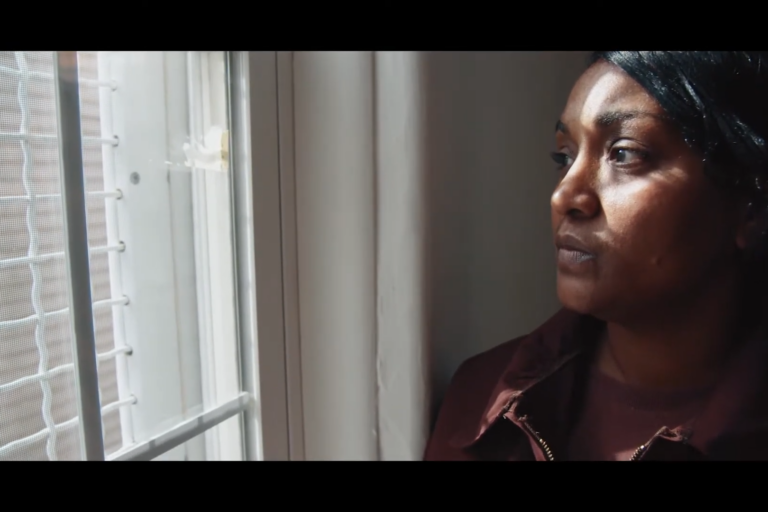
Eating healthy is a challenge for many women at Muncy, Miller said, with a limited selection of highly processed foods available through the commissary and food served in the cafeteria having little nutritional value. There’s a “black market” for vegetables, where inmates will trade cigarettes for onions and peppers to cook on their own when they can’t get them from the cafeteria, she said.
“Here, we are at the mercy of whatever they sell us or whatever they serve us,” Miller said.
A 2018 study comparing jail inmates to older adults on the outside found geriatric conditions were significantly more common among the incarcerated than those on the outside. Those in jail, whose average age was 59, experienced functional, sensory, and mobility impairments at rates similar to those 75 or older, according to the study.
“Chronic stress literally breaks down your body, every part of your body mentally, physically, emotionally, and then when you don’t have the proper foods to be eating or you don’t have proper access to healthcare, your body’s just gonna deteriorate,” said Alyssa Gordon, an attorney and Borchard Fellow in Law and Aging at the American Civil Liberties Union National Prison Project.
Miller has also struggled to navigate the healthcare system at Muncy. It took her a year of waiting and advocacy from people on the outside for her to get an ultrasound for breast pain that she worried was cancer, she said.
“Prison is not designed to make people better,” Miller said. “Everything that you want in here, you have to fight for. So if you have a person that doesn’t know how to advocate for themselves, you definitely can fall to the wayside.”
Miller was convicted of first-degree murder in 2004. She too is seeking commutation of her sentence as well as her case to be investigated by the Philadelphia District Attorney’s Office as a wrongful conviction.
For now, Miller edits the magazine Daughters, featuring work from incarcerated people across the state, which she founded in 2020. She wakes up early in the morning to pray and meditate before burying herself in writing for the magazine.
“I don’t believe in rehabilitation because when I look that word up in the dictionary, it means to go back to something,” Miller said. “I believe in transformation.”
WHYY is your source for fact-based, in-depth journalism and information. As a nonprofit organization, we rely on financial support from readers like you. Please give today.