Bonus Episode Two: Live at Temple University– Women Impacted
A panel of women impacted by the criminal justice system discussed their experiences of incarceration and the long road toward rebuilding their lives after release.
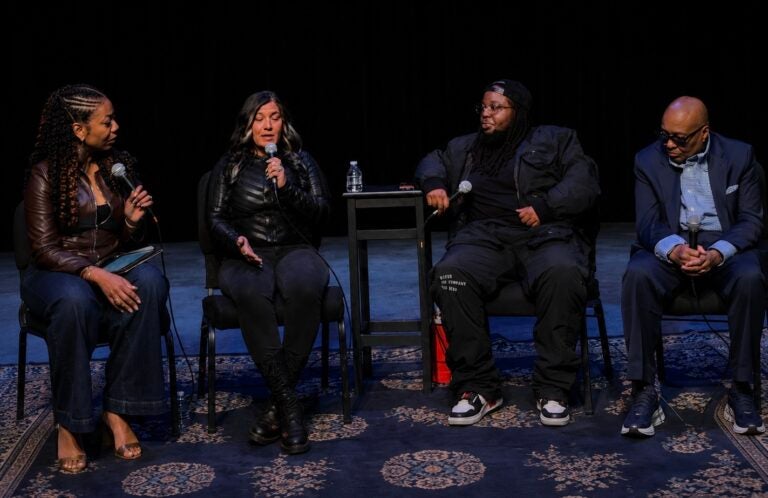
A panel of women impacted by the criminal justice system, moderated by Cherri Gregg (left), discussed their experiences of incarceration at Temple University on May 13, 2026. | JOLYNE BYRD
A panel of three women impacted by the criminal justice system convened at Temple University on May 13 to discuss the circumstances that led them to being incarcerated, their experiences in prison, and how they have worked to rebuild their lives after their release and help others on the inside. BL Shirelle, who was incarcerated at State Correctional Institution Muncy after a shootout with an undercover police officer, put her artistic talents to use in prison and helped build the first record label for justice-impacted artists following her release. Sarah Laurel, the executive director of the nonprofit Savage Sisters, became addicted to drugs and was jailed before experiencing homelessness on the streets of Kensington. She got sober and went on to found Savage Sisters to help people recover from addiction. Marie “Mechie” Scott spent more than five decades incarcerated at SCI Muncy for second-degree murder before having her sentence commuted in 2025. Scott has created a coloring book for children who have experienced trauma and a booklet on codependency that she teaches in prisons.
-
Episode Transcript
Cherri Gregg: This is a bonus episode of Dying on the Inside: Women Lifers at Muncy Prison. I’m Cherri Gregg, Host and co-Executive Producer of the podcast.
What you’re about to hear is a live conversation recorded on May 13th, 2026, at Temple University’s Randall Theater. We called the event “Women Impacted” because we wanted to broaden the conversation beyond prison walls and focus on the women whose lives have been shaped by incarceration in different ways.This discussion brought together women with lived experience in the criminal justice system to talk candidly about survival, addiction, healing, accountability, re-entry, and the long road toward rebuilding a life. The program began with my co-Executive Producer Yvonne Latty reading a letter from Terri Harper, one of the women featured in this podcast. Terri is serving a life sentence at SCI Muncy and asked Yvonne to share her words with the audience. Here’s that conversation.
[music]
Yvonne Latty: This is a podcast about women lifers living at Muncy Prison, aging, and healthcare issues. So the first speaker I would like to introduce is Terri Harper. She can’t be here because she is serving a life sentence at State Correctional Institution Muncy.
“There are many issues with healthcare across the board. So everyone is challenged to acquire the help they need. The thing is that inside these gates, there are many more obstacles, most insurmountable to overcome. Because comprehensive healthcare is not a thing. We are covered by a healthcare entity that filed bankruptcy last year and will likely just move into a new name under the shield of their parent company, this time if they’ve done in the past, which allows them to continue the neglect and substandard care indefinitely. Individuals without family support, a strong temperament for self-advocacy, or just the basic know-how are often left to be spun by the medical professionals who are supposed to care for them. It isn’t just medical, physical health, but the rising amounts of mental health patients wallowing in the system is a real problem as well. It is my prayer that all of you are moved to ask some hard questions. Listen carefully to what isn’t being said and hold the powers that be accountable to bring some relief. Relief medically, psychologically, and financially. You are the beacons of light and change we rely on. Again, thank you all for being present. Please stay open. God bless, Terri.”
And now, I’d like to turn things over to my partner in this, my co-Executive Producer and our Host, Cherri Gregg, who many of you know as the host of WHYY’s Studio 2, but who I know as a fearless journalist who is not afraid to take on a really hard story like this one. Cherri works a demanding full-time job, but for months she would come home and have me knocking on her door, so we could wait for a call from one of the women. What followed was a tough, emotional interview that left our knees weak. Reporting on mass incarceration is really, really hard. It’s filled with landmines, but Cherri never wavered. We worked on this project for two years, and I am so proud of what we created together. I am so excited also to hear this conversation. So here’s Cherri.
[applause]
Cherri: Thank you so much. Can you all hear me? Yes, thank you so much Yvonne. It’s been a true pleasure working with you.
This is our second in a series of conversations around the podcast. And over the past several weeks, through Dying on the Inside, we’ve been talking about aging in prison, illness, long sentences, and the question of what justice looked like after decades behind bars. But tonight we wanted to really go deeper because incarceration doesn’t just happen in a courtroom. For many women, addiction is also part of that story, not in isolation, abandonment is part of the story, trauma. All sorts of things go into why women end up becoming impacted by the system. Mental health, struggles, survival.And too often in this country, we see women not get the treatment they need, not get the support they need, and it leads to cycles of incarceration. And for women especially, incarceration also comes with layers that we rarely talk about. Abuse, family separation, motherhood, mental health struggles. And of course the challenge once you get out, what does life look like? How do you find purpose once you fully go through recovery and rebuild yourself and your life? So tonight we’re talking about that lived experience. What does it take to survive prison, emotionally and physically? What happens when someone comes home? What does actual healing of yourself look like? And this conversation is not about excusing harm, it’s a conversation about understanding people fully and what growth, redemption, and public safety really mean over time.
And so I wanna introduce my panelists to help us walk through this conversation.First, we have Sarah Laurel, Executive Director of Savage Sisters, a Philadelphia-based organization focused on recovery, harm reduction, housing, and outreach. Sarah, thanks so much for being here. We also have BL Shirelle, a Philadelphia Rapper, Producer, and co-Executive Director of FREER Records, a label that supports incarcerated and formerly incarcerated artists. BL, thank you for being a part of this conversation. Yes, and last but not least, we have Marie Scott, AKA Mechie, who spent more than 50 years incarcerated for felony murder before recently receiving a commutation from Governor Josh Shapiro. Welcome home, Mechie.
Marie “Mechie” Scott: Thank you.
[applause]
And thank you all for being part of this panel. And so, all of you have things in common. You all are walking in purpose right now with your life, using all the knowledge that you’ve acquired through your experiences to help other people. But I want to go back to the beginning. And I’m trying to divide this conversation into three parts: how you got there in the first place, how you survived everything, and then how you found your purpose on the other side. And so I wanna kinda start the conversation with what was going on in life when you got there. And so BL, I’m gonna start with you first. What was happening in your life emotionally, socially, structurally, that set you on a path that kinda led you to the role? So take us back to the beginning, that-where you ended up in the justice system.
BL Shirelle: Yeah, so everyone can hear me? I’m good? I was indoctrinated into the criminal justice system probably at age 12. I grew up, I was in a-I come from an upper middle class family in uptown, West Oak Lane, Philadelphia. And my family was impacted by the crack cocaine epidemic. And my mother was an addict for quite a few years. And in that time, it kind of became a family business. My mom was a drug dealer as well, so I started selling drugs at age 12 also, and by the time I was 18, I was already in and out of placements constantly from that age. I started using drugs at a very young age also, pills, weed, all that stuff. I’m exposed to all kinds of violence and abuse and all the things that you would think would come with living in a crack house, growing up in a crack house. And at 18, I got into a shootout with an undercover police officer where I was shot multiple times, beat really bad, and sentenced to 12 years, so.
Cherri: And so tell us about that young BL. What was your mindset like? Because we want to contrast that later in the conversation with how that has shifted. Get us in your head and how all of this life that you were living was sort of justified in your head.
BL: So, interestingly enough, I started selling drugs out of safety. I wanted safety. My mom was an addict and she was a pretty good drug dealer to be an addict, but she still was an addict. So, she would mess up people’s packs and stuff like that and guys would come and kick our door down and, you know, pistol whip people, and it was a lot of violence and my rationale at that time was, if I’m the person that’s selling the drugs in the house, then I don’t got to worry about—
Cherri: The money will be right.
BL: The money’ll be right, right? We can keep the money in the house and people won’t be like-we will be exposed to less violence. That was my rationale in that. And when I started, I actually grew up in a family surrounded by love. I never felt othered. I never felt bad about who I was as a person. I was always embraced. The things that I needed to make it now in life, thank God I had then, but those circumstances is what led me into it. It was very much so a family business. My aunt, who I also lived with, she also was an addict. So we were all just in there hustling, doing what we do. I was pretty detached because of getting high and all that. Had my emotions kind of everywhere. And I actually had a lot of potential. I went to Central High School when I was a kid.
Cherri: Smart, yeah.
BL: Right, I was winning spelling bees and poetry contests. I got my first poetry book published in third grade. So I always had high hopes and potential, but eventually, you know, bad decisions catch up. So eventually they caught up to me. And once I got into that spiral, I just couldn’t get out. I actually entered the justice system from truancy. And from age 12 to 32, I was in it nonstop, but it started from truancy.
Cherri: Thank you, BL, for sharing that with us. Sarah, I wanted to kind of start with you, because your life, your story is a little bit different. You were doing all the things, suffered an injury, and then got sidetracked. And that’s how your thing—so tell us about how you ended up becoming justice-impacted.
Sarah Laurel: Sure, I had a great job and thought everything was great. I got prescribed opiates and I found a doctor that then prescribed me amphetamines and benzos and so I had this self-medicating journey and then the doctor sent me a letter in the mail and said, You can no longer receive any of these medications. I went to the street. And started getting pills on the street and eventually left my corporate job, started working in a strip club and doing heroin and other substances and then got into a terrible relationship and got arrested.
My charges were around-I do a long, I didn’t go upstate. I went to jail and fought the case, but it was burglaries in Delco, Montco, Philly? And I don’t know. And then I got like a paraphernalia and a possession charge and like a distribution charge which the county dropped because of evidence reasons. But it got me involved in the system and that turned me, like, in and out of jail from Kensington, being homeless and then going to jail and coming out. It was kind of, once you’re involved in it, it’s difficult to get out when you’re in that kind of spiral.
Cherri: And so take us into your mindset, Sarah Laurel, because substance use was a big part of the reason why you got caught up, kinda. But take us into your mindset and to the justification that you had in your head at the time that just kept you on this road until one day, I guess, and we’ll talk about that, sort of you decided to get off, to stop the cycle.
Sarah: So I was the last person to realize I had an issue. Because I got it from a doctor, I used that as an excuse. I think in the back of my mind, I knew it was problematic. And then once I shifted into, I guess, the nightlife vibe, I didn’t care anymore. I slowly crossed lines in the sand that I had created. And the only thing that I was seeking at that point was to not get sick without the substances. I abandoned my family. I abandoned responsibilities and the only thing I cared about was not facing anything. That would change later on, but it was a very lonely, dark place and the consequences that came that many people warn you about in the DARE program, those consequences didn’t stop me. I was fine with them at that point. I felt like I deserved it. I was worthless and I just didn’t care. I know that’s not what people want to hear, but I just didn’t care.
Cherri: Truth is truth, you know, truth is truth. Thank you, Sarah, for sharing your perspective. Mechie, Ms. Mechie. And we talked on the phone a few days ago about this conversation, and so I want you to take us back to the time when you were getting caught into the system and you told me that substances had a lot to do with that. So take us to those days, tell us who you were, and how you got caught up.
Mechie: I was raised in Teaneck, New Jersey, Orlando, Florida, and Topeka, Kansas, rotationally. I was never around drugs at that time. Back then, you didn’t hear too much of anything about drugs in the ‘50s. And when I got a little older—I realized that I was having trouble from my family and a lot of incest and sexual abuse going on. So that started to turn wheels backwards in my life for me. And I couldn’t figure out why I was the way I was, why everybody wanted to come around me and be the way they were, and they were men. I started running away from home because I didn’t want to have to fight with that every night with the people who were doing it. So I would jump out the second floor window and walk the street all night. So that was my younger life.
As I got older, I became pregnant and thrown into New York City, where there was nothing but drugs. And that’s when I became affiliated with heroin. And that was my best friend, until—I decided to give my son up and choose the drugs over my son. I gave my son to my father because I couldn’t sustain a habit and take care of a child, too, and I was only 16. I didn’t have any hustling abilities, so I did the best that I could by giving him to my father.
Cherri: And use your mic.Mechie: Is it on?
Cherri: Yes, you just have to-you have to hold it up.
Mechie: Okay.
Cherri: Yeah, there you go.
Mechie: So, being on that run, I ended up going into a program, and eventually I stopped using heroin, and my father told me to come over to Philadelphia because I would stop using drugs if I stayed over there. I went because I was still a juvenile, and he was the adult. But coming over to Philadelphia landed me in a different type of world where it wasn’t drugs, it was alcohol. I had a stepmother who couldn’t stand me because the woman that was cheating with her husband was my mother. And I didn’t even know that. I thought my mother was my father’s wife. So I stayed in Temple Hospital getting my head stitched up all the time from her abusing me and eventually she put me out and I was working at this restaurant and these guys came in to rob me and I didn’t know what to do. I’d never been in a robbery before, being robbed or in one. But they came and they said what they were gonna do, and all of a sudden this guy from the back, not on the workman’s side, still on the customer’s side. He pulled up a gun and made everybody get out of the store.
So, me. Being the good, severely co-dependent that I was, I felt like if a man or a guy took you to the movies, he had to be in love with you, you know? If he took you to dinner afterwards, I’m waiting for him to propose. So you can about imagine what I felt like when this guy saved my life. I thought I owed my life to him. It was nothing that he could ask me for that I would have said no to. And that was my first symptom of being a co-dependent, not being able to say no. At that time, of course, I didn’t even, had never heard of the word co-dependency. But when he asked me 10 days later to go on this robbery with him and be a lookout, I couldn’t say no, and I did. And I went to prison and I never came back to the street, you know? The man who was killed was Mayor Rizzo’s best friend. He was white, I’m Black, the co-dependent Black, so I can just leave that for you for what happened. But that started my first run with going to prison. And it was horrible because I didn’t know anything about the prison life. I’m trying to be Joe and be [unclear] with everybody, and I’m doing it all wrong, you know, so—
Cherri: And I’mma pause you right there because we’re gonna talk about survival next.
Mechie: Okay.
Cherri: But can we give Ms. Mechie a round of applause?
[applause]
And I want to say thank you to all three of you because it is not easy to sit in front of an audience of people and talk about some of the most vulnerable times in your life. So thank you for being so open and candid with all of us. So can we give them all a round of applause? We have to acknowledge that.
[applause]
And so now that you’ve taken all of us into your individual lives at the moment where all of this saga sort of began, I do wanna now talk about survival because in order to get to the place where now you all are living with purpose, you gotta get through the thick of it. And the thick is the change. The thick is—how do you go into a system? How do you heal yourself, get into recovery, do whatever you have to do to shift your mindset? And I’m going to start with you this time, Sarah Laurel, and go to BL, and then go back to Mechie. So you were in a “I don’t care.” We heard you. And you said, I know it sounds bad, but you just did not care. What made you start caring again?
Sarah: So it was in 2017. I had been running for a while and I was unhoused in Kensington and I had an-there was like a dope set that I used to go to and there was a new group of people running the dope set and I didn’t recognize them. We got into an altercation. I went out a second story window and ended up in the ICU. I had to get surgery, to learn to walk again. I had broken ribs, broken nose, broken orbital bone, contusions in my head, like I was stuck. I wasn’t going anywhere. That didn’t really make me wanna change my life. It just made me sit still. And then two-one of my friends who I was-she was my celly twice, reached out while I was in that hospital and said, I have an empty three bedroom house if you wanna come. I was wearing a dress that said “savage” when I was thrown out of the window. So that’s why the nonprofit’s called Savage Sisters. It was the only thing I had when I got out of the hospital.
The rest of that journey was brutal. It was ugly. It was messy. It was selfish. It was a lot of pain and it was a lot of reality. Because when you go from being on heroin, crack, coke, and xannies to being completely abstinent, there’s a lot happening in your brain and in your body and in you mind and there wasn’t a moment where I felt deeply connected to some spirituality. I just felt very void. I was grateful to have the women in that house with me that I had known for years and they carried me through, that camaraderie and connection and it was like being a blank canvas. I just kind of stayed, and then sadly over the next couple of years I buried both of them. And—
Cherri: I’m sorry for your loss.
Sarah: Thank you, I am, you know, it’s been so much, anybody, I mean Philly knows it’s been brutal. And then I went to Kensington and started doing, hanging out on my porch and hanging out with people that were using substances and selling substances and trying to attack it from a different angle and healing happened. I’m still healing, I’m still evolving. I’ve experienced sexual violence and a lot of different, I would say, different traumas that I’ve had to go through therapy to process. And in 2020, I turned myself in for felony warrants for burglary. And they offered me a one and a half to three and I was like, all right, I lay myself against the system. I’m sober now, I’m doing the right thing. I need to take accountability.
And I got letters from the community because I had been doing this work and I was like, We’ll see what happens. And they dropped the charges. Obviously that doesn’t happen all the time, but it was something that happened and it felt like any little minuscule thing, like, okay, maybe I can continue to move forward with this. And now I’ve been doing Savage for nine years and I have all of the work. It was—but I think some people want it to be pretty and cute and it’s really just ugly and hard. And you have to be determined.
Cherri: What do you think it was inside of you, like when you go through the hard stuff, you said you felt bullied, you know, in the beginning, like people were just trying to keep you, you know when you’re in that tender place and change is hard, what do you think it was, the thing inside of you, that kept you going and not reverting back and going back to the old way? Like what was the, besides the injuries, cause I know that you could not for a while. But I mean, you could have easily just said, You know what, I don’t care, but you started to care.Sarah: I was exhausted from the cycle. I think exhaustion was there, and then I think there was this, there was a moment when I had a couple of months sober where I realized that I had done it. And it was-it wasn’t an aha moment, it was just this minute where I sat alone on the bed and I was like, Wow, you really haven’t taken any substances. Maybe you can do this. It was slow, and it was a soul-reckoning of I am capable of this and then I started telling myself that I was worthy. I was worthy of healing, I was worthy of connection and community and all those things.
Cherri: And then things started to change.
Sarah: Then it just happens, very organically. And then you keep going. That healing process, that evolution that I go through happens every year. It’s like shedding your skin every year and learning something new about yourself. Especially women, we’re always growing and evolving.
Cherri: We are, we’re some evolving creatures, thank you. Thank you Sarah Laurel.
[applause]
So BL, you gave us, you told us a story, you got in a shootout, you end up incarcerated, you got a pretty lengthy sentence that time. Take us to that place, because you were, people were loving on you when you got inside, but who were you then? When you went in prison for the longer bid, and were you ready to change? Did somebody had to, you know, put you upside the wall, like what shifted you?
BL: When I first got to prison, sadly I was already very institutionalized because as a teenager I was always in placements and all that stuff so I went straight from juvenile placements, straight to jail, straight to prison. So I already was pretty acclimated to that type of society and I was always the type of inmate that people would be like-the guards would be like, Dag, Mo, what are you doing here? You’re so smart, you’re so this. But it’s just because I kind of knew how to assimilate into these types of environments.
When I got to prison, the same thing that kept me sane my whole life kept me sane then, which was writing. I’ve been a writer ever since I can remember. And I was the person who, if your mom passed away in prison, you would say, Hey, can you write me a poem for my mom’s funeral? And like if they couldn’t make it and stuff and I would say How was your mom or what was your relationship like? Or whatever and I would ask all these questions about the mom and then I will write you know like this fantastic poem for them to present at the funeral, stuff like that. I would write-I probably wrote every single girl that I had a crush on a great poem. I want all my poems back by the way.
[laughter]
Cherri: So you wooing people with the poetry?
BL: I want to make a poetry book of all of my poems. So anybody, if y’all see this, you got one, give it back. So I wrote my way through. I was very positive about it, because I actually had the nerve to go back to prison after this. So I did my first sentence, and I left. And I violated 18 months later, and I went back. And that’s when things got dark for me.
But I like to say that prison is broken down in demographics, pretty much. So if you were the demographic I was in, which I was 18 years old, I was a lesbian, and I grew a natural beard, okay? That was like college or something, right? But if you’re married with three kids and a straight woman, it’s like hell. At middle age, you’re in hell. But if you are an elderly woman, it’s a graveyard, you know? It just all depends on the demographic that you land in. And the amount of support you do or you don’t have. So my first bid was great—
Cherri: College.
BL: Like, yeah, all my friends now, or friends that I met then, it was literally like my college years. I did a lot of programming and all that stuff. I thought I was gonna come home and be a fiber optic technician because I did the training and all that. I was an electrician for six years. Like, I thought that I was going to use that. And when I came home at the time, they weren’t, they weren’t very forgiving to violent offenders at that time. They were just starting to forgive non-violent offenders. So when I got out and I found out that I wasn’t gonna be able to work for Comcast because they not letting me in nobody house with this, you know, shootout with these cops. I’m not being no electrician or nothing. You know, I just kinda, I came from so far up, I just went straight down. I didn’t give myself any real shot, any real chance. I gave up and I just went back to everything that I know.
And when I winded up coming back to prison, one of the first people I saw was Ms. Naomi, whose music y’all heard as y’all was walking in here. And the first thing she said to me was, I’m so glad God kept you. That’s the first thing she said. Mind you, I was ducking the lifers for the life of me. I didn’t wanna see none of y’all, you hear me?Cherri: Cause you knew what they was gonna say to you. Like, why you back?
BL: What? You know, because that’s just the one opportunity that they want of freedom, and you’re just squandering it so worthlessly, you just act like it means nothing. And then you gotta come back and face them, you know? Like, it’s a very humbling and embarrassing experience.
Cherri: But you were a different demographic, right? I mean, you were, I mean you still, you know, liking the ladies, but at the same time, you’re older at this point.
BL: Yes.
Cherri: You had been in there and now you gotta come back and face all your mentors.
BL: Yes, things were way different the second time. I did half the time, and it felt like double the time that I did the first time. It was way different because I had kids, I had a house, I had, you know, a car. All that stuff got stripped away. My son was in a placement himself from abandonment. I’m watching the generational curse play out. I’m devastated. My grandmom, my wife’s grandmom passed away while we were in there. It was just so much. It was so different. And I was in the darkest, darkest place I’ve ever been in my life. So much so that I couldn’t even write a song. And that was the thing that I did when I didn’t have anything. I couldn’t even do that. I was so deep down.
Cherri: Your gift was gone.
BL: It was gone.
Cherri: A block.
BL: It was gone
Cherri: And so what in your mind sort of shifted you and said, You know what, this has got to stop. I gotta get off this-I gotta break the cycle.
BL: Yeah, so Ms. Theresa, I mean, Ms. Jamila, Theresa Battles, when I saw her, old lifer, she passed away a few years back, she made me write out my goals. She said, Meet me back in this Day Room with your goals written down. All the lifers, like, they raised me, literally. Like, they really took the space up where my grandmom, because my grandmom raised me because my mom was an addict, and then the lifers stepped right in her spot, like—
So she said, Write your goals down. So I wrote the goals down, and I came back out to the Day Room with the goals the next day, and it was like five goals. She said, Okay, we’re gonna name A, B, C, D, E. She said, Okay, so what about F, G, H, I? I said, What? I go back to my room, I come out the next day, got it written down. She said, Well what about J, K, L, right? So now I figure it out, she’s gonna make me write all through the whole alphabet. So I write the goals out through the whole alphabet, I bring them back out to the Day Room, and she says, I don’t ever wanna see you again. And I don’t want you to-if this don’t work, you do this. If this don’t work, you do this, if—there’s no reason to ever give up on your own life, on your own self. I want you to follow this list, keep this list. Guard it with your life. And I said, Okay.
And then I winded up doing a TEDx performance with my band and a gentleman by the name of Fury Young wrote me a letter. He wrote one of my bandmates a letter, he was working on an album about mass incarceration through the Black experience. And he wanted one of us to write a song for his album. And the concept of the album was always-started from the minstrel era and it went all the way up and it was this one character who went in prison, came out of prison. It was songs about saying bye to lifers, it was songs the jail food, it was songs about reentry and it had like, character X is leaving prison, says bye to lifers, genre: rock and roll. Like, and it was all spread out like that in a spreadsheet. And I’m reading this, idea of this album and it’s literally my life. He didn’t even write the letter to me. He wrote it to my bandmate. And my bandmate gave me the letter because I was the band leader. And this person that I didn’t know was telling my whole story. Word for word. Just—
Cherri: So you felt like this was directly speaking to you, to your soul.
BL: I felt-it was burning my soul. It was like, how can a stranger just tell me everything I am and everything I-how is that possible? He’s not even talking to me, but he’s telling my story as if he knows me, as if this is my personal autobiography. It was, even though it was inspiring, it was offensive. Not like he did anything wrong, but like me, like how dare I leave my destiny just in the hands of a statistic or of somebody could just know everything I’ve been through and every decision I’m gonna make before I make it, that is, I couldn’t fathom it, I couldn’t stomach it. And I just decided right then, I’m never going to be able to let somebody just tell my story without ever meeting me, without ever knowing me, without ever even thinking of me. I’m more special than that. And—
Cherri: That mindset, can we give, thank you for sharing that.
[applause]
You don’t know when it’s going to hit you and then it hits you. Everybody got hit in different ways. Hit in different ways, literally.
And so, Mechie, coming back to you. And I want to talk about how you went in. You know, you were this co-dependent person, you go in. And you have to survive 50 years. I cannot even imagine how you had to change yourself, how you had to grow, what you had to do to survive that. And I know it’s hard to summarize that, because that’s quite a bit of time, but if you could try to walk us through in a way that we could understand how you went in and what sort of made that shift inside of you and your psyche. And use your microphone and pick it up like this. There you go.
[laughter]
Mechie: I’ll see you tomorrow. Okay, can everybody hear me?
Cherri: Perfect, that is perfect.
Mechie: When I got to Muncy, I instantly made a map of how to get out of it. I was going to be the escape artist. There was no fence, but if you were Black and didn’t have a ride, you were gonna get caught more than likely, unless you took the mountains. And I’m scared of animals in the mountains, so I was, you know, it took me three times, three escapes. Well, they called them “breaches” back then. But I kept running away because I didn’t want to be there. And I guess I loathed myself so much that—every time I could do something for somebody, help somebody, that was my way of getting them to like me because I couldn’t like myself.
And come to find out I couldn’t like myself because I could not swallow the fact that I was in jail and they were telling me that I was a murderer and that I had took [crying] a life of a precious individual. And I kept saying, Well, I didn’t kill anybody. Why do you keep calling me a murderer? And I would just keep running away. And the second time I escaped, I came back with being eight weeks pregnant, having the girl that I wanted. I knew that by the time I got out of prison, I was gonna be too old to have kids. So if you don’t go out there and get them yourself, then you just don’t have any. I had a son who was four when I came to prison. And when I had my daughter, I had her in ‘80, and I said I wanted to try one more time because I wanted be with her. And I said if I didn’t make it, I wasn’t gonna do it anymore. And I didn’t make it. And I didn’t do it any more.
So now I’m faced with having to deal with how I’m gonna stay here and do this time. Because when I was in my 20s, you couldn’t tell me that I was going to do more than 10 years on a life sentence because I had life with parole. I didn’t have life without parole like everybody else did because my judge said that I had parole, that I would be on release depending on the discretion of the parole board. So I didn’t know any different, you know? They lied. They didn’t even know what a life sentence was back then. You know, the judiciary didn’t know. So after having my daughter, running away and getting caught, I started to stand and face my fears. And in facing my loathingness, I had to find out what was I going to do with that? And I met someone named Peachie, Sharon Wiggins, and I—she just opened up everything for me. Her and Rose Dinkins. You know, these were lifers that were in longer than I had been, you know? And all I wanted to do was be, grow up to be like them. You know they had, they knew so much, they had so much going for them. And I named myself Mechie because I wanted to be, like Peachie, you know?
[laughter]
And that’s how that name stuck with me.
But at any rate, speeding it up, I realized through going to groups and some of the staff there really cared. They really wanted to help you. So I said, Well, if they cared about me, why can’t I care about myself? And something horrible happened. I lost my son, and I lost my mind, and it was that moment of pain that I was faced with realizing, Okay, now I know what Mr. Kerrigan’s wife felt like. Mr. Kerrigan’s mother, Mr. Kerrigan’s father, Mr. Kerrigan’s brother felt like, when I took his life. It took me to lose my son to feel that pain of knowing what my victim’s family members must have went through.[crying]
And from that moment on, that’s what made me change, because I was so hurt. Even though I know I didn’t kill him with my own hands, I was there. I was responsible. And damn it, I was gonna be held accountable for that. If nobody else held me accountable for it, I was going to hold myself.
And I promised Mr. Kerrigan every night and every day that I prayed that I would never let his murder go in vain if I ever got a chance to come home. And I will not let his life, his death, his murder, go in vain, I won’t do that. Every time I get a chance to save a life, I’mma be there, I’mma be doing that. Every time I get the chance to help somebody learn what co-dependency is and how easy you can be taken off the streets and thrust into prison for the rest of your natural life behind not being able to say no, behind being a people pleaser. You got to wake up and understand this can’t keep happening, but that’s what made me wake up. I don’t want to keep—
Cherri: No, no Mechie, look.
[applause]
And my follow up to you is, and thank you for sharing that. I mean, clearly this is very emotional and I felt every word you had to say. Did y’all feel it?
Audience: Yes.
Cherri: And I thank you for sharing that with all of us and this is a safe space. And so I just want to ask you to follow up. I mean what do you think was the key thing that helped you survive? And not just survive, but really sort of heal yourself and move yourself to this space where now you’re able to sit in front of this audience, share that truth, and hopefully influence other people?
Mechie: What did that for me was becoming everyone’s mother.
[laughter]
That’s what did it. I had to walk the way I wanted them to grow up. A lot of the lifers in here, I raised them, you know? A lot the women without life that are in here, I raised them. But I had to show them that there’s something else meaningful that they could go out and never come back again and be a survivor and make it out there. And that was in my process of transformation. I was transforming kids into young ladies, into women. That to this day write me and tell me what a difference I’ve made in their life when they never came back. You know?
[applause]
[music, midroll]
Voiceover: At Klein College of Media and Communication, at Temple University, we believe the best way to learn it is to live it. From day one, students get real world experience in sports media, journalism, communication, production, PR, advertising, and more. Guided by industry pros and fueled by Philly’s energy, Klein prepares you to lead in media and communication. Learn more at klein.temple.edu.
Cherri: I want to ask all of you this question because we-I’ve covered prisons, I’ve covered mass incarceration, I’ve covered the many obstacles that men and women face when they come home. And this podcast has been about women specifically. And I want to sort of get your thoughts on what you think—how you think women experience prison, how women experience this whole being justice-impacted that’s different, or the things that people don’t think about when it comes to being women. And because we talk about incarceration a lot. We talk about recovery a lot, we talk about healing and trauma and all the things, but women have a lot of different obstacles that are very different from men. And so I wanna hone in on that to make sure we get in on the woman part. And whoever wants to go, go first. BL, you wanna jump in?
BL: For one, it’s a bunch of matriarchs, right? So it’s automatic community. Like you go in there, next thing you know, you got a mom, you got dad, you’ve got a grandmom.
[laughter]
Mechie: It works.
BL: And I wanna second everything that Mechie said. Mechie’s one of my mentors. Ms. Danni’s one of my mentors, made me my best and favorite hat and scarf set ever. Like, you know they take care of you and they raise you. And when they come around, you know, you sit up a little straighter. You might pull your pants up. You know, you’re not cursing around them. You know it’s—
Cherri: It’s respect.
BL: It really is. And I wouldn’t be here. I wouldn’t have a successful non-profit if it wasn’t for these ladies. So I just want to thank y’all and I love y’all and y’all know that. And Star too. So it’s a very community place. So what you don’t have, that’s a lot different than men, I’m sure. They’re not going in there getting daddies and you know what I mean?
But also, I think our number one threat is our health, medical. Medical is the boogeyman for a woman in prison. It’s like, you ain’t thinking about getting raped or stabbed or nothing like that. You trying to get a pap for five years, you know what I mean? You have a pain in your pelvic and they not helping you, like stuff like that, and I’ve watched people literally wither away and they’ll say-like Nadja. She, when I came back to prison, she was 100 pounds lighter. And when I saw her, I just started crying. I knew she was, like, dying. And she was, like, They saying there’s nothing wrong with me, baby. They saying there’s nothing wrong with me. And then a few weeks later, she came and told me that she was going to hospice. And every time someone kind of finds out they’re sick, it’s like too late.That’s like our biggest threat. And I think that one thing that is overlooked a lot with women is that we’re the fastest growing demographic, population over the past decade and a half. Women are going to prison more than men right now, and it’s not-we’re silent. People don’t think that, like, and a lot of times when people think to volunteer at a prison or something, they thinking, Oh, I’mma go to a men’s prison, cause they think that’s where all the resources are needed. And I hate to even bring up the point, cause I feel like I’m pitting us against each other and I don’t wanna do that, right? Cause they need resources too, you know, but they have so many more volunteers and stuff than women do in the women’s prisons.
And I think also just acknowledging that we’re different will go a long way. Acknowledging that the men’s prison and the women’s prison have different needs will go a long ways. No reason why a women’s prison got two staff in the parenting building, just because the men prison does, you know what I mean? So like, I think it just starts at just acknowledging the differences in us and what that means in terms of resources and how they should be allocated. I don’t think it should just be all across the board, everybody gets the same thing.
Cherri: Yeah, thank you for that. And I’ll say that one of the things that we learned is when you go to men’s prisons, the women are usually the ones taking the kids and everybody to visit the men, right? But a lot of women who are incarcerated are mothers. And there’s someone taking care of her children. And so a lot of times, they can’t bring the kids to see the mom. And you hope they do. You want them to. But there’s a difference.
And so I also wonder, my follow up to you is, when women come home, is the stigma different? Is there a stigma? Do women get treated differently when they come home? And I wonder, Sarah, you could jump in on this, too. Do you feel like there’s a gender dynamic difference, the way society views women who are formerly incarcerated versus men?
BL: That’s a good question. I’m gonna say, I don’t think so.
Cherri: You don’t think so?
BL: Yeah. And the reason why I’m going to say I don’t think so is because I don’t think we need not another handicap or not another thing in our minds that makes us believe that we can’t do whatever it is that we need to do.
Cherri: And I think that’s good. I think, that’s wonderful. Yes.
Sarah Laurel: I think, I think that women are treated as second-class citizens in this country. And I think the system, the judicial system, regardless of whether it’s going to jail, going to prison, even if you look at sexual violence and sex crimes, women are treated as second-class citizens across the board. In front of the judge, when they’re in the police station, when they’re filing for something. We just simply do not get the respect or our word is not honored, in my opinion. There’s so many women that are incarcerated that have experienced sexual violence and responded to it, and that isn’t even taken into consideration because the system was built to support men and to allow perpetrators and predators to harm us. So I think that needs to be highlighted, and women’s stories need to be told.
[applause]
I also think that the healthcare disparities that are men versus women are not just in prisons, they’re across everywhere. Women are gaslit into saying, Oh, you’re just, you know, it’s just your period. You just have cramps and they have endometriosis for years. So I think that there is a trend within this patriarchal society that we live in that silences the voices of women and discriminates against women overall. And of course it’s gonna be highlighted in a prison system because they already don’t care. But I think we need to bring voice to it. And I think women who have experienced sexual violence need to be elevated and their stories need to be told and listened to and really believed. But that’s just, obviously I am a misandrist.
[laughter]
Cherri: Yeah. Yeah.
BL: What do you think about the re-entry piece, the reentry? Do you think that women have it harder, or do you-we have a separate stigma than men that are re-entering society?
Sarah: I do, I think, and this is just a societal imprint, I think men are like celebrated, it’s like cool, it’s bad, it’s tough, and women are like, Oh, what a shame, you left your children, you’re a bad mom. I do think that—
[applause]
I think it’s real, and I think we have to acknowledge it, and we have push back against it, you know? I do think it’s important that we talk about it too.
BL: Right, yeah. Can I?
Cherri: Yeah, go ahead.
BL: So I think it’s different, but I don’t think that different always means worse. So I think a lot of men, when they get out, Black men especially, people just look at them as violent, especially if they did a lot a time. It’s a certain trauma that they carry in their body, just from walking around super stiff and you hardly see them smile. They have their own separate challenges. I think they’re just different.
Cherri: Different challenges.
BL: It’s like, you know, I’ve seen men try to get jobs and stuff and they just look too intimidating or you know they just look-they think, Oh what did he do? Whereas women, I have seen them sometimes be able to get employed easier because it’s not, they don’t have that intimidating presence, you know? So I think that it’s different for sure, but I’m not sure who has it worse and I think that it’s wasting time even considering who has it worse.
Cherri: And just so you know, it’s not a who has it worse. It’s more of what are the gender differences and dynamics that maybe people don’t think about. And that’s all. We’re not saying who has it worse. Because there are barriers for everybody, I think, with regard to housing, employment, certifications that have nothing to do. And there’s been a lot of advocacy around that. So I just want to clarify that that wasn’t the intention of that to cause division in any way.
BL: No, no, I didn’t take it like that.
Cherri: Yeah. And so I want to move our conversation because we’re getting close to the end of our conversation. But Mechie, you out now, you home.
[applause]
And—that’s right. Y’all love some Mechie over here. You got a lot of love in this room.
Mechie: Yes, I do.
Cherri: And so you talked a little bit about your purpose, but I want to talk about rebuilding your life. And I want all of y’all to talk about this because you know, you one way when you go in, you go through the fire, you forge a new version of yourself, heal yourself, go through the change and then you got to do the work on the other side to build something new, to execute on all the the goals, A to Z-Z-Z, that you wrote about when you were going through the process. And so, Mechie, what’s the plan?
Mechie: I wrote a coloring book. I created a coloring for children who have lost a loved one, children who are latchkey children, children of divorced parents, children who are up against great trauma, you know? And in this book, it’s a dragonfly, which signifies my son. And his name is Peppy. And he introduces himself to the child, whether it’s on CD or coloring book.
Cherri: Use your mic.
Mechie: Whether it’s on CD or a coloring book, and I don’t wanna spend too much, you know, in talking about that, but that book, if BL Shirelle or myself has anything to do with it, everybody will know about Peppy. And that’s going to be my life’s work, giving back to people, children, most of all, who are in pain. And I can reach out and touch that pain and make it feel better, you know?
BL: Talk about the co-dependency—
Mechie: And I also wrote a booklet on co-dependency, of course, that was the first thing, no, the second thing that I did. And the Bureau of Corrections approved it and they started having me teach it within the walls. Now I’m trying to get into drug rehabs to be able to teach it outside so women won’t come to prison. You know what I’m saying? I want to stop it before you get there. And it’s a long process, but these are my callings. Volunteer, volunteer, volunteer. The three V’s for me. That’s what I want, to die doing God’s work through volunteering.
[applause]
Cherri: That is right. I love it. And so BL—
BL: Yeah, and so if anybody wants to help me in terms of—
Cherri: And tell people if they don’t know about FREER records, explain—
BL: I’m on Mechie right now though.
Cherri: Okay okay.
BL: If anybody-because I’m helping her publish her book. So if anybody you know got editors or publishers or illustrators who you think would be down to help us out please send them my way. So yeah.
As for me, yes I run a nonprofit, it’s called FREER Records. We’re the first nonprofit record label in America for prison-impacted musicians. I go in prisons all across the country. I work with the best musicians in the world, I put their music out. And my latest act, she’s the first woman to release an album from prison. Her name is B. Alexis, and I have a movie about her that-her album is a visual album, so every one of her songs has music videos, and I tell her life story through this movie. I’ll be screening it all across the country, so if anybody’s interested in hosting that, reach out. Halfway houses, jails, living rooms. I don’t give a damn, we are there to inspire people.Cherri: You said living rooms, like, we coming to the crib, right?
BL: I’m trying to inspire people with her story. And also Ms. Naomi’s album. So the woman that y’all heard coming in, legendary singer, absolute star, my mentor, she recently passed last year. But I’ll be releasing her album probably next year and I’m trying to make a movie about her as well. So when that comes, I hope that I see all y’all there too.
Cherri: And we get the artists, but I want to talk a little bit about your intention, like what drives you to do this work? I know you said it’s almost like it burned through the soul, but you put together this nonprofit, you’re helping people produce. What is the motivation? What’s the driving factor that keeps you going? Because I know it’s not easy. It’s a lot of—prison is behind the wall, it’s a lot of effort to getting inside of prisons and being given the opportunity to work with these artists. So what keeps you going?
BL Shirelle: Music was all I had, you know? Like it maintained my sanity for so many years. It was all I had. And I met the most talented people I ever, ever saw or ever even thought to see in prison. That’s where all, that’s why the music sucks now. Cause everybody’s in prison, I’m talking about like talent. Yo, Ms. Naomi was so talented. I’m talking about the church would be packed. The line would be wrapped down the whole campus. I’m talking about atheists, baby killers, pedophiles, Muslims, Christians, we all in there just to hear this lady sing. So I understand the power of music and what it can do.
She sung her way out of prison. I’ve seen people sing their way out of life sentences. One of my artists, I put his mixtape out. He was wrongfully doing 60 years for a murder he didn’t commit. Put his mixtape out, they got all his support for his case. He literally rapped his way out of prison. You know, music is one of those things that America is really like passionate about, you know, fanatic about.Cherri: Yeah
BL: That’s the thing that can change hearts and minds. And I truly believe that. And that’s what I wanna do. I wanna change hearts and minds one at a time through music. So that’s why I do what I do.
Cherri Gregg: I love it, thank you. Thank you for that. You know I was gonna push you a little bit, you know?
[applause]
BL: Thank you, Cherri, thank you.
Cherri: And Sarah Laurel, I know you’ve been in a fight with the city, with Savage Sisters, working really hard to try to help people who are in the situation that you pulled yourself out of with a lot of help. And so what keeps you going? And tell us about the mission of Savage Sisters and why you keep up the fight.
Sarah: Oh, that’s a loaded question. So the work that we do is outreach, education, and housing, and we have had pushback from many different levels. But we work for the people that’s what-who we show up for, that’s who we work for. The outreach is for our unhoused friends. The housing is for friends who want to get into recovery. I don’t work for an administration. So if they don’t like it, if you don’t like my message, you don’t have to listen. If you don’t like the work that we’re doing, you don’t have to do it alongside me. I do not ask for permission to serve. I just do it. And I have a team of people that serve alongside me so—thank you. I will continue to do this work. My team will continue to show up for our community and we will stay savage.
[applause]
Cherri: Yeah, I like that. And then this is my last question, because we’re going to wrap this up. And we’re opening up to questions. Do y’all have questions? We’ll take a few. So I want to ask you each to briefly explain one thing you wish people understood about women who have been impacted by the justice system. What’s one thing that you wish people understood that you think that they don’t understand now. And Sarah, you want to go first? BL you want to go first?
BL: I think sometimes when you say lifer, right, like what do people think about? What do you think about when you hear that word or when you see that word? And the only way that you can really have any kind of accurate depiction of that is if you have exposure to that. And a lot of these lifers, obviously, they’re not seen or heard by the public. When I hear or see the word lifer, I think of elderly women, I think, you know, people who raised me. I think of people who I sometimes had to wash up. Or they all got this certain walk, it’s graceful. I can’t explain it, but just by their posture, you can tell that’s a lifer. And they’re good people, and they really are saving lives in there. They really are. And a lot of them, like Ms. Mechie and Ms. Danni and all that, we can use them right now for our youth that’s really just headed to be the next new lifers. We gotta try and start preventing that. And I just want people to have more compassion for people who are serving life in prison. You know, a lot of them saved my life personally. I can speak to that. And again, I just love y’all so much and thank y’all for everything. I owe y’all a lot.
Cherri: Sarah or Mechie, anybody got one thing they want to share?
Sarah: So, I mean, I have-most of the people that I work with are justice-involved, in the housing program and on the streets. And there is this wild way that individuals who haven’t been to jail consider that. And I will just say, every single person in this room is a criminal that could be sentenced for a very long time. Some of you just get caught and some of you get your sentences dropped. So we’re all on the same space, and we need to remove the way that we look at the system that’s in place and see each other as humans and then move forward in that way.
[applause]
Cherri: And Mechie, I can give you the final word. Is there one thing you wish people knew that maybe you think they don’t know right now about justice-impacted women?
Mechie: I have to say this the way it’s going to come out. Maybe you don’t really see it at first, but the thing that has impacted the women that I know was someone from the outside reaching in to us on the inside and said, Hey, I want to help you, you know? And a lot of people don’t know that, you know, a lot people didn’t even know that women were serving life in prison, you know? But we stood on the backs of the giants, females for the most part, that held us up and gave us exposure and let public know, Yes, there are a lot of women in prison serving a life sentence.
Cherri: Can I just say thank you one more time to Sarah Laurel, BL Shirelle, and Mechie Scott?
[applause]
Thanks for listening to this bonus episode of Dying on The Inside: Women Lifers at Muncy Prison, held and originally recorded at Temple University’s Randall Theater in Philadelphia.
[music]
Dying on the Inside is a production of Create.Genius.Media and Temple University Klein College’s Logan Center for Urban Investigative Reporting.
I’m Cherri Gregg, Executive Producer and Host.
The podcast’s Executive Producer, Producer, and Script Writer is Yvonne Latty, the Director of The Logan Center.
This bonus episode was produced by Natalie Reitz.
Original music and mixing and mastering by Theodore Damascus Merz and Jarvis Cain.
Our Podcast Art is by Tracy Agostarola.
Funding support comes from The People’s Media Fund, Women’s International Media Foundation, Jonathan Logan Family Foundation, The Lenfest Institute for Journalism, Eppchez Yo-Sí Yes, and Temple University’s Klein College of Media and Communication.Thanks to Klein College’s Dawn Ramos and Amanda Stankiewicz and the Randall Theater’s Production Crew, Amoirie Perteet and Kyle Amick.
Thanks to WHYY’s Head of Digital Studios Tom Grahsler and Audio General Manager Joan Isabella.
Please rate and review this podcast wherever you are listening and hit us up on social media, our handle is @dyingontheinsidepodcast. We would absolutely love to hear from you.
And check out all of our stories on mass incarceration issues and solutions at whyy.org/dyingontheinside. And join this conversation.This podcast is presented by WHYY. Thanks for listening.
collapse
WHYY is your source for fact-based, in-depth journalism and information. As a nonprofit organization, we rely on financial support from readers like you. Please give today.