

Women’s incarceration in the U.S., by the numbers
Women face unique challenges in a prison system originally designed for men
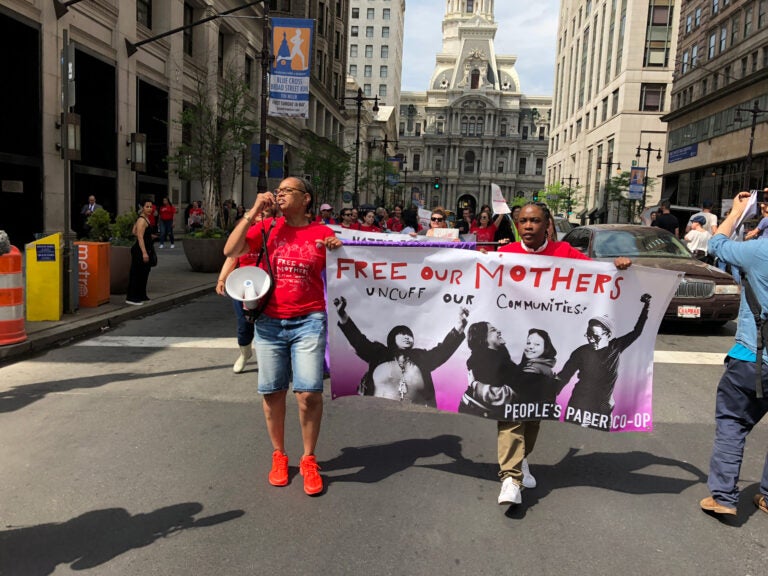
Latonya Myers (right) leads a protest march on South Broad Street to end cash bail | YVONNE LATTY/LOGAN CENTER
When LaTonya Myers was serving a six-month sentence at State Correctional Institution Muncy, she noticed the women alongside her received hardly any visitors, even if they had a lot of children.
“Nobody got a lot of visits,” Myers said. “The bus is just like $100 to get up there. It’s just too far.”
SCI Muncy is about three hours from Philadelphia, and Pennsylvania’s other women’s prison, State Correctional Institution Cambridge, is six hours away. There’s no easy way to get to either, Myers said.
Many of the incarcerated women are mothers, meaning the demanding role of childcare was left to their mothers and grandmothers, who oftentimes do not have the time or money to visit their incarcerated loved ones consistently. When older lifers became grandparents, there was even more sorrow, Myers said.
“‘I want to go home, I want to go home,’” Myers said the women would cry. “They’d be so happy trying to knit like blankets, doing whatever they can to still try to be in their kid’s life especially as grandmothers. It was hard for them.”
When Myers got out of prison in 2016, her goal was to help the women she left behind. She was a lead organizer at Philadelphia Community Bail Fund’s Mother’s Day Bail Out events.
“These are people’s mothers, daughters, sisters,” Myers said. “These are my friends and these are people that took care of me when I thought I had no one.”
Myers went on to launch an organization, Above All Odds, to help those on probation apply for early release like she successfully did.
Myers now advocates for a growing number of incarcerated women, a population that has greatly increased in the last half-century. Women continue to comprise a larger share of the pie in jails and prisons, and they face unique challenges in regards to their healthcare and relationships with people on the outside.
“These prisons weren’t designed for women,” Myers said. “It’s not a one-size-fits-all.”
Explore the charts below to learn more about women’s representation in the criminal justice system.
Women’s prison population explodes
In 2025, more than one million women in the United States were in jails, prisons, probation or parole, according to the Sentencing Project. While women still represent a minority of the incarcerated population, their involvement in the system has expanded at a pace that’s outstripped men.
Women’s incarceration has grown by more than 600% since 1980, increasing from just over 26,000 women to more than 186,000 in prisons and jails by 2023. They comprised nearly 8 percent of all federal and state prisoners in 2023, up from three percent in 1973.
In Pennsylvania, the women’s prison population steadily rose through the 2010s before it dropped off during the COVID-19 pandemic, though the population saw a modest uptick again in 2023, according to data from the Pennsylvania Department of Corrections. State prisons housed more than 37,000 men and nearly 2,200 women in 2024.
Men receive more visitors than women
A 2002 study in the Journal of Offender Rehabilitation found that while 79% of incarcerated women received at least one visit from a friend or family member, the most frequent visitors were friends, not family, and 61% mothers did not receive any visits from their children. Compared to men, more women in state prison – 62% – are parents, according to the Bureau of Justice Statistics.
Conversely, men’s prisons tend to receive mostly female visitors, who experience “secondary prisonization” through their emotional support of incarcerated loved ones.
“People talk about how the visiting rooms in women’s prisons are often empty,” said Rupalee Rashatwar, a staff attorney with the Abolitionist Law Center in Pennsylvania. “A lot of women are holding down men who are incarcerated, but they’re not necessarily getting that same level of care and attention.”
Racial disparities persist
Though racial disparities have shifted in recent years, they continue to define the makeup of incarcerated women in the U.S. Black women were incarcerated at 1.7 times the rate of white women, while Latina women were incarcerated at 1.2 times the rate in 2023, according to the Sentencing Project. The imprisonment rate for Black women has declined 67% since 2000, while the rate for white women has increased 21%.
WHYY is your source for fact-based, in-depth journalism and information. As a nonprofit organization, we rely on financial support from readers like you. Please give today.