

Secretary of state’s reluctance to speak publicly about Delaware’s unclaimed property program raises eyebrows
Delaware Secretary of State Charuni Patibanda-Sanchez asked to speak privately to give her views on the state’s unclaimed property program.
Listen 0:49
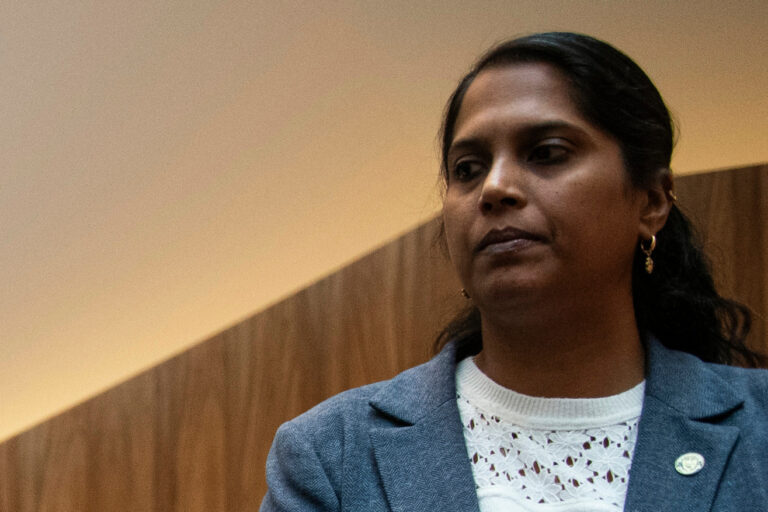
Delaware Secretary of State Charuni Patibanda-Sanchez speak with reporters alongside other Democratic secretaries of state during the National Associate of Secretaries of State Conference in Washington, Friday, Jan. 30, 2026. (AP Photo/Cliff Owen)
What are journalists missing from the state of Delaware? What would you most like WHYY News to cover? Let us know.
A member of Delaware Gov. Matt Meyer’s administration expressed reluctance to openly give her views on the state’s unclaimed property program at the first meeting of a legislative taskforce last week.
Open government advocates and those familiar with Delaware’s unclaimed property program said they’re concerned those in the industry might prefer fewer public conversations about the program because of all of the revenue going into the state coffers and its third-party vendors.
Secretary of state asks to exclude public from taskforce discussion
Delaware Secretary of State Charuni Patibanda-Sanchez’s request to go behind doors without citing a legal justification, has sparked fears that state lawmakers and members of Meyers’ administration will seek to weaponize the state’s open meetings law to secretly discuss how the state collects and uses its third-largest revenue source.
When asked about the legal justification for her request under Delaware’s Freedom of Information Act, a spokesperson for Patibanda-Sanchez said in an email that they had “no response.”
“You just can’t arbitrarily say, ‘I want to go into executive session,’” said John Flaherty, spokesperson for the Delaware Coalition for Open Government. “You have to cite exactly what section of the law triggers the executive session request. I think she needs to maybe bone up on the open meeting law.”
Senate Majority Leader Bryan Townsend, who co-chairs the task force, said previous administrations also tried to prevent public discussions of the program’s inner workings, such as during Gov. Jack Markell’s tenure, when a similar legislative taskforce met in 2014.
“I fondly recall in 2013 being approached in the hallway downstairs,” Townsend said. “One could even maybe say accosted by representatives of the office of the governor who thought that this should not be a topic that was looked at for a variety of reasons that one could very fairly say apply even now.”
Still, a spokesperson for Townsend, who is working on a bill to increase government transparency, said the task force could legally go behind closed doors to discuss pending or potential litigation. The law says that is only allowed when an open meeting would have an adverse effect on the litigation position of the public body.
Flaherty said Townsend needs to defend the public’s right to know if he is serious about revamping FOIA.
“That’s crazy,” Flaherty said. “Secrecy doesn’t solve anything. It just engenders a lot of suspicion.”
Related Content
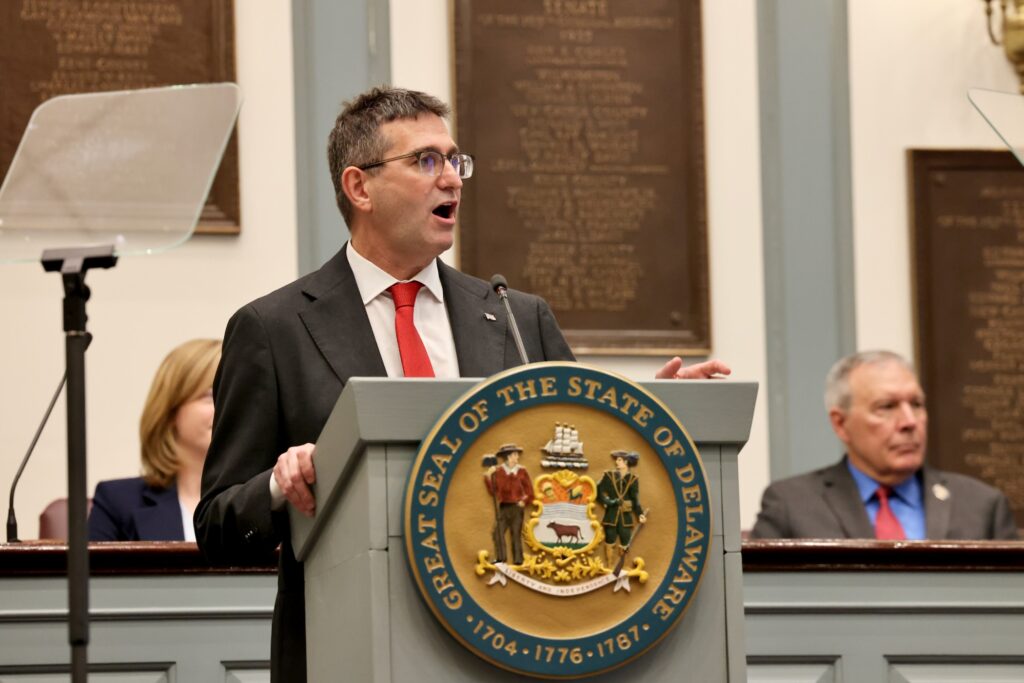
Delaware Gov. Matt Meyer’s executive order raises questions about whether members of other task forces could meet the standards.
3 months ago
Listen 0:50Unclaimed property’s reputation as a ‘piggy bank’
Delaware’s unclaimed property revenue has the reputation of being a “slush fund” or “piggy bank” because some of those dollars have been diverted for other uses, with the Meyer administration and previous governors using the money and declining to answer questions about it.
State lawmakers approved raising the amount of unclaimed property revenue that goes into the general fund from $554 million to $614 million for fiscal year 2027.
The official purpose of the state’s unclaimed property program is to reunite orphaned financial instruments from across the country with their owners. But because Delaware is the incorporation destination for millions of businesses, the First State takes in more than its share of unclaimed property, relative to size and population, and adds it to its general revenue fund.
Companies must turn over items, such as someone’s uncashed checks, old bank accounts and stocks and bonds after a certain time period. It can vary based on the type of property, ranging from three years to 15 years.
After the property is declared abandoned, the state transfers, or escheats, the money into the state’s general fund. Excess money goes into a pot reserved to satisfy what it defines as extraordinary claims. Amounts of money above what the secretary of the finance deems necessary to resolve those claims goes into another fund that is used for retired state employee benefits and can also be used for school construction projects.
Earlier this year, a spokesperson for the secretary of finance declined to give WHYY News the balance of the special budgetary fund or a legal basis for withholding that information.
It’s that surplus escheat fund that former Gov. John Carney tapped during his tenure and the Meyer administration used in fiscal year 2027 to fund the Edgemoor container terminal project at the Port of Wilmington. The fund is also part of the lawsuit against the state.
Related Content
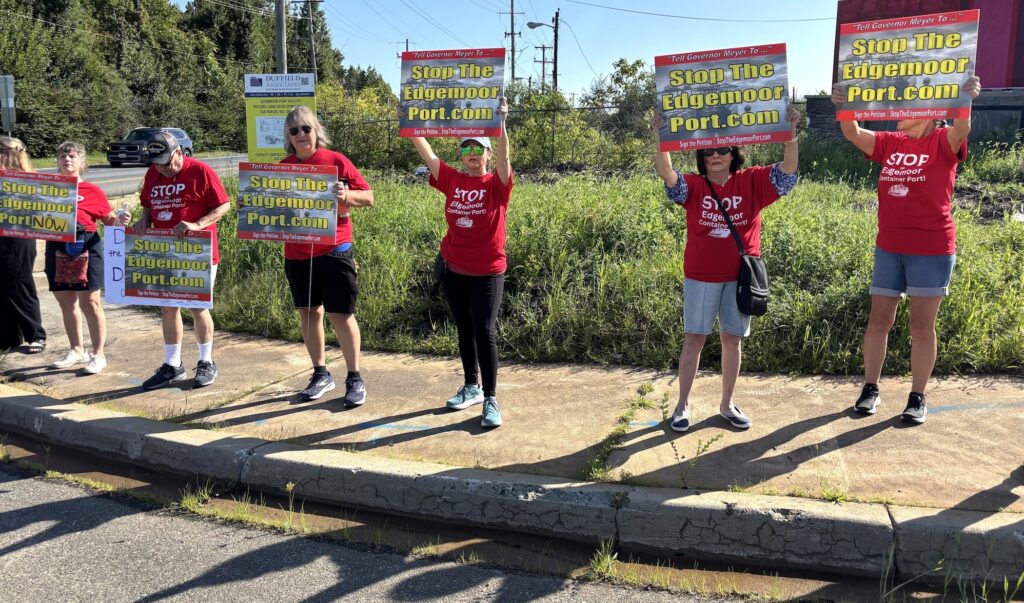
‘Slowly poisoned’: Neighbors protest controversial Delaware port project over health concerns
Neighbors living near the Edgemoor site say they’re concerned about truck exhaust, noise and harm to local wildlife.
2 months ago
Listen 0:49Vendors make millions off volunteer disclosure program, audits
The Delaware Department of State administers the unclaimed property Voluntary Disclosure Agreement Program, where companies are invited to self-report past-due abandoned or unclaimed property and resolve compliance issues without facing a formal audit.
According to the law firm Reed Smith LLP, companies receiving the “invitation” must confirm participation within 90 days or be referred to the Delaware Department of Finance for an unclaimed property audit.
“The Delaware Secretary of Finance is required to allow companies the opportunity to participate in the VDA program before commencing an audit,” Reed Smith attorneys Autumn Homza and Sara Lima wrote in May 2025. “So, the ‘invitation’ really is a warning and a threat. Participate in the secretary of state program or suffer the consequences.”
The VDA program uses third-party vendors who take in millions each year. Other state contractors do the audits.
According to the state checkbook, the three VDA vendors — Barnes & Thornburg, Faegre Drinker Biddle & Reath and KDAC — together earned about $17.2 million in fiscal year 2026.
The four audit companies combined invoiced about $40 million from the state finance department, with Kelmar Associates collecting nearly $20 million and Specialty Audit Services making about $18.2 million.
Michael Giovannini, a partner at Alston & Bird law firm, told WHYY News in June that the audit firms will estimate unclaimed property liability for companies incorporated in Delaware if they don’t have complete books and records going back typically 15 years.
“To the extent the company did not have financial records going back that far, which is fairly common, Delaware would estimate an unclaimed property liability for those older periods,” he said. “So that’s really pure revenue for the state.”
Related Content
Delaware recently implemented 2 land-use laws. Here’s what they mean for affordable housing
House Bill 450 and Senate Bill 23 both require Delaware counties and local governments to make changes in the way they approve developments.
1 month ago
Listen 1:02Lawsuit could decide constitutional issue regarding special escheat fund
The unclaimed property program has been the subject of multiple lawsuits over the years, including a current case where the plaintiff has accused Delaware of improperly seizing his securities and liquidating them. He received approximately $2.6 million after claiming the stock, which was roughly $11 million less than the property’s actual value. The judge denied Delaware’s motion to dismiss the case earlier this year.
Giovannini said the case raises the question of whether Delaware can take unclaimed stock and keep it without proper warning or fair payment.
According to court filings, Delaware is arguing it has immunity from being forced to pay damages from its general fund. But Giovannini said that if the money comes from the escheat special fund, immunity may not apply. Expedited discovery on that issue is ongoing.

Get daily updates from WHYY News!
WHYY is your source for fact-based, in-depth journalism and information. As a nonprofit organization, we rely on financial support from readers like you. Please give today.
Part of the series
Delaware House speaker keeps her gavel despite leadership challenge
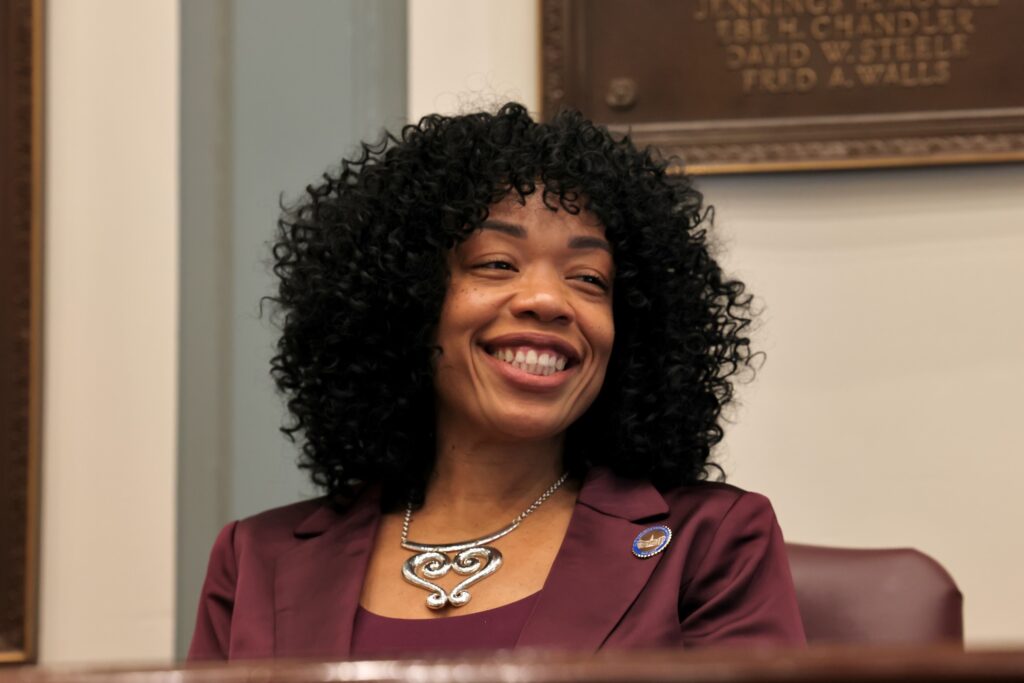
House Speaker Melissa Minor-Brown is the first Black woman and the second woman to serve in the role.
1 week ago
Listen 0:36
Dr. Michael Katz said Delawareans needed to take back the Democratically held U.S. Senate seat from an entrenched political establishment.
3 weeks ago
Listen 0:49
The Delaware Attorney General’s Office said its FOIA opinions are non-binding and it lacks the resources to enforce violations.
3 weeks ago
Listen 0:58