

Historically red Sussex County, Delaware, votes Democratic for first time since 2012
Sussex County has long been considered Delaware’s conservative stronghold, but the 2026 midterm election shows a strong shift, especially amid a growing population.
Listen 1:08
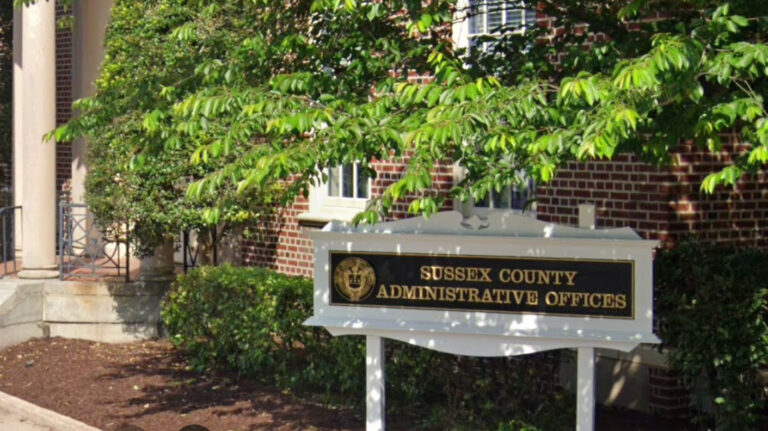
File - The Sussex County administrative building in Georgetown, Del. (Google Maps)
Races for several federal and statewide elections were called quickly during this week’s midterm elections. The major races yielded wins for Democrats in an unsurprising turn, maintaining the party’s control of the state. However, in an unexpected upset, conservative stronghold Sussex County found common ground with its northern neighbors in voting blue.
U.S. Sen. Chris Coons was easily reelected to his seat Tuesday night, and secured nearly 51% of Sussex County’s votes, according to the Associated Press. That was also the case for U.S. Rep. Sarah McBride, who received about 53% of the county’s votes, and Attorney General Kathy Jennings, who took home about 52% of the county’s votes.
State Treasurer-elect Ted Lauzen also won his race by a slim margin in the county, receiving about 51% of votes in Sussex, according to the state’s Department of Elections.
“When I ran for Congress, I made two fundamental promises: that I would work with anyone who would work with me to deliver for Delaware and that I would stand up to anyone I believed was hurting Delaware,” McBride said in a released statement. “After two years of showing up in our communities, defending all of our neighbors, and getting results, I am honored that Delawareans have once again placed their trust in me to continue serving them in Congress.”
Evelyn Brady, chair for the Delaware Democratic Party, said she was “thrilled” to see the election outcome in Sussex County.
“While we were confident [statewide candidates] would win their races, Sussex has over the past several cycles not been in [Democrats’] favor,” she told WHYY News. “But to see them win all of [the counties] is just absolutely amazing.”
A hard left turn
Despite Delaware’s status as a blue state, its southernmost county frequently has diverged right.
The last time Sussex County voted in favor of any Democrat for a statewide or federal position was in 2012. The county voted majorly for the former U.S. Sen. Tom Carper, former U.S. Rep. John Carney and former Gov. Jack Markell.
Since then, Republicans have had a lock on the county. In the 2024 election, President Donald Trump received about 55% of Sussex County’s vote compared with the statewide total of about 42% of votes. Sussex County also voted for him in the 2016 and 2020 election cycle.
McBride was first elected to the U.S. House of Representatives in 2024 and lost Sussex County to her Republican opponent John Whalen.
Coons was first elected in 2010, but only secured about 40% of Sussex County votes at the time. He had never won the county before Tuesday’s election, marking a shift for him, as well.
In her past campaigns, Jennings also lost in Sussex County, but won statewide. That includes her 2022 race, in which Jennings was elected to her second term with only 41% of the Sussex vote.
According to Brady, Sussex County was part of a larger national “blue wave.”
“I think with the Trump administration, and as we’ve seen around the country, Democrats are winning in places that before this cycle no one thought that they could,” Brady said. “I think Sussex is just showing that Delaware is a microcosm of the country.”
Related Content
Follow along for live special coverage of the 2026 general election, with reporting on the ground from Pennsylvania, New Jersey and Delaware.
2 weeks ago
A growing Sussex bringing a call for change?
The county is considered a hot spot for growth in Delaware and the nation. According to data from the U.S. Census Bureau, Sussex County’s population has increased by nearly 17% from 2020 to 2025.
That’s true for registered voters in the county, as well. The number of registered voters increased from about 182,500 in 2020 to about 220,300 this month.
With that growth also came shifts in party registrations. About 40% of Sussex County voters were registered as Republicans in 2020, and that percentage dropped to about 35% this year. It is, however, also true for Democrats. In 2020, 36% of Sussex County voters were registered as Democrats, with that percentage dropping to 31%.
Voters with no party affiliation, on the other hand, have increased in the county. Only about 21% of voters were registered with no party affiliation in 2020, compared to 30% of voters in 2026.
Brady could not specifically speak to how the county has grown between the last two elections, but said that the state’s Democratic Party is spending time in Sussex County because with its population growing, that’ll constitute some “growing pains.”
“It’s growing so fast and we knew that there are opportunities in Sussex, and we as the state party wanted to be there to engage, expand, get to meet these new Delawareans who are coming into Delaware, and make sure that they feel a part of the party,” Brady said.
Brady also said that the state party wants to make sure that they invest in the entire state, and that Sussex County’s needs are met.
Related Content

Election 2026: Here’s who won and who lost in Delaware
Democrats maintained their dominance in Delaware’s statewide races.
2 weeks ago
Some local elections flip, some stay the same
In the Sussex County Council race, voters in District 5 flipped a seat, electing Democrat Jill Hicks. She defeated incumbent John Rieley by less than 600 votes. The district encompasses areas of Georgetown, Lewes, Millsboro, Milton and Harbeson.
Sussex County Council President Doug Hudson, a Republican, kept his District 4 seat. He defeated challenger Justine Cuccia by nearly 11 percentage points. That seat also represents parts of Millsboro, as well as Frankford, Selbyville, Dagsboro, Fenwick Island, Bethany Beach and South Bethany. Looking ahead, the county council will move from a 4-1 Republican majority to a 3-2 majority.
One seat in Delaware’s House of Representatives in Sussex County was flipped, with voters electing Democrat Gregg Lindner to the District 4 seat. District 20 incumbent state Rep. Alonna Berry was able to hold on to her seat in Milton with 56% of the vote.
Meanwhile, Republicans won in some competitive races, including John Atkins in District 41. Several Republicans in Sussex County also ran without a challenger.
With some local successes, Brady said she would like to get involved more in local elections moving forward, and see how the Democratic Party can “bring some of this excitement at the top of a ticket down to the local races.”
“I am proud of the successes we had locally with the one house seat and the one county seat, but I think that there’s still opportunity to have some more success in Sussex,” she said.

Get daily updates from WHYY News!
WHYY is your source for fact-based, in-depth journalism and information. As a nonprofit organization, we rely on financial support from readers like you. Please give today.
Delaware House speaker keeps her gavel despite leadership challenge
House Speaker Melissa Minor-Brown is the first Black woman and the second woman to serve in the role.
1 week ago
Listen 0:36
Dr. Michael Katz said Delawareans needed to take back the Democratically held U.S. Senate seat from an entrenched political establishment.
3 weeks ago
Listen 0:49
Delaware Working Family Party candidates defeated five incumbent state lawmakers, four in the House and one in the Senate.
1 month ago
Listen 0:50