

Sunoco pipeline leak similar to Upper Makefield spill prompts federal directive
The order comes after Energy Transfer identified a 600-gallon crude oil pipeline leak in Michigan similar to the one discovered in Bucks County last year.
Listen 0:57
File: A Sunoco sign is visible outside a gas station, Feb. 27, 2023. (AP Photo/Charles Krupa, file)
From Delco to Chesco and Montco to Bucks, what about life in Philly’s suburbs do you want WHYY News to cover? Let us know!
A federal regulatory agency has concluded that Energy Transfer’s pipelines have a “system-wide risk” of leaks similar to the one discovered last year in its Twin Oaks pipeline in Upper Makefield Township, Bucks County, that contaminated drinking water sources with jet fuel.
As a result, the agency has ordered the firm to inspect and, if necessary, repair its pipelines.
The Pipeline and Hazardous Materials Safety Administration, which oversees the transportation of hazardous materials across state lines, issued the corrective action order to Energy Transfer, parent company of Sunoco LP, in September after the company identified a 600-gallon crude oil pipeline leak in Macomb County, Michigan.
Energy Transfer did not respond to a request for comment.
PHMSA described the circumstances surrounding the Michigan leak as “similar” to those of the Twin Oaks pipeline failure in Upper Makefield that, per the agency’s preliminary investigation, continued undetected for 16 months, spilling what the company has estimated as more than 6,000 gallons of jet fuel.
Both leaks originated at a failed repair sleeve, the agency said.
The company could not locate repair records for the sleeves responsible for the two leaks, or those of hundreds of other sleeves installed in its pipeline systems, the agency said. Such documents “contain information that is necessary to verify the proper installation and ongoing integrity of repair sleeves,” officials wrote.
The agency found that a faulty Type-A sleeve repair was responsible for the Upper Makefield leak and ordered Sunoco LP in May 2025 to inspect and verify the integrity of all Type-A sleeve repairs along the length of the 105-mile Twin Oaks pipeline.
In June 2026, the agency issued a safety advisory for Type-A sleeve repairs for all hazardous liquid pipeline operators. Officials found that the repair responsible for the Michigan leak was a Type-B sleeve repair, which is similar to a Type-A repair with some structural differences.
The agency said the similarities in the sleeves that led to both leaks as well as the company’s “apparent inability” to detect them “[indicate] a system-wide risk of additional similar failures.”
“PHMSA finds a high likelihood that the same conditions underlying the MTC and Twin Oaks pipeline failures remain present in Energy Transfer’s other hazardous liquid pipeline systems and that those conditions could result in additional failures,” the agency said in the order.
Related Content
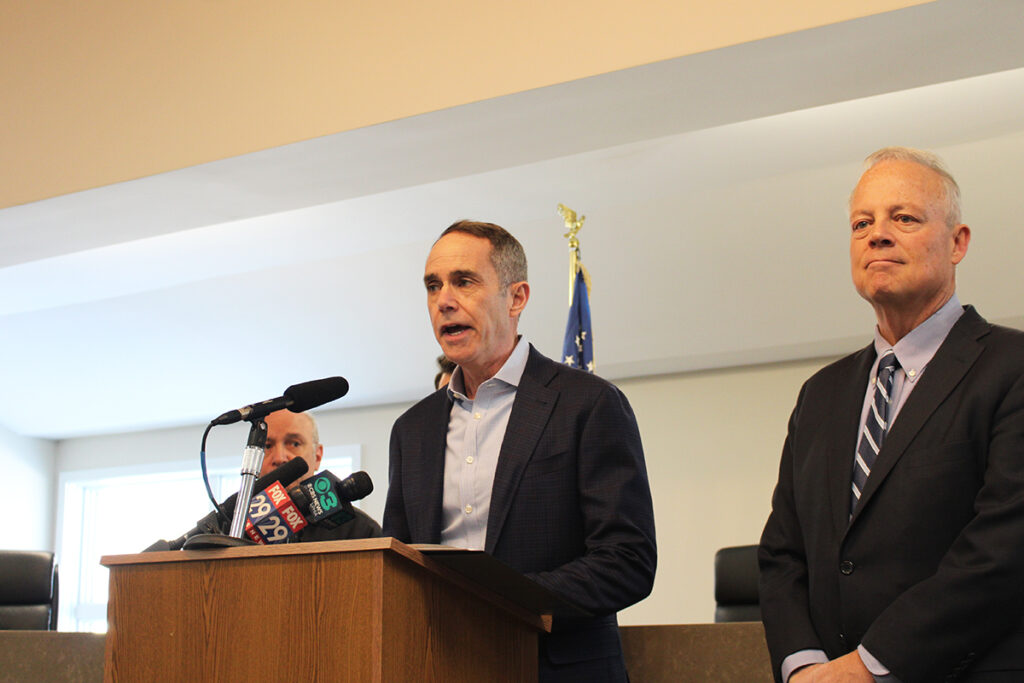
Pennsylvania lawmakers push for new clean up law, a year after Upper Makefield pipeline leak
The legislation comes as Mt. Eyre residents continue to grapple with the Sunoco pipeline leak that contaminated six wells with jet fuel.
9 months ago
Listen 1:13The order requires a pressure restriction and a repair sleeve inventory, in addition to several other measures, to evaluate the integrity of the impacted pipelines and all other hazardous liquid pipelines owned and operated by Energy Transfer and its subsidiaries.
Without those measures, agency officials wrote that Energy Transfer’s pipeline network “is or would be hazardous to life, property, or the environment.”
The investigations into the Michigan and Upper Makefield pipeline leaks remain ongoing.
U.S. Rep. Brian Fitzpatrick, R-Bucks County, worked with impacted community members in Upper Makefield’s Mt. Eyre neighborhood to introduce legislation to strengthen pipeline safety. He said in a statement to WHYY News that the agency’s latest findings “underscore precisely why these reforms cannot wait.”
“Halfway across the country, another Energy Transfer pipeline has suffered strikingly similar failures in repairs, safety records, and leak detection,” Fitzpatrick said. “With questions surrounding countless additional repairs, these findings raise serious concerns about systemic vulnerabilities that could threaten communities nationwide. We cannot continue addressing these failures only after the damage is done.”
The Twin Oaks pipeline is currently operating with a 20% pressure reduction, per the order.
Over the summer, residents expressed complaints that the company’s clean-up is not moving quickly enough and is disrupting everyday life in the once bucolic neighborhood.
Upper Makefield community members and local elected officials have also called for the pipeline to be shut down while federal regulators continue the investigation into the leak.

Get daily updates from WHYY News!
WHYY is your source for fact-based, in-depth journalism and information. As a nonprofit organization, we rely on financial support from readers like you. Please give today.

U.S. Rep. Brian Fitzpatrick sues to remove Bucks County commissioner from Board of Elections
The county says there is no basis in election code for Bucks County Commissioner Diane Ellis-Marseglia’s removal from the board.
1 week ago
Listen 1:14
The West Chester resident was previously a senior U.S. diplomat in Mozambique.
5 months ago
Listen 0:42
New laws will take effect in Pa. in 2026. Here’s what you need to know
A hair discrimination ban, supplemental breast cancer screenings and park ranger body cameras are among the changes that will take place.
11 months ago