

‘Burn in hell’: Fired scientist’s death threats against AstraZeneca, Aetna officials land him in prison, but diatribes continue
Justin Dynlacht thought his employer and health insurer didn’t provide adequate coverage for Crohn’s disease, but took his complaints way too far.
Listen 1:52
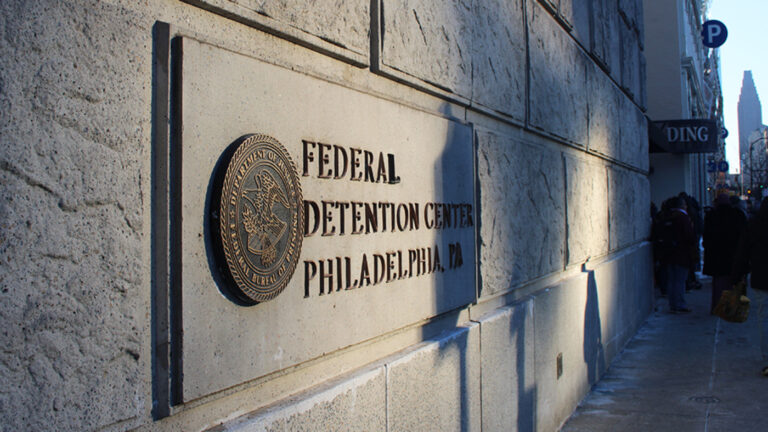
File - The Federal Detention Center in Philadelphia, where Justin Dynlacht is being held (Emily Neil/WHYY)
What are journalists missing from the state of Delaware? What would you most like WHYY News to cover? Let us know.
A woman in Delaware who worked for health insurer Aetna must have been horrified when she read the email sent to her in April 2024.
“Hopefully, you and the Aetna middle and senior management are executed for your crimes,’’ wrote the man who identified himself as Irving Schwinner. The message also included graphic language that said the woman should be raped and tortured before she was killed.
The sender’s name wasn’t Irving Schwinner, though.
He was Justin Dynlacht, a scientist who had been fired more than a year earlier by pharmaceutical giant AstraZeneca.
Dynlacht, who claimed Aetna and his former employer wrongfully denied him coverage for treatment of Crohn’s disease, had been sending similarly graphic and vulgar messages, texts and letters to executives and employees of both companies for 18 months.
In his maniacal, relentless rants, Dynlacht told some two dozen people they should be victims of unspeakable violence: getting hacked up with machetes, killed in a fiery plane crash, burned with explosives, shot to death, strangled, even beheaded.
Once they were dead, Dynlacht wrote in one letter, he hoped they would “burn in hell, you greedy, corrupt f***ing thieves.”
Dynlacht’s complaints against AstraZeneca and Aetna — albeit without the savage, bloody rhetoric — was included in an April 2024 article in The New York Times about the cost to patients of out-of-network health care claims.
“I’m being ripped off,’’ he told the newspaper. “It’s not right.”
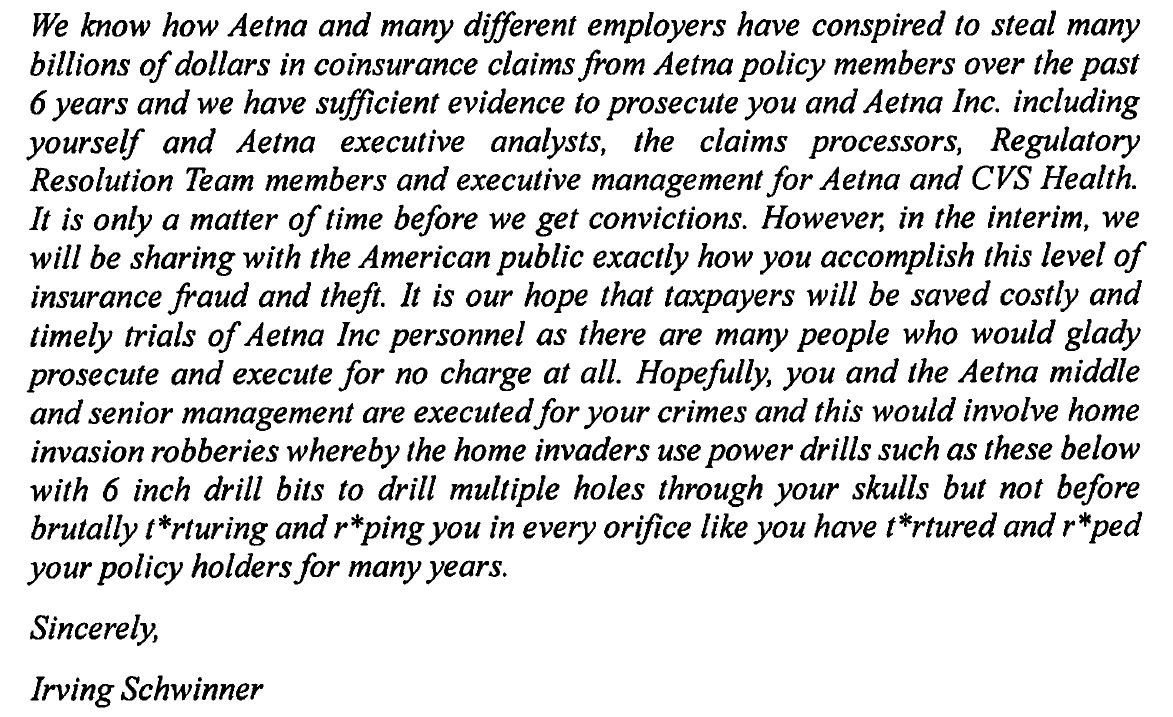
That was the same month Dynlacht told the Delaware woman by email that she should be murdered by a power drill.
Days later, on May 8, 2024, FBI agents raided Dynlacht’s apartment in Rockville, Maryland. Agents said they found another similar letter he hadn’t mailed and other evidence, and arrested him for cyberstalking.
His criminal complaint and later indictment include passages from several letters that WHYY News has reviewed along with hundreds of pages of court documents.
Dynlacht later pleaded guilty and was sentenced last week to 46 months in federal prison, but didn’t stop disputing the allegations against him and has continued his single-minded diatribes.
Since admitting his crimes in March 2025, Dynlacht has tried unsuccessfully to renege on his plea, fired his lawyers, and sought — without success — to remove the federal judge handling the case.
He’s currently suing AstraZeneca and Aetna, and has a separate case against the federal government, alleging improper medical care at the Federal Detention Center in Philadelphia.
That’s where Dynacht has been held since his May 2024 arrest. He’ll be free sometime in 2028.
Now 57, Dynlacht has attempted in court papers and appearances to minimize his vicious messages as justifiable but “extreme hyperbole,” considering his health insurance dispute. He also insisted he never intended to harm anyone and that any threats he made were not “credible.”
Assistant U.S. Attorney Carly Hudson countered that Dynlacht’s crimes terrorized his victims and that such actions cannot be tolerated in society.
Hudson noted that Luigi Mangione, whose journal documents his frustration with the health insurance industry, allegedly shot UnitedHealthCare CEO Brian Thompson to death in Manhattan in December 2024 while Dynlacht’s case was moving through U.S. District Court in Wilmington.
“This is a person who just wantonly disregarded the humanity of other people. He worked himself up over a perceived injustice against himself, and could look only inward at his own perception that he was a victim,” Hudson said of Dynlacht.
“He then lashed out against every single person he could find over the course of over a year, threatening to invade the very most personal aspects of their lives and their bodies and their families.’’
Hudson, who heads the criminal division of the U.S. Attorney’s Office in Delaware, said Dynlacht struck deep fear in about two dozen AstraZeneca and Aetna officials in several states.
One woman has a son who began sleeping with a baseball bat. Others changed the locks at their homes or moved. Some quit their jobs.
AstraZeneca and Aetna would not comment for this article.
Related Content
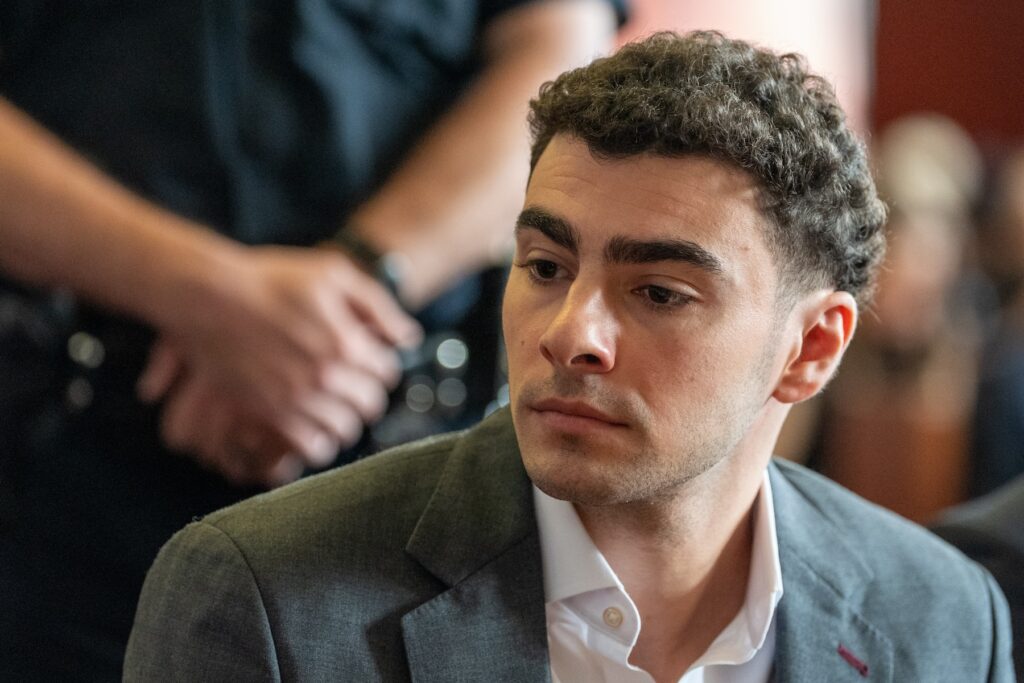
Luigi Mangione pleads guilty to federal stalking charges in the killing of UnitedHealthcare CEO
Mangione admitted to following UnitedHealthcare CEO Brian Thompson to an investor conference in 2024 and shooting him on a New York City street.
3 months ago
‘Its executives are all criminals who I sincerely hope burn in hell’
Dynlacht, who has a bachelor’s degree in biological sciences, worked as a quality assurance specialist at AstraZeneca’s research and development facility in Gaithersburg, Maryland.
The Gaithersburg campus is one of the pharmaceutical company’s three main U.S. hubs, including Boston and the suburbs near Wilmington.

In his lawsuit against the company and Aetna, Dynlacht said he’d spent 30 years in the pharmaceutical industry. He alleged his career began to unravel in 2022 amid a dispute about coverage by Aetna for Crohn’s disease, which he has suffered from since 1995. AstraZeneca contracted with Aetna to provide insurance for its employees.
Dynlacht claimed that Aetna denied him coverage for an unspecified medical procedure because it was performed “out of network” — a designation that costs patients substantially more in out-of-pocket expenses. He complained and appealed the decision, to no avail.
In his lawsuit against his former employer and its health insurer, Dynlacht claimed the decision cost him “tens of thousands of dollars” and fueled his campaign for what he called justice.
The first letter, sent in November 2022 to Daniel Finke, then Aetna’s president, was profane but could be considered tepid compared to his later rants.
Dynlacht called his doctors “f***ing quacks” and told Finke he wished he never “met you and the greedy and corrupt g*oddamn assholes” who run Aetna.
But Dynlacht was only getting started.
The next month, he sent Finke another letter. He mentioned two employees, including the Delaware woman, who was a senior benefit specialist, calling them “two of the greediest, most corrupt and useless people that I have ever interacted with. Honestly, I find useless idiots like [them] in my bowel movements.”
Also in December 2022, he yelled expletives at an Aetna employee during a recorded phone call, court records show.
Dynlacht ratcheted up his verbal venom in January 2023, sending an email to four people, including the Delaware woman and the CEO of Aetna’s parent company.
In a profanity-laced screed, he called Aetna “absolutely the worst health insurance company in the U.S. and its executives are all criminals who I sincerely hope burn in f***ing hell.”
Aetna informed AstraZeneca about what Dynlacht had done. So he was summoned to a meeting on Jan. 18, 2023, to answer allegations that he had violated the company’s ethics and conduct rules with his “offensive, unprofessional, and vulgar language,” AstraZeneca officials told prosecutors.
Dynlacht was not apologetic. Instead, he told them he was justified in “having to write strongly worded messages,’’ court documents state, because he was frustrated by how Aetna was treating him.
Five days later, AstraZeneca fired him.
Related Content
A man working for the contractor Greggo & Ferrara alleged he was called the N-word and “boy” by a white co-worker.
1 month ago
Listen 1:11‘May you suffer greatly and be savagely tortured’
Dynlacht’s firing sent him into a frenzy.
Over the next 13 months he bombarded a total of 20 officials at AstraZeneca and Aetna with letters, emails and faxes that had a singular theme: their torture and murder.
Though he used different names in his communications, all utilized the internet protocol address affiliated with his apartment in Maryland, court records state.
His April 17, 2023 fax to the Delaware woman was sent using the name Syed Hussein, who claimed to be from Saudi Arabia. He continued to send multiple messages with graphic descriptions of attacks he wished on the recipients.
In November, he targeted an AstraZeneca lawyer, signing the letter in the name of a quality assurance division colleague.
Again wishing the woman a gruesome death, Dynlacht wrote that he hoped her children “suffer greatly when they become motherless.”
In one letter sent to two Aetna analysts in March 2024, he called them “dishonest pieces of human excrement” and other vile, profane names. He also accused them and their colleagues of stealing “billions of dollars of coinsurance benefits” from patients with the help of the government.
Hudson said one man had a letter mailed to his home, showing that Dynlacht knew how to find him.
“It is clear that he did his research, that he intended to be threatening in deeply personal ways,” Hudson said. “It’s also clear from these messages that he fashioned them in a way to make all of these recipients feel unsafe in the everyday moments of their lives.”
Related Content
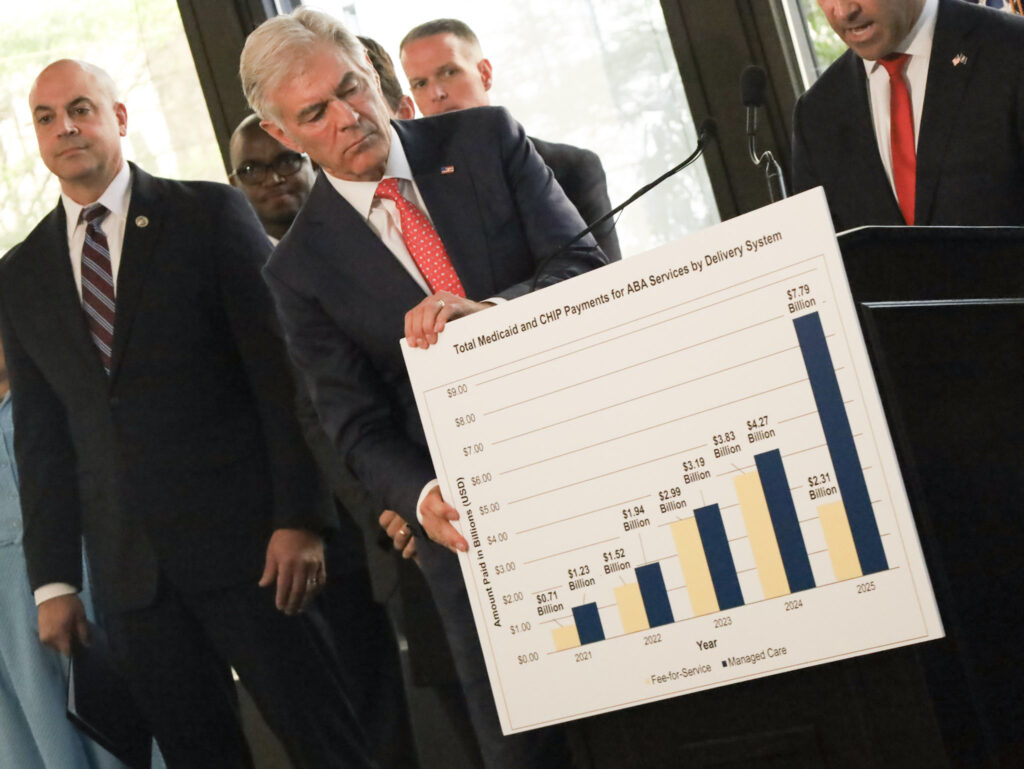
Federal agencies and state partners announced criminal charges against 19 people who allegedly defrauded Medicaid with home health schemes.
3 months ago
Listen 1:18‘I was basically giving them a taste of their own medicine’
Dynlacht’s threats, while merely words, constituted the textbook definition of the crime of cyberstalking, Hudson said.
Under federal law, cyberstalking occurs when someone uses the mail or any electronic means of communication to engage in conduct that puts the recipient in “reasonable fear” of death or serious injury or could be “reasonably expected” to cause them serious emotional distress.
While Dynlacht was only charged with cyberstalking the woman in Delaware, Hudson said he also threatened AstraZeneca or Aetna officials who live in South Carolina, Massachusetts, Maryland, Georgia, Ohio, Texas, Florida, Pennsylvania, Indiana and New York.
“These messages were graphic enough that I think it is entirely reasonable that the victims were afraid that he would cross state lines up and down the Eastern Seaboard to find and invade every single one of their homes,” Hudson said.
No charges have been brought in those jurisdictions.
After his arrest for what he wrote to the Delaware woman, a federal magistrate ordered Dynlacht detained pending trial.
But after 10 months, a period during which he fired his public defenders and had a private attorney appointed to represent him, Dynlacht pleaded guilty in March 2025.
During the hearing, Dynlacht told U.S. District Judge Richard Andrews he suffered from anxiety, insomnia and depression as well as Crohn’s disease, but was mentally stable and ready to admit his crime.
Yet the defendant still took pains to disparage his former employer and health insurer when Andrews asked if he made the threats because he was angry.
“Very angry and also undergoing mental health breakdown because of the situation that occurred,” Dynlacht replied. “I wanted to influence their behavior to discontinue defrauding policy holders of Aetna insurance because they put me basically through hell by denying coverage and reimbursements for me with serious life-threatening conditions.”
He acknowledged he wanted to frighten and “harass” the recipients by threatening them.
“I was basically giving them a taste of their own medicine and showing how horrific and evil people could be to them as they are to us, the policy holders and patients,’’ Dynlacht said.
Three months later, though, Dynlacht sought to withdraw his guilty plea, claiming he did so “under coercion due to horrible conditions in the Federal Detention Center.”
The motion filed by defense attorney Kenneth C. Edelin, Jr. said the plea “was not the product of free will, but rather the result of coercive influences that overwhelmed his capacity to make a knowing, intelligent, and voluntary waiver of his rights.”
Edelin and other attorneys who represented Dynlacht in the cyberstalking case would not comment on their former client.
Andrews rejected the motion, noting in his ruling that Dynlacht did not mention “coercion” or “horrible” prison conditions when he pleaded guilty, and nothing in the record suggested his plea was not “knowing and voluntary.”
Dynlacht’s dissatisfaction with his medical treatment at the Philadelphia detention center led him to sue the facility itself in September 2025, however.
The complaint totals 37 pages of typed and handwritten allegations.
“FDC Philadelphia was once just a federal detention center in the United States but has since evolved into a cross between an insane asylum, a Nazi concentration camp and a Stephen King horror movie,’’ wrote Dynlacht, who is representing himself.
A judge dismissed the case but Dynlacht is appealing.
Hudson expects the admitted cyberstalker to appeal his prison sentence as well. She had sought the maximum five years behind bars for Dynlacht, but noted that he will be on supervised release for three years after his 2028 release and his internet access will be limited.
“The danger that a person like that poses not only in Delaware, but in many different states across the country, by virtue of the internet, cannot be overstated,’’ Hudson said.

Get daily updates from WHYY News!
WHYY is your source for fact-based, in-depth journalism and information. As a nonprofit organization, we rely on financial support from readers like you. Please give today.

Delaware AG charges teens with attempted murder after Newark mass shooting on Halloween
The two suspects are charged with multiple offenses, including seven counts of attempted murder in the first degree.
3 days ago
Listen 0:52
Police and prosecutors can’t provide the public with identifying info unless the charge is a felony and it’s “necessary to protect the public’s safety.”
2 weeks ago
Listen 2:15
New Castle County Recorder of Deeds Mike Kozikowski lost the race to David Tackett, who filed a complaint with prosecutors about the gambit.
3 weeks ago
Listen 1:24