

Philly teens advocate for universal free student SEPTA passes
As City Council weighs an expansion of the student SEPTA program, issues around trust of teens have emerged.
Listen 1:04
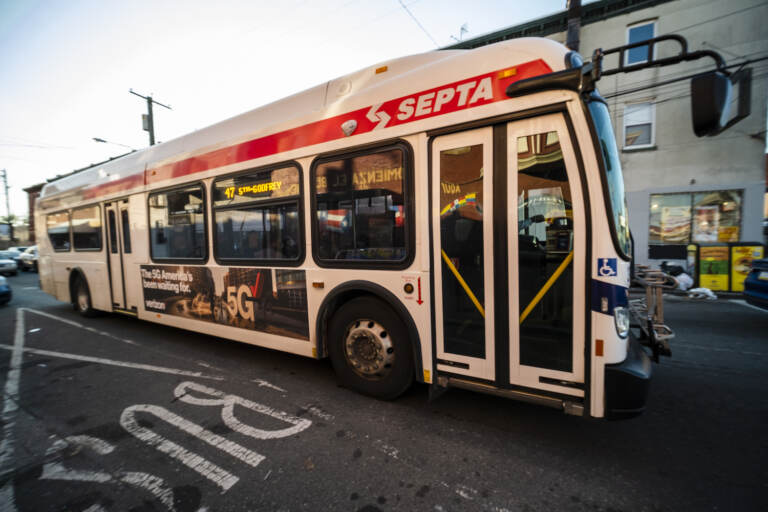
File photo: A SEPTA bus travels down a street in Philadelphia. (Bernardo Morillo for WHYY)
From Philly and the Pa. suburbs to South Jersey and Delaware, what would you like WHYY News to cover? Let us know!
Ciera Drayton, 14, just started high school but already knows the stress of daily commuting. She lives in South Philadelphia but attends Mercy Career and Technical School on the north side. She wakes up at 5 a.m. every day and uses her student SEPTA pass to take two buses, the 47 and 60, to arrive at school around 7:30 a.m.
Her commute can be crowded and chaotic, and paying for public transit is yet another challenge. Her mother had a baby just as the school year began, and finances are tighter than ever, she said.
But free SEPTA rides are limited depending on the day, time and number of rides — limitations that she said are unrealistic to teenagers’ lives.
“I feel like we don’t stop being kids after 8 p.m. We don’t stop being students after Friday,” Ciera said.
That’s why she and other youth, along with adult community leaders, are advocating for an expansion of free student SEPTA passes, removing limitations that have been in place since 2001 to create around-the-clock free rides for all Philadelphia students.
Currently, the student cards, distributed by the School District of Philadelphia, only work when school is in session, meaning no free rides on weekends, holidays or during summer vacation. Students are limited to eight rides per day between 5:30 a.m. and 8 p.m.
Furthermore, only students who live more than 1 1/2 miles from their school are eligible for passes, which excludes more than 30,000 young people, according to Councilmember Rue Landau, who proposed a resolution to examine an expansion.
At an Oct. 6 hearing of City Council’s Committee on Transportation and Public Utilities, Landau said her son used SEPTA constantly throughout his high school years. She said the city and SEPTA impose too many restrictions on student passes, which is especially burdensome for working and low-income families and limits young people’s opportunities around the city.
“Today’s hearing isn’t about getting kids to and from school. This is about Philadelphia being their school,” Landau said. “This is about their education not as teenagers, but as people.”
She said transit is critical to young people’s access to jobs, socialization, culture and civic life — but adults must give them easy access.
“SEPTA is their key to the city, and due to restrictions on student passes, we are holding that key at arm’s length,” Landau said.
Related Content
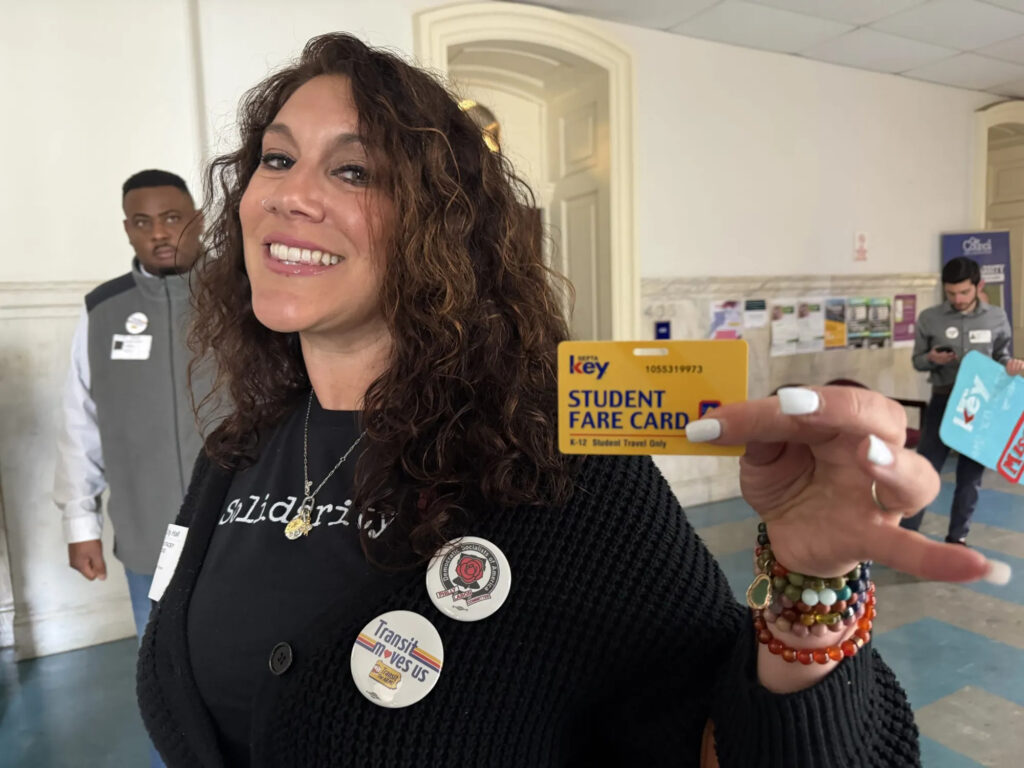
Philly should fund year-round SEPTA passes for all students, Councilmember Rue Landau says
The cards would work over weekends and summers, even for students who live near their schools.
7 months ago
Teen behavior concerns
Drayton said she often attends evening and weekend community events at her school, usually covering fares out of pocket. That’s where she met Rebecca Fabiano, executive director of Fab Youth Philly, a nonprofit that creates job pipelines for teens.
Many public places, such as malls and parks, send a message — either subtly or explicitly — that teenagers aren’t welcome, Fabiano told WHYY News.
“Teens are constantly telling us they need places to go,” she said.
Fabiano said she supports free SEPTA rides for youth under 18 and perhaps up to 21. She said investing in access would help young people live more affordably, contribute to the economy, build relationships with city institutions and become lifelong SEPTA riders.
However, some lawmakers have said safety concerns should be at the forefront of any discussion of expansion.
Though SEPTA has reported declines in serious crime, some incidents of teens being victims and perpetrators of violence on SEPTA have made headlines.
For instance, 18-year-old Zayki Davis was recently sentenced to up to 40 years in prison for fatally shooting then-15-year-old Zahkir Whitfield on a SEPTA bus in West Philadelphia in 2025. Davis was 17 at the time of the shooting. And in June 2025, 18-year-old Quadir Humphrey was sentenced for shooting into the crowd at the 15th Street SEPTA station, killing a 16-year-old bystander.
At the committee hearing, Councilmember Curtis Jones Jr. also expressed concern about hundreds of teens converging on City Hall Plaza to fight and cause chaos, resulting in police citations and arrests.
Jones said while he backs the expansion’s goals, there should be a process to pause or revoke student passes in cases of misbehavior.
Most are using transit responsibly, but “for those who are doing the wrong thing, we need to have some checks and balances involved,” he said.
To Fabiano, this message was yet another example of young people being unfairly mistrusted.
Concerns about youth causing mayhem on SEPTA represent “a very antiquated, 1980s ‘scared straight’” mindset, she said.
Related Content
SEPTA unveils wishlist for improvements and upgrades, but no sign of funding to make it happen
SEPTA’s blueprint for “best-in-class” service includes new vehicles and shorter wait times, but it all hinges on consistent funding, which doesn’t exist yet.
2 months ago
Listen 1:16‘Money that we don’t really have’
Cost is yet another issue in weighing an expansion. At the hearing, Philadelphia Superintendent Tony Watlington emphasized the need for consistent funding.
“The district certainly understands that adolescents thrive with increased autonomy and independence,” he said. “At the same time, we want to be candid about the scale of the investment.”
The school district pays SEPTA upfront for student passes and is reimbursed only for tapped rides, Watlington said. If students don’t tap, there’s no reimbursement — and skipping taps is already a problem among existing users, he said.
Watlington cited a preliminary projection of $64 million to expand SEPTA student passes to the full calendar year and to start eligibility at fifth grade, rather than the current seventh.
The district cannot absorb the cost alone, but given a consistent funding source, “we would be eager to be a partner in making this vision a reality,” he said.
For teens like Drayton, change can’t come soon enough. Far too often, she’s had to ask her mom for transportation money — “money that we don’t really have,” she said.
Drayton said she’s participated in a summer program for the past three years. Though it was a paid opportunity, all the transit fares came out of pocket. One time, returning home late from a weekend poetry slam, she said she and her cousin had to use three different payment cards to cover the fares.
At the same time, Drayton said she’d like to see young people behaving more respectfully on public transit, especially around elderly riders and small children.
Some teens’ rowdiness on SEPTA is “honestly insane,” which reflects poorly on all of them, she said.
“As a teenager, I kind of see why we get kicked out of places for being a teenager,” Drayton said. “People just feel like one bad apple spoils the bunch, and that’s not really what it is.”
She said the majority of students always pay their fare, act respectfully and simply rely on SEPTA to get to where they need to be. Those who do should have universal free access — but perhaps those who don’t should not, Drayton said.
“I feel like these teenagers should start just being responsible, because nothing in life is free. Not even public transportation,” she said.

Get daily updates from WHYY News!
WHYY is your source for fact-based, in-depth journalism and information. As a nonprofit organization, we rely on financial support from readers like you. Please give today.
Part of the series
Philadelphia teachers union releases plan to save 17 schools
The Philadelphia Federation of Teachers is calling on Mayor Cherelle Parker to intervene to stop the closures and begin overdue maintenance.
1 day ago
Listen 0:57
Drexel University halts all student events involving alcohol following fraternity suspensions
This comes after Pi Kappa Phi and Lambda Chi Alpha fraternities were placed under interim suspension earlier this week for hazing allegations.
1 week ago
Students push back against ‘pause’ of Drexel University’s elementary education major
The university enrolled only seven full-time students this fall, but students and alums say all pathways into teaching must be preserved.
2 weeks ago
Listen 0:59