

Philly’s fight against home appraisal bias starts with getting more residents to join the ranks
The majority of home appraisers working in the city are from the suburbs or outside Pennsylvania, which opens the door to homes being undervalued.
Listen 1:14
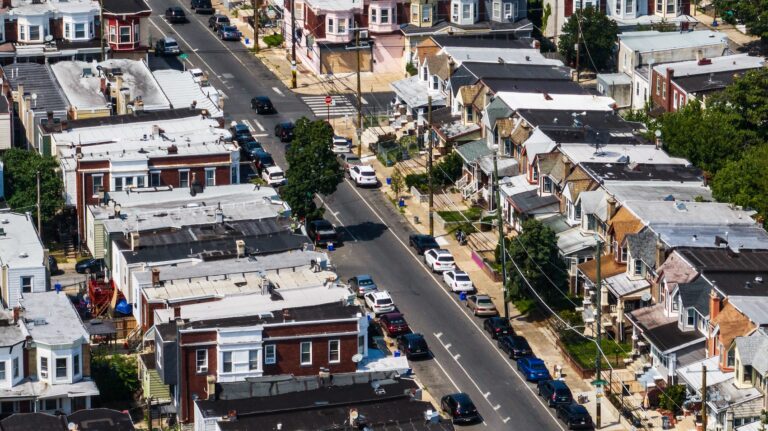
West Philadelphia rowhomes. (Kimberly Paynter/WHYY)
Have a question about Philly’s neighborhoods or the systems that shape them? PlanPhilly reporters want to hear from you! Ask us a question or send us a story idea you think we should cover.
The nation’s home appraisal industry is shrinking nationwide due to a variety of factors, including an aging workforce, ongoing barriers to entry and advances in valuation technology.
At the same time, evidence of appraisal bias persists, threatening to cheat families out of generational wealth, while potentially making it harder for homeowners to refinance or pull equity out of their properties.
In Philadelphia, that combination spurred Mayor Cherelle Parker’s administration to quietly launch an initiative aimed at expanding and diversifying the pool of appraisers from the city.
“It’s not all the time, but there is more potential for bias when you have people that are unfamiliar with the communities that they’re appraising and are not representative of the communities they’re appraising,” said Andy Toy, director of the city’s Home Appraisal Bias Program.
The administration is looking at ways to reduce the financial burden that makes it difficult to break into the industry.
In the meantime, the city is hosting public events aimed at educating people about this niche profession. That includes a free career expo later this month, where participants will have the opportunity to hear from and network with industry experts, including certified home appraisers working in the Philadelphia region.
Part of Toy’s elevator pitch is about the flexibility and income the profession offers. Some appraisers make well over $100,000 a year.
But he’s also making a more holistic appeal.
“You can get into this field and feel good about the work that you’re doing,” Toy said. “You’re helping people to understand their asset — to make sure that they’re getting the full value of their home, that they’re holding onto their wealth.”
Fighting appraisal bias
Toy’s program is rooted in the work of a task force convened while Parker was a member of City Council.
In 2022, the Philadelphia Home Appraisal Task Force released a set of recommendations aimed at eliminating home appraisal bias across the city, state and country. Underpinning the group’s list was the finding that valuations for homes owned by Black residents in the city were often lower than appraisals for similar homes owned by white residents.
Homes in primarily Black neighborhoods were undervalued by an average of nearly $26,000, according to a 2021 analysis from Redfin. Anecdotally, gaps like these have led Black homeowners to “whitewash” their homes — remove family photos and other identifying objects — before a real estate appraisal, in an effort to not lose out.
Typically, the appraised value of a home is close to, or even matches, the contracted sale price.
“It’s a form of bullying to me,” Parker said at the time. “It makes me sick to my stomach.”
In its report, the task force called for governments at all levels to make it easier for women and people of color to break into the industry, as well as to help ensure that appraisers have a more defined knowledge of local markets.
Related Content
The total is more than half of the plan’s 30,000-unit goal. The milestone comes as the administration prepares to submit its first report on the plan.
2 months ago
Listen 1:02In Philadelphia, 95% of appraisers are white. The vast majority are men. And most of them live outside the city, according to the report.
Many are from New Jersey and Delaware and work in Philadelphia.
“It’s not just about fixing Philadelphia’s problem. It’s about fixing Philadelphia’s problem and trying to create a movement around it that would benefit the states and the entirety of the country,” said Ira Goldstein, who chaired the task force.
Over the next four years, the administration wants to mint roughly 100 more home appraisers from Philadelphia.
That won’t be easy. Becoming a real estate appraiser in Pennsylvania requires a college degree, and traditionally up to two years of training under a licensed appraiser, a difficult task that has become more challenging as more supervisors retire.
In Philadelphia, the average age for an appraiser is 60.
“That’s the No. 1 challenge. You don’t have enough licensed appraisers in the city to create new appraisers,” said Carlo Batts, principal appraiser at Rittenhouse Appraisals in Philadelphia.
Trainees can opt to complete an online program instead of an apprenticeship. However, the price tag for getting certified through the program, known as the Practical Applications of Real Estate Appraisal, can present another barrier.
According to the Appraisal Institute, it can cost more than $15,000.
A worthy goal
Nailing down an apprenticeship is particularly difficult for newcomers who lack professional connections in the industry. Historically, mentorships have been passed down through informal networks.
In an industry dominated by white men, that makes it even harder for women and people of color to find a mentor.
Batts, among the state’s only appraisers of color, applied to four shops before landing an apprenticeship with a bank in Delaware.
Jamal Pitts, an appraiser with All Access Appraisals, said he got his apprenticeship after begging his mentor to keep his business going so he could train under him.
“He was ready to retire,” Pitts said. “He only stayed on because of me.”
Another challenge lies in the way the home appraisal operates.
Mortgage lenders often contract with appraisal management companies, which in turn contract with individual appraisers as solopreneurs.
Experts say this arrangement incentivizes speed over quality, opening the door for racial bias. These businesses are also typically part of a panel of up to 200 appraisers from which a lender effectively solicits bids.
Getting on that list can be challenging, particularly for a new appraiser who doesn’t have a lot of experience. While not all management companies favor experience when selecting an appraiser, many do.
“We still need more people in the profession but the problem is bigger, in my opinion, than getting more people in the business. It’s how the business is actually run and structured when you’re dealing with financing,” Pitts said.
Over time, as new appraisers build their businesses, these obstacles can become less burdensome, and advocates still see sense in trying to expand and diversify the city’s pool of appraisers.
“When we’re successful, there’ll be others that will follow what we’re doing,” Toy said. “Let’s hope it’s not many years from now.”

Get daily updates from WHYY News!
WHYY is your source for fact-based, in-depth journalism and information. As a nonprofit organization, we rely on financial support from readers like you. Please give today.
Brought to you by PlanPhilly

PlanPhilly
In-depth, original reporting on housing, transportation, and development.
Homebuying in the Philly area is more expensive than last year. Here’s why
The news is particularly challenging for first-time homebuyers daunted by overvalued sale prices and high mortgage rates.
3 months ago
Listen 1:08
‘A chain of dominos’: Philly luxury home sales remain on the rise amid affordability crisis
New research out of Drexel University is raising concerns about affordability and gentrification.
1 year ago
Federal data show evidence of home appraisal bias in Philadelphia
Appraisals are more likely to be below contract sale prices in primarily Black neighborhoods than in primarily white neighborhoods in the city.
4 years ago
Listen 1:15