
I took an alleged Philly killer to lunch 12 years ago. Here’s what I learned about a self-proclaimed ‘sociopath’
The Olney home of the late R.C. Horsch is at the center of a grisly police investigation. I interviewed him for over three hours a decade ago.
Listen 6:02
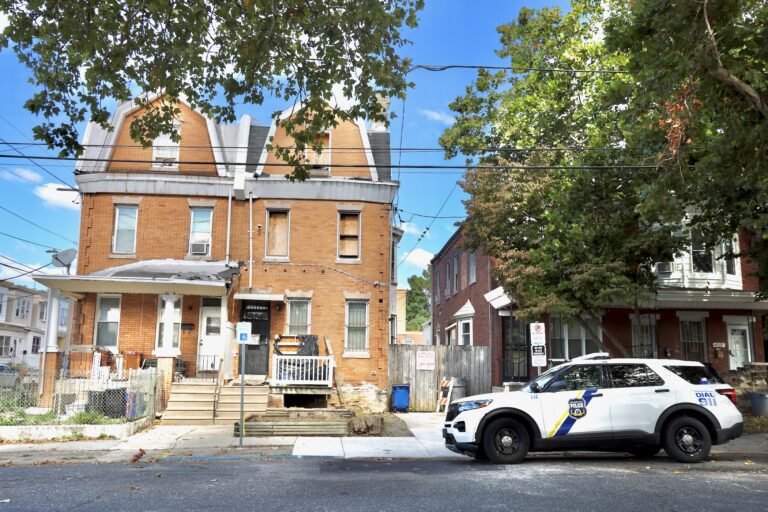
A police car idles outside the former home of R.C. Horsch on West Chew Avenue in Philadelphia's Olney neighborhood. The house is connected to the disappearances of several women, some of whom police identified in pornographic photos and videos made by Horsch. (Emma Lee/WHYY)
From Philly and the Pa. suburbs to South Jersey and Delaware, what would you like WHYY News to cover? Let us know!
I once took R.C. Horsch to lunch.
I had no idea that the man sitting across from me would one day be at the center of a disturbing police investigation into the disappearances of several women in Philadelphia. Horsch brought women into his Chew Avenue home to model for his dark photography projects that depict acts of depravity and violence. Although no direct evidence has been uncovered yet, police suspect some of them may have been killed. Horsch died last year, at 82. Now, investigators say they have recovered more than 1 million pieces of digital evidence of physical and sexual abuse from the home.
When I interviewed Horsch in 2014, I knew nothing about any of this. I had come across his work as a writer, photographer and filmmaker, much of it intentionally provocative and deeply disturbing. I recorded two conversations with him, and had long since assumed those recordings were lost. Then, after reading the extensive coverage of the case I went looking for them. And I found them.
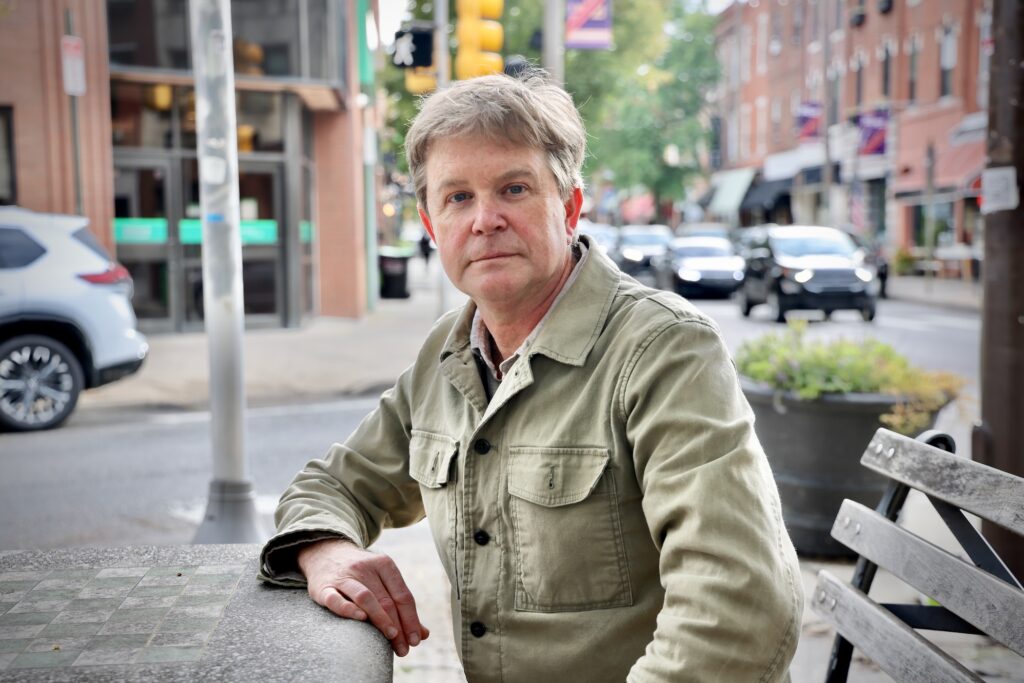
The recordings offer a rare, first-hand glimpse of a man who is now at the center of one of the strangest and most disturbing criminal investigations in Philadelphia.
Here are excerpts from my conversations.
Related Content
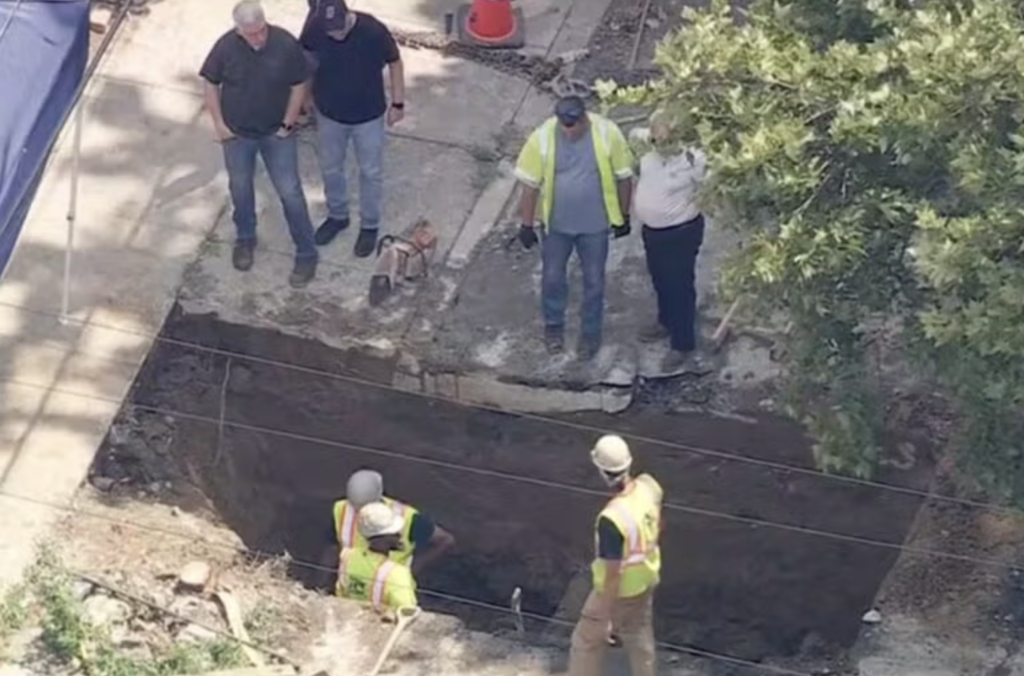
Philadelphia’s ‘house of horrors’ investigation: All that we know
With only about 30% of the material from the Olney house reviewed by investigators, here is what authorities know — and what remains unclear.
3 weeks ago
The first interview: ‘I’m a sociopath’
I first interviewed Horsch in early January 2014. I was covering a Philadelphia film festival called “Cinema of Sexual Revolution,” and it included one of Horsch’s works. At the time, his pornographic film “Erotic Memoirs of a Male Chauvinist Pig” was already several decades old. It was made in 1973 during the so-called “Golden Age of Porn,” when adult films had achieved mainstream recognition.
I invited Horsch to WHYY to record an interview about his 41-year-old film.
“What drove you to make this film?” I asked.
Horsch paused for 15 seconds before responding.
“You have to give me a couple minutes here,” he said. “I mean, it’s like I’m looking for some kind of deeper meaning to that question. Basically, I’m a sociopath, always have been, and it was a nice way to express myself. I hope you can edit this.”
A long pause at the first question is usually a sign that this might be a difficult interview. Horsch was hesitant, unsure why the local public broadcasting station would pay attention to him and his mostly criminal life.
Horsch was less interested in rehashing “Erotic Memoirs,” a film he said he was not particularly proud of, and more interested in pointing out the ways it broke normal codes of decency, even for pornography. He said it has scenes and themes of a sort that landed other filmmakers in jail, such as Paul Little, aka Max Hardcore, who in 2008 was sentenced to nearly four years in prison for his adult films.
“You were never arrested for your films, were you?” I asked.
“No, but not for lack of trying,” he said. “I think the reason I haven’t gotten into more trouble with my artwork is simply because it’s remained obscure.”
Horsch had been released from prison six months earlier, having been convicted of drug and firearm crimes. He had previously spent time in federal prison for counterfeiting currency. He had spent the last decade working on an explicit photography project involving women who were experiencing addiction to street drugs, showing them nude in decrepit settings.
“I’ve been doing a series of still photographs of basically drug-addicted prostitutes and the connotation there is that, ‘Wow, I must get off on drug addiction and prostitution,’” he said. “But at the same time, someone taking pictures of starving children in Ethiopia, or wherever they’re starving nowadays, the connotation there isn’t, ‘Wow, that photographer is into starving children. He must get off on starving children.’”
He said that, offensive as they may be to some, his works carried a broader message.
“Society’s entire attitude towards sex is what causes problems and that’s what I’m trying to communicate in my artwork,” he said. “With almost no success whatsoever.”
I followed up on a previous comment.
“Earlier when we started recording, you described yourself as a sociopath,” I said. “What makes you describe yourself as a sociopath?”
“I think civilization is the biggest evolutionary mistake ever made,” Horsch said. “I like individual human beings, but collectively I think the human race is despicable. I don’t support a government who maintains armies that go around the world killing people, and now doing it by remote control. I don’t support governments who employ a police force to go and arrest drug addicts and other sick people and prostitutes. I just don’t support anything that that government does. I don’t support cutting back on schools. I mean, what kind of a society do we live in that doesn’t value its children?”
“Society is sick and I just don’t want to be a part of it.”
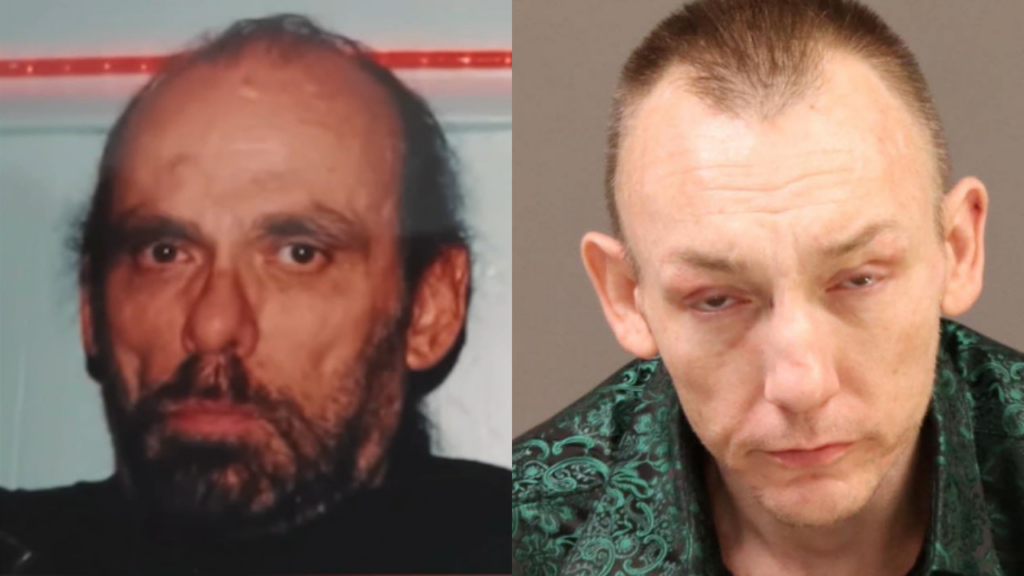
We wrapped the interview in about 30 minutes. In my story about the film festival I used a brief soundbite of Horsch complaining about prudish American culture that did not appreciate his work.
I left thinking there might be more to the story.
Related Content
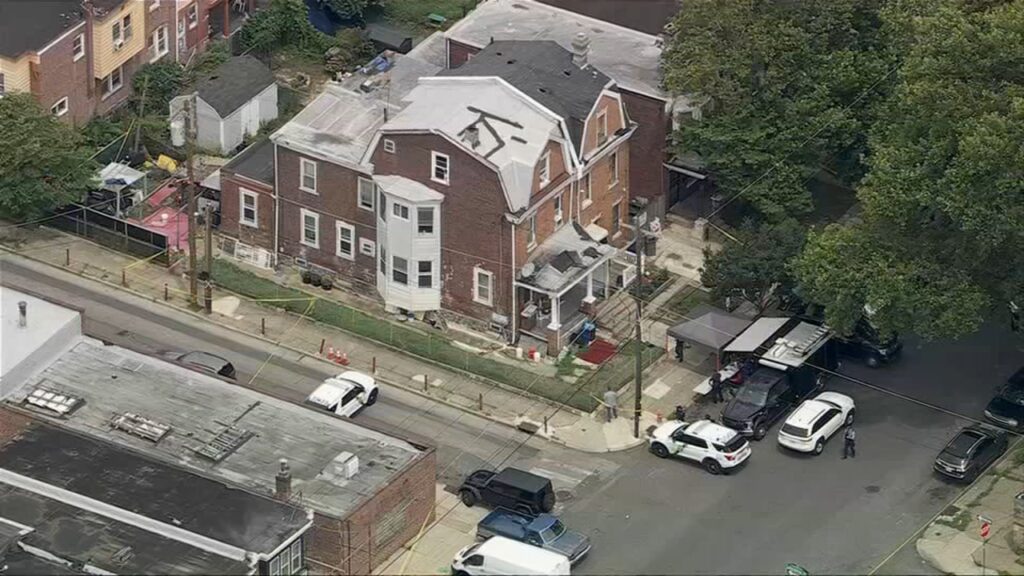
The bizarre case of the Olney house
A dilapidated property in the Olney section of Philadelphia is at the center of a sprawling criminal investigation. Reporters walk us through the case.
Air Date: September 21, 2026
Listen 51:10The second interview: ‘My mind races’
My second interview with Raymond Horsch occurred several months later. I had an ambitious idea, one that never materialized, to write a long piece or a book about Philadelphia’s criminal underworld of the 1960s and ‘70s. Horsch had moved through that world: In 1973, his “Erotic Memoirs” film was funded with money from organized crime, Salvatore LaRussa, or “Sam the Barber;” and in 1974 he was arrested for counterfeiting $10 bills.
I wanted to feel out Horsch as a possible subject, so I asked him to lunch at a Mexican restaurant on Passyunk Avenue. He ordered a sampler of dips: hummus, tomato with goat cheese and sweet pea with ricotta. I ordered the chicken mole and put a microphone on the table. This time our recording lasted about three hours.
The first thing he asked about was our previous interview for WHYY. He described the station’s radio programming as “really weird.”
“Kind of amazing that they played it,” Horsch said. “Was that something you were trying to slip by them?”
“No, no,” I said. “That’s something they were fully aware of.”
Again, Horsch was hesitant at first, unsure of the point of this interview. He did not know what I wanted, and, to be honest, neither did I. I was fishing for possible stories.
He told me he often struggled to converse with other people.
“When somebody asks me a question like, ‘How are you?’ a lot of times I interpret that as this big, philosophical, existential thing. I go into this thing: ‘Well, how am I?’ which can be kind of maddening,” he explained. “My mind kind of races. Even with the most ordinary conversation, I’m constantly going off into tangents and kind of getting lost and I lose track of where the conversation actually is.”
The early years of R.C. Horsch
Horsch grew up in Philadelphia and Bucks County, where his father owned a farm.
“I grew up in an idyllic [place], except that it wasn’t,” he said. “I spent my childhood shoveling shit.”
He left his father’s farm and “wandered around a bit,” mostly moving between New York City and Philadelphia.
Horsch said that at 21 he was in Philadelphia working for Louis Kellman Studios, a film processing company on the 1700 block of Sansom Street that processed daily news camera footage for most of the city’s TV stations in the 1950s, before video. It also produced industrial films and the occasional feature. He said he worked on the 1957 Jayne Mansfield film “The Burglar.”
“I was an independent contractor. I did technical stuff, special effects such as it was back then,” he said. “Mostly consisted of shooting titles. A lot of industrial work.”
From there Horsch worked with the security and investigations company Wackenhut. He said he was hired to install surveillance equipment, including hidden cameras and telephone bugs. He said he worked on some surveillance projects associated with the FBI.
Horsch spoke with remarkable technical detail about electronics, photography, chemistry and aviation, but said he always had difficulty holding down a job.
“I was a very bad employee, and I got fired a lot, so I ended up being an independent contractor,” he said. “I did a lot of technical stuff for engineering companies. I was a design draftsman, illustrator, made maps, mostly things involving a little bit of artistic talent and a little bit of technical knowledge.”
”I went for an interview and actually got hired by this company in Malvern,” Horsch said about a job he got in 1972 with what is now the electronics firm Vishay Intertechnology.
“They were taking me around and on a tour of the place and introducing me to all the people that I’d be working with. Eventually got around to this guy, I have no idea what his name was, but they introduced him as somebody who would be my superior,” he said. “I started thinking about that and had a vaguely psychotic moment. The idea that this person would be my superior was not something that I was ready to accept, so I just turned around and walked out.”
The memory pushed Horsch into a short moment of self-reflection. He was aware of the narrative potential of his life story.
“Probably phrased better that could be a funny story,” he said. “Or an illustration of my ego problems.”
Related Content

Authorities urged the public to be patient as they continue to sort through millions of pieces of evidence.
3 weeks ago
Listen 1:22What is fact? What is fiction?
As our meeting progressed, the stories became more spectacular. My impression at the time was that he was leading me on, embellishing his life.
He compared himself to the Tom Hanks character Forrest Gump from the movie of the same name, for his knack for stumbling into historically important moments. The work he would have done at Vishay was an early process of electronics miniaturization, which birthed the computer age.
He said he ran an extensive amphetamine manufacturing operation in a homemade lab on North Third Street in Philadelphia for several years, which he compared to the TV show “Breaking Bad.”
“At the time, I was probably supplying at least 40%, maybe more, of the amphetamine on the East Coast,” Horsch said. “It was a very big operation. I made millions at it.”
He said he delivered amphetamines cross-country by small airplane, which he piloted himself. Horsch claimed to have bought a BD-5 microjet, the smallest jet ever made, from Richard Bach, author of the bestselling book “Jonathan Livingston Seagull,” and then flew that jet, unsanctioned, in the 1980 National Championship Air Race in Reno, which was captured by ABC’s “Wide World of Sports.”
When law enforcement caught up to his drug operation, Horsch said he fled to New Zealand under a false identity, Stanley Edward Stokowski, the name of a physicist at Stanford University. In New Zealand, he helped develop an ethanol plant that broke down leftover industrial cheese whey into food-grade alcohol and biofuel.
Due to his work for the New Zealand cheese industry, Horsch claimed to have the personal phone number of New Zealand’s prime minister Robert Muldoon, and that the eventual revelation of Horsch’s false identity caused such a public scandal that it thwarted Muldoon’s reelection.
During the interview Horsch’s stories seemed outlandish to me. I later learned that they were true, or at least mostly true. He was arrested for manufacturing methamphetamine in Philadelphia, although his claim of making “40% of amphetamine on the East Coast” could not be confirmed.
According to the New Zealand Herald, Horsch fled to South Canterbury, New Zealand, in 1980 with his first wife, Anna Ferkuniak, and their young son, Eugene, where he was described as a “brilliant and hard working” employee for Chemical Technology Limited. Whether he had the prime minister’s private phone number or he affected the outcome of a national election could not be confirmed.
Ferkuniak died in 1989 of a drug overdose.
Horsch did own a BD-5 microject, according to Ryan Briggs, a reporter with The Philadelphia Inquirer who spoke with colleague Ellie Rushing on WHYY’s “Studio 2,” Whether he bought it from Richard Bach and flew it in Reno could not be confirmed.
Horsch used the alias “Stokowski” for the rest of his life. For his self-published work, the false identity posed as a patron or manager. I have received press releases from “S.E. Stokowski.” Promotional blurbs on Horsch’s paperbacks and website are attributed to him.
Later in the interview, Horsch apparently forgot that he had already revealed to me the false identity, insisting Stokowski was his creative supporter.
“He’s older than I am. The one person who’s believed in me, stuck by me,” Horsch said of the invented Stokowski. ”He’s, like, in his 80s. He’s been retired for a long time. I’m probably his only client right now. He’s a total agoraphobic and almost never leaves the house. He lives in Boca Raton, [Florida.]”
Related Content
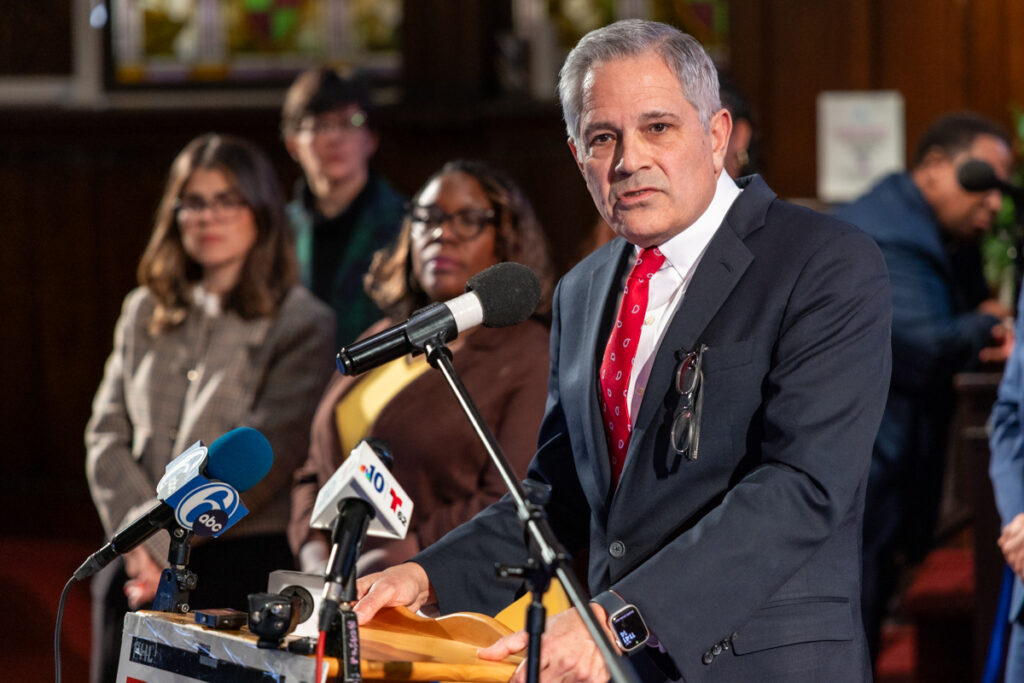
Federal judge refers Philadelphia DA Larry Krasner to U.S. Attorney’s Office over possible crimes
The judge says Krasner and one of his top aides may have committed perjury, obstruction of justice and conspiracy.
3 weeks ago
Listen 0:55‘Never raised a hand in anger’
About 50 minutes into our interview, Horsch asked a waiter to wrap his remaining sample platter to go. With his bagged dip assortment on the table, he continued talking with me for almost two more hours.
In hindsight, I believe Horsch stayed with the interview because he enjoyed the attention being paid to him by an arts reporter. He saw himself as a writer and art photographer, one who crafted extremely dark, psychosexual scenarios involving dominance, abuse and death. He told me that he sought out women experiencing addiction in Philadelphia’s Kensington neighborhood to use as subjects in his work. His nude photography highlighted women’s bodies deteriorated by drugs.
Horsch made a film called “Slaves” in 2003 about domineering quasi-sexual relationships with women. It starred himself.
“Did you have full-time dominant-submissive relationships that were 24/7, like what was depicted?” I asked.
“Pretty much,” Horsch said. “Everything in the ‘Slaves’ film happened, compressed and stylized and translated so what happened to one character may have happened to three or four characters.”
He paused for a moment, reflecting.
“Maybe this is a major confession, but I am not and have never been into [sadomasochism] on a personal level,” he said. “I have never, for example, ever raised a hand in anger to anybody, man, woman or child. I would never be violent or hit a woman unless she very politely and sincerely asked for it.”
“My interest in all of this is what you might call an anthropological level. I’m interested in the emotions and dynamics and the interactions behind it,” he added.
Horsch was upset that his art was not being recognized, and he was hoping negative reactions to his work might raise its profile. He was planning an upcoming exhibition of explicit photography called “Transgressions,” featuring nude images of women living with addiction he found on the streets of Kensington. The images highlight bodies that have been ravaged by drugs.
The “Transgressions” exhibition occurred in The Papermill, a theater and gallery space in Kensington.
“The neighbors hate the drugs and prostitution in the neighborhood,” he said. “ So hopefully somebody will picket the show.”
“Addicted women?” I asked. “Are they addicted?”
“Pretty much,” he said.
Horsch suggested he was ready to move onto something new.
“It’s been a 15-year project. I’m kind of repeating myself now,” he said. “I’ve done a few images in the past couple months but it’s kind of, like, more of the same.”
After departing the restaurant, I remember my head was spinning trying to keep up with Horsch’s rapid-fire tales, winnowing truth from fiction. He was leaning into his criminal past to paint himself – thoughtfully, even politely – as an artist who stood apart from society with an aura of danger.
Ironically, Horsch himself summed up my thoughts: In one of his rants against “evil” people he knew in prison or in organized crime, he noted how normal they seem.
“The most amazing thing to me is that you take the most outlandish people in the most horrible, illegal occupations, in dealing with them the amazing thing is how totally ordinary they are,” Horsch said. “No nobody I know – murders or whatever – I don’t know anyone who thought of himself as evil or bad or whatever. It’s like no matter what they did, it was all justified.”
Editor’s note: This story has been updated to reflect the correct spelling of R.C. Horsch. A previous version also misidentified the location of Stroudsburg, Pa. It is in Monroe County.

Never miss a moment with the WHYY Listen App!


WHYY is your source for fact-based, in-depth journalism and information. As a nonprofit organization, we rely on financial support from readers like you. Please give today.
The centers are intended to allow abuse survivors to get help from multiple providers at one location.
2 years ago
Listen 1:02
Why Philly residents paid tribute to ‘the motherland’ on Africa Day
Organizers of Philadelphia’s Africa Liberation Day want more people to know that the heritage of Black Americans didn’t start with U.S. slavery.
2 years ago
Suspect identified and charged in Rittenhouse Square sex assault: Police
According to police, the 27-year-old victim left a bar and was walking home when the attack happened.
4 years ago