
‘Politics of contempt’: Republican Utah governor joins Pa. Gov. Shapiro to push back against hateful rhetoric and partisanship
The governors said political disagreement is essential to democracy, but warned that dehumanizing rhetoric is contributing to violence and eroding trust.

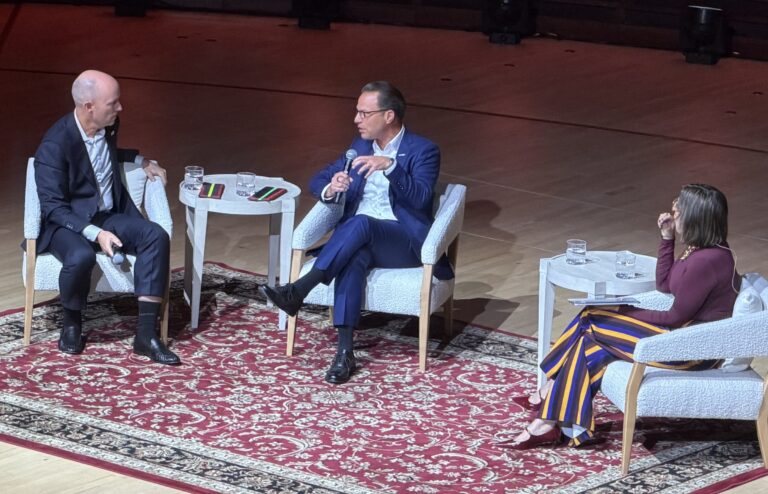
Gov. Josh Shapiro, a Democrat, discusses free speech and political violence with Utah Republican Gov. Spencer Cox during an event at the Kimmel Center moderated by New York Times journalist Lulu Garcia-Navarro. (Carmen Russell-Sluchansky/WHYY)
From Philly and the Pa. suburbs to South Jersey and Delaware, what would you like WHYY News to cover? Let us know!
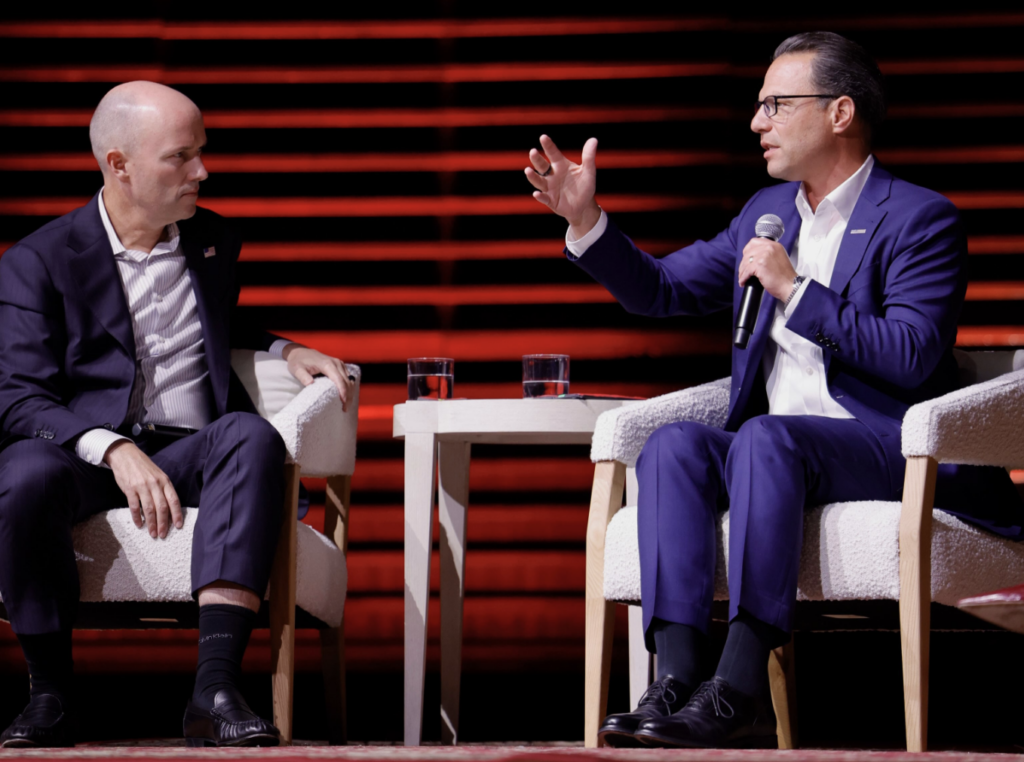
Utah Gov. Spencer Cox, a Republican, joined Gov. Josh Shapiro, a Democrat, to urge Americans to reject politicians who encourage contempt for their opponents, warning that increasingly hostile rhetoric is pushing the country further apart and contributing to political violence.
The governors from opposing parties appeared together Wednesday night at Philadelphia’s Kimmel Center for a discussion about the First Amendment, free expression and how Americans can engage across political divisions.
“We have to stop incentivizing … incendiary political speech,” Shapiro told the audience. “We have to stop electing people that behave that way, and we have to stop allowing the discourse online to drive us further apart.”
“The First at 250” event was presented by the John S. and James L. Knight Foundation, in partnership with Disagree Better and the National Constitution Center. The New York Times journalist Lulu Garcia-Navarro moderated the discussion.
Cox, who launched the Disagree Better initiative while serving as chair of the National Governors Association, said that conflict itself is not the central problem confronting the country. The Utah Republican compared the country’s political divisions to troubled relationships in which disagreement has given way to contempt.
“Conflict is neutral,” Cox said. “There’s unhealthy conflict and there’s healthy conflict, and conflict can be good. Conflict can build relationships [and] can make you stronger when you have these serious disagreements.”
But democracy cannot survive, he said, if Americans refuse to engage with people who vote differently. Cox cited research finding that more than one-third of Americans have lost a relationship over political differences, four times higher than just a decade ago.
Political violence and inflammatory rhetoric
The conversation came on the eve of the first anniversary of conservative personality Charlie Kirk’s assassination in Utah. Cox recalled the public address he delivered after the killing, in which he described the nation as broken and called for a rejection of political violence.
Cox said Shapiro advised him before that appearance to discard his prepared remarks and speak from the heart.
“I’m grateful for that advice,” Cox told the audience. “I took it and it was really important in that moment.”
Shapiro had confronted his own political violence in Pennsylvania through the attempted assassination of President Donald Trump in Butler County in 2024 and the arson attack on the Governor’s Residence the following year.
During Wednesday’s discussion, Shapiro said Americans should be “deeply concerned” about political violence and the rhetoric surrounding it.
“We all have a responsibility to not reward acts of political violence, not aggrandize them and not allow it to take deeper root in our nation,” Shapiro said. “Too oftentimes we have political leaders that will say things that go right up to a line of inciting violence.”
He said that social media platforms, campaign fundraising and political parties frequently reward politicians who use the angriest language.
Related Content
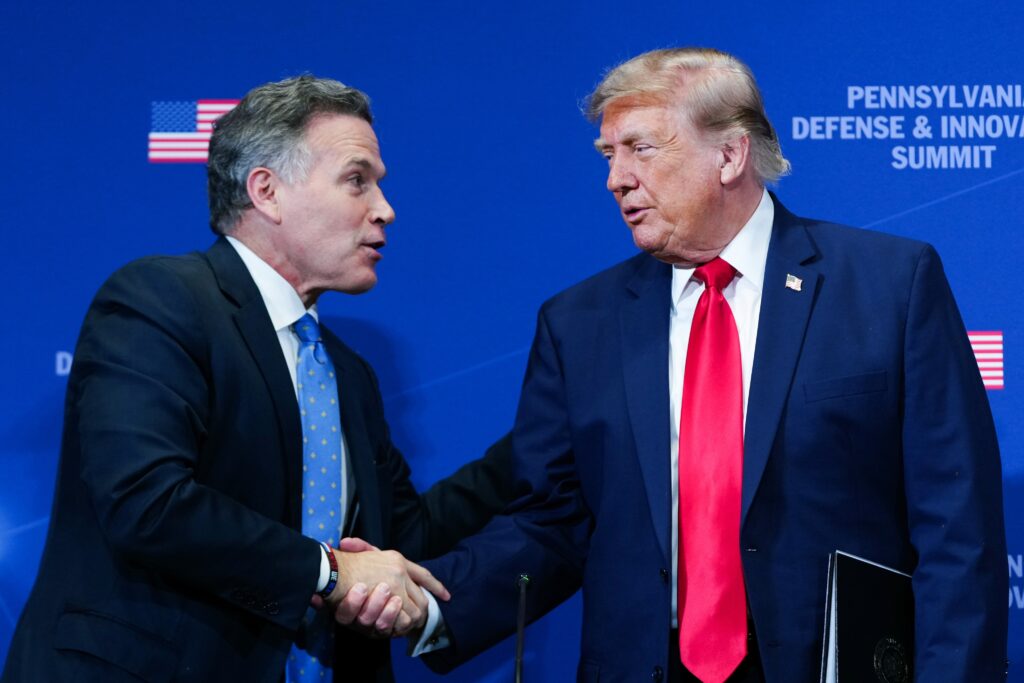
‘Trumpapalooza’: Vulnerable incumbents among those attending the Republican midterm convention
U.S. Rep. Madeleine Dean is also headed to Dallas to join other Democrats for a parallel event designed to counter the GOP message.
4 weeks ago
Shapiro briefly discussed the April 2025 attack on the Governor’s Residence, as well as subsequent threats against his family. But he said his encounters with Pennsylvanians outside the political and social media spheres provide a sharply different picture of the country.
“I am met by good, decent people who offer prayers to my family in ways that I don’t worship, who invite me into their homes, who tell me what’s inside of them — what’s bothering them, what they’re excited about,” Shapiro said. “My hope is that the people teach the politicians a lesson.”
Disagreement without hatred
Cox said elected officials can reduce partisan hostility by showing that people with sharply different positions can still treat one another with respect.
He cited research conducted in connection with the Disagree Better initiative, in which Republican and Democratic governors appeared together in messages promoting healthier political debate. Cox said viewers subsequently reported lower levels of hostility toward the opposing party.
At the same time, he said political leaders reflect the choices made by voters.
“We do something about it by showing up and voting for candidates who don’t govern with contempt,” Cox said.
Cox also described a “perception gap” between what Republicans and Democrats actually believe and what members of each party assume the other side believes. He said voters tend to treat the most extreme voices as representative of an entire political party, making the country appear more divided than it is on many issues.
Social media algorithms worsen the problem by rewarding outrage, he said.
“I come out and just say normal stuff, and that doesn’t get any clicks,” Cox said. “If I come out and say something crazy, then it goes viral.”
Still, Cox said he sees signs that Americans are tiring of the hostility.
“I don’t know that we’re going to save the country overnight,” he said. “But I truly believe that the way we save the country is one conversation and one relationship at a time.”
Teaching people how to evaluate information
The governors also addressed a Knight Foundation survey, which found that only 54% of Americans feel free to express their political opinions, a decline of nearly 20 percentage points over the last decade.
Shapiro said protecting free expression requires more than defending the legal right to speak. Schools must also give students the knowledge needed to evaluate information and participate constructively in public debate, he said.
“A big part of what Lori and I are working on here in Pennsylvania is ensuring that we are teaching young people facts, teaching young people about digital literacy — how to see something online and know if it’s factual,” Shapiro said, referring to First Lady Lori Shapiro.
Shapiro said the goal should not be to prescribe opinions, but to give students a factual foundation from which they can reach their own conclusions.
“If we can teach young people how to do that better, that’s going to cure our politics in a generation from now,” he said.
Both governors called for rebuilding local institutions where people develop relationships around shared interests rather than partisan identities.
Cox pointed to neighborhoods, religious congregations and service organizations as places where Americans can restore a sense of community and trust. Shapiro added sports leagues and civic groups to the list.
The country’s democratic institutions depend on people maintaining enough respect for one another to continue talking through their differences, Shapiro said.
“That’s the work we need to do,” he said.
Disclosure: The John S. and James L. Knight Foundation is among WHYY’s financial supporters. WHYY News produces independent, fact-based news content for audiences in Greater Philadelphia, Delaware and South Jersey.

Get daily updates from WHYY News!
WHYY is your source for fact-based, in-depth journalism and information. As a nonprofit organization, we rely on financial support from readers like you. Please give today.
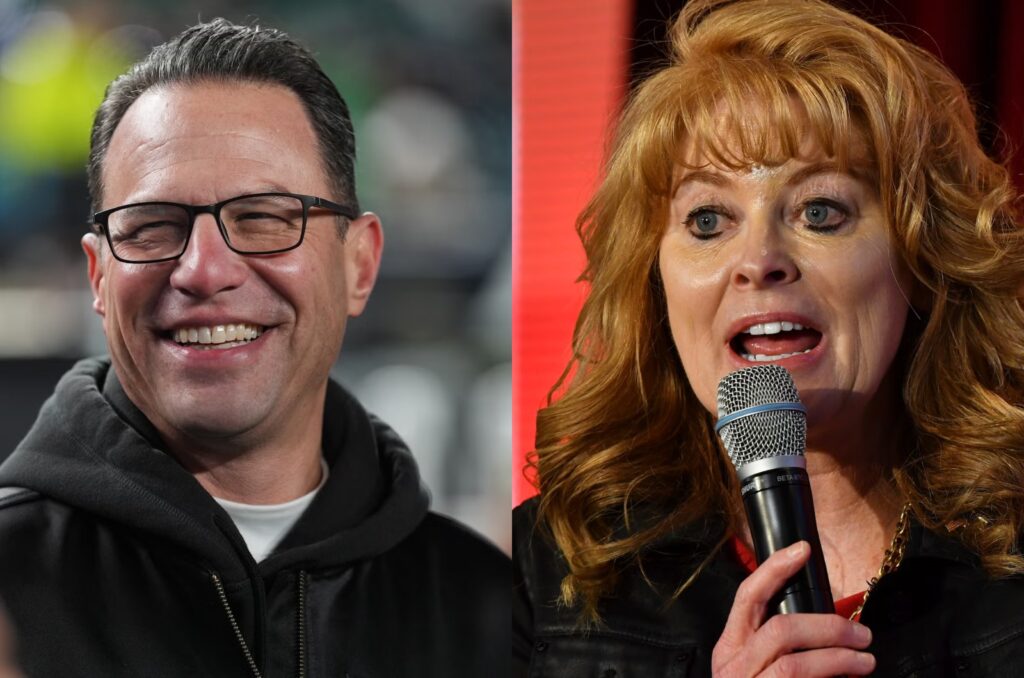
Pa. election 2026: Where Josh Shapiro and Stacy Garrity stand on the economy, affordability and more
The candidates for Pennsylvania governor offer competing approaches to taxes, housing, energy and business development. Here’s what to know ahead of the midterms.
2 weeks ago

Pennsylvania ends budget stalemate, sealed with concession by Democrats on climate
Pennsylvania is passing a $50 billion spending package to end a four-month budget stalemate that has held up billions for public schools and social services.
11 months ago
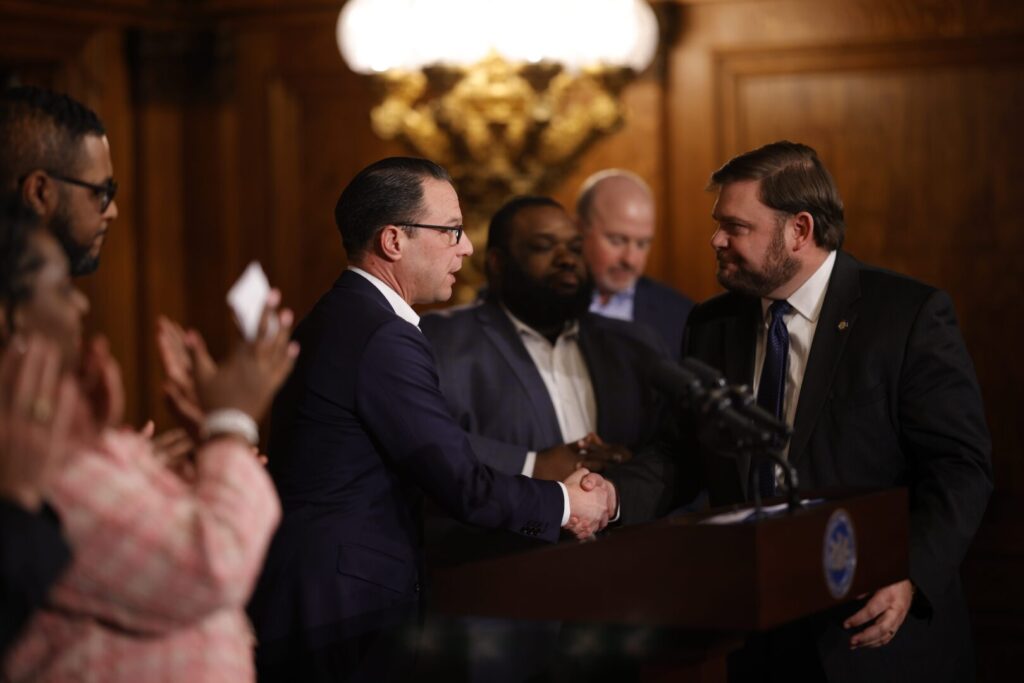
Political gridlock continues over Pa. budget, straining finances for counties, schools, nonprofits
Despite their insistence a few weeks ago that a deal was as near as a few days away, neither chamber convened in the Capitol for a voting session during the week of Sept. 15.
1 year ago