
Tariffs, taxes and other takeaways from Josh Shapiro and Stacy Garrity’s governor debate
Garrity accused Shapiro of driving the economy into the ground while Shapiro tried to paint his opponent as allegiant to the president.
Listen 1:01
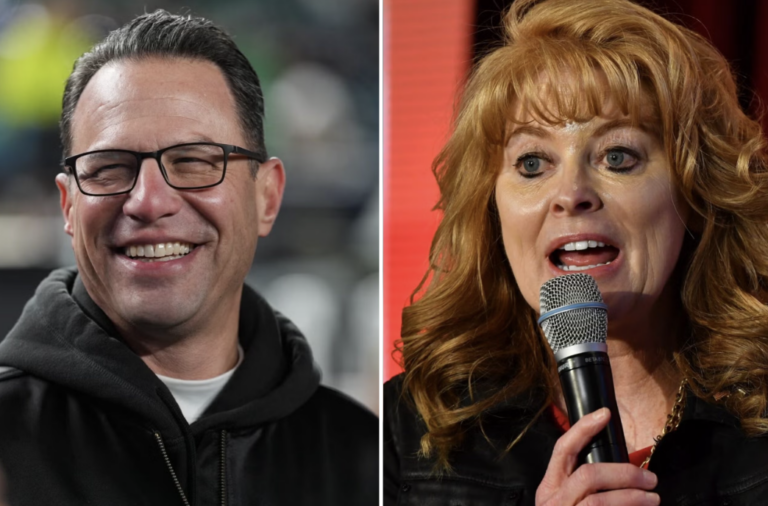
File: Democratic incumbent Gov. Josh Shapiro faces challenger Republican Stacy Garrity in Pennsylvania's 2026 election for governor. (AP Photo/Marc Levy, File)
With less than four weeks until Election Day, Pennsylvania Gov. Josh Shapiro and challenger Stacy Garrity faced off Wednesday night in Harrisburg for their only scheduled debate as part of the 2026 governor’s race.
The Democratic incumbent and the Republican state treasurer sparred over a variety of policies, including the economy, the state budget, data centers and health care, offering voters diverging views on how the state should be run.
While the debate mostly focused on policy, the candidates got heated at times, such as when abc27’s Dennis Owens asked Shapiro whether he would sign a voter ID law.
The Democrat responded that he would be open to it but that “it can’t be based on the kind of conspiracy theories that my opponent and others continue to this day to spew.”
President Donald Trump has regularly called for additional voter screening, casting doubt about the security of the upcoming midterm election and spreading fear that noncitizens are voting. Election experts have repeatedly debunked those claims. He has also falsely claimed to have won the 2020 election.
Shortly after being elected treasurer, Garrity joined a rally of skeptics questioning the results of the 2020 presidential election but has since distanced herself from that position.
The discussion over voter IDs led to a heated exchange in which Shapiro accused Garrity of taking direction from Trump and said that she couldn’t be trusted to take part in certifying the 2028 election.
“That’s the most ridiculous thing I’ve ever heard,” Garrity shot back at Shapiro. “I don’t even know why you’d say that and how you can look yourself in the mirror at night.”
“It’s the facts of your record,” Shapiro said.
“No, it’s not the facts of my record,” Garrity responded.
Here are some other key takeaways from the debate.
Data centers: Policy vs. pause
Owens pointed out that both candidates had shifted positions on data centers. He said that a majority of Americans have expressed concern over their local placement.
Asked why he was not in favor of a moratorium on new data center development as other states are doing, Shapiro called moratoriums a “timeline to get to a policy” and said that he had already implemented an executive order that obviated the need for a pause.
“I put in place the strictest policy, the strictest guardrails in the nation to ensure that our communities are protected,” he said. “If a local community does not want that data center to be built in their community, it will not be built.”
Garrity has called for a moratorium but did not give a duration for it.
“A real leader doesn’t need that long of a pause,” she said. “You get all the stakeholders around the table and you find out what you need to do to protect rate payers and protect communities. So as long as it takes.”
Pa. election 2026: What to know
- 🤔 Voter FAQs: WHYY News’ Pa. voter guide has the answers you need.
- 🗳️ Governor’s race: Here’s what to know about the race between Josh Shapiro and Stacy Garrity.
- 💰 On the issues: Here’s where Shapiro and Garrity stand on the economy and health care issues.
- 📬 Voting by mail: Here’s what to know about requesting, filling out and returning your ballot.
- 📱 Your go-to coverage: As election developments unfold, follow WHYY News on WHYY.org and the WHYY App.
Pa.’s growing budget
Garrity assailed Shapiro for proposing larger budgets each year that draw down on the state’s surplus fund while claiming that they are balanced.
“A rainy day fund is there for an economic downturn or a crisis,” she said. “And so he claims that he passed for balanced budgets, but clearly he didn’t because every time he took money from the surplus and used it to plug a budget hole.”
Shapiro countered that there was a better use of the so-called rainy day funds.
“There is $8 billion sitting here in Harrisburg as opposed to being invested in the good people of Pennsylvania,” he said, adding that economic growth is adding to the state budget. “Revenues that were just reported a few days ago were hundreds of millions of dollars higher than ever before because our economy is growing.”
Both would legalize skill games, but tax them differently
Legalizing and heavily taxing skill games has long been one of Shapiro’s goals for increasing state revenue. He would tax them at 52%, “which is the traditional tax rate we have on other gaming in Pennsylvania so that we wouldn’t advantage one type of gaming over another,” he said.
“I would drive those dollars into the general fund and then use a core chunk of that to fund mass transit across Pennsylvania,” Shapiro said.
Garrity said she would tax them at only $500 per month and noted that many of the games are housed at VFWs and other small establishments that benefit from the revenue.
“I would urge the governor to think about the jobs and all the money that these groups give back to the community because American Legions, VFWs, fire halls, small businesses, they are the backbone of Pennsylvania,” she said.
Reading and math
The candidates have fallen on opposite sides of the education funding debate, with Garrity criticizing Shapiro for prioritizing public schools with record levels of funding.
“We have spent $3 billion more on education since the governor came into office and this is the issue: our results are not improving,” she said. “Seven out of 10 of our eighth graders cannot read or do math at grade level,” Garrity added, citing a statistic supported by the National Assessment of Educational Progress.
Garrity said she supported “school choice,” which could include publicly funded vouchers for students to attend private schools.
Shapiro countered that electing Garrity would result in going backward.
“We have to remember what life was like the last time we had a Republican governor,” he said. “They cut a billion dollars out of public education. On my watch, we’ve invested 35% more in our public schools, but it’s not just about the bottom line of a school district’s budget. It’s about the difference it’s making in their schools.”
Shortly after Shapiro was elected, Pennsylvania’s Commonwealth Court declared that the state’s system of funding public schools was unconstitutional. Shapiro has cited that decision during each budget cycle and requested additional funding.
Shapiro previously supported school choice but vetoed a bill because of his own party’s resistance. Asked about that at the debate, he said he was “consistent” on the issue and that “it is not an either-or” solution.
Related Content
Pa. election 2026: Voter guides, key races and more
Election Day is Tuesday, Nov. 3. Here’s what you should know beforehand, from voter deadlines to who’s on the ballot in Philadelphia and statewide.
3 months ago
The fuel economy
Garrity found one use for the rainy-day fund: providing a tax rebate for gas.
“Just for two to three months because I think prices are going to start going down,” she said.
She also promised $750 in rebates for summer driving, contrasting her proposal with the $250 rebate Shapiro proposed during his first campaign for governor.
“Well, I don’t know about our listeners, but I didn’t get my check in the mail,” Garrity said.
Shapiro did not directly explain why the earlier rebate proposal had not materialized but blamed new tariffs and the war in Iran for increasing household expenses, tying Garrity to policies he argued were undermining the state’s efforts to make life more affordable.
“When the Commonwealth of Pennsylvania put $1 in your pocket, the policies of the Trump administration, tariffs and this war in Iran … that makes it feel like they’re yanking two bucks out,” Shapiro said.
Pressed by a moderator on whether he supported suspending the gas tax, Shapiro said he was open to it, but emphasized that lawmakers would have to act.
“That’s not something the governor can do on his own,” he said.
Garrity also advocated expanding natural gas production and eliminating taxes on electric bills.
‘The Eagles will remain’
Shapiro and Garrity declined to commit public money to potential new stadiums for the Philadelphia Eagles and Pittsburgh Steelers, though neither categorically ruled out a deal involving taxpayer support.
Garrity argued that subsidizing wealthy team owners should not be a priority while Pennsylvanians are struggling with household costs.
“I don’t think that we need to be giving taxpayer dollars to billionaire owners,” she said but “If they came and they had a proposal and it was something that we could work out and it was a win-win, certainly I would be open to it.”
Shapiro said he had spoken with owners of both teams but would not commit taxpayer dollars without first reviewing their plans. He pointed to the proposed arena for the Philadelphia 76ers and Flyers as an example of keeping teams in the city through private financing.
Pressed on whether he would provide state funding to keep the football teams in their current cities, Shapiro instead offered an unequivocal commitment about their locations.
“On my watch, the Steelers will remain in Pittsburgh. The Eagles will remain in Philadelphia, period,” he said.
The death penalty
Shapiro, who continued the execution moratorium established by former Gov. Tom Wolf, renewed his call to abolish Pennsylvania’s death penalty.
“The Commonwealth of Pennsylvania should not be in the business of putting people to death,” Shapiro said.
The governor described how his views changed after reviewing cases as attorney general and discussing the issue with his young son led him to conclude that executions were not morally justified.
Garrity answered the death-penalty question by saying, “I support the law that’s on the books,” then accused Shapiro of failing to push lawmakers to resolve a separate sentencing issue.
In March, the Pennsylvania Supreme Court ruled that mandatory life without parole for second-degree murder, imposed without considering individual culpability, violated the state constitution. Garrity urged Shapiro to press for the passage of legislation that would establish a new sentencing framework, generally requiring a minimum sentence of at least 35 years, saying it would stop more than 1,200 people convicted of second-degree murder from seeking release, potentially causing further harm to victims’ families.
Shapiro sharply rejected her characterization, saying courts would review sentencing questions individually rather than automatically release prisoners.
“It’s dangerous for you to suggest that and it’s irresponsible for you to suggest that,” he said.
Presidential ambitions
Shapiro declined to commit to serving a full second term if reelected, leaving open the possibility of a presidential bid in 2028.
Asked directly whether he would complete all four years, the governor said his attention was on reelection and helping candidates who would challenge President Trump.
“The only thing I am focused on is running for reelection as governor,” Shapiro said.
Shapiro was also asked about his support for Israel and whether his position put him at odds with Democratic voters. A moderator cited polling showing that 60% of likely Pennsylvania Democrats opposed military and economic support for Israel.
Shapiro initially emphasized that governors do not decide whether to send weapons overseas. On the third anniversary of the Oct. 7 Hamas attacks, he expressed solidarity with Israelis and the Jewish community and called for opposition to terrorism and antisemitism.
Pressed about divisions within his party, Shapiro distinguished his support for Israel from his opposition to Prime Minister Benjamin Netanyahu.
“I think he has led Israel down a very dangerous and isolated path,” Shapiro said.
Trump, tariffs and the measles
Owens asked about Garrity’s support for the president, who is currently ranking well underwater in terms of his approval rating.
“Are there specific issues or policies that you can tell us where you disagree?” Owens asked.
“Nobody, I don’t think, agrees with the president 100% of the time,” she said. “And tariffs would be a perfect example. While some tariffs have helped manufacturing, some have not.”
Garrity was also asked about her appearance alongside Health and Human Services Secretary Robert Kennedy Jr. at a Make America Healthy Again rally in Harrisburg, and whether she supported vaccines.
“I’ve had the MMR vaccination. I know it’s safe. I know it’s effective,” she said.
Garrity pivoted to accusing the governor of seeking publicity during the outbreak.
“He didn’t go console the families,” she said. “He didn’t get boots on the ground, conduct an investigation and wait to announce the results until he had the facts.”
The governor blamed vaccine misinformation and disinformation for measles’ resurgence and said Pennsylvania’s case count had reached 1,078.
“My opponent stands with RFK Jr. I stand on the side of science,” he said.

Get daily updates from WHYY News!
WHYY is your source for fact-based, in-depth journalism and information. As a nonprofit organization, we rely on financial support from readers like you. Please give today.
Part of the series
Trump’s Justice Department faces a new era of scrutiny under a Democratic-led Congress
Attorney General Todd Blanche says the department will cooperate with Congress but has also insisted that “we will not back down” from the Republican president's agenda.
2 days ago
Delaware district judge rejects Trump’s DOJ attempt to obtain the state’s voting data
The U.S. Department of Justice wanted the state’s unredacted voter list, including Social Security numbers and addresses.
4 days ago
Listen 0:58
Camden County residents agree to tax increase to reduce sewage spills, preserve nature
Millions of gallons of raw sewage spills into Camden’s waterways because of outdated sewer systems.
6 days ago
Listen 0:57