

Philadelphia-area psychotherapists struggle to navigate the world of ‘Uberized’ online counseling platforms
Therapists say investor-backed counseling giants monopolize search results and pressure them to take high caseloads at low pay.
Listen 2:59

Arlene Navarro, M.A. LPC, in her office in Center City Philadelphia, where she provides therapy services to clients. (Kimberly Paynter/WHYY)
From Philly and the Pa. suburbs to South Jersey and Delaware, what would you like WHYY News to cover? Let us know!
During the COVID-19 pandemic, demand for psychotherapy went through the roof.
“Everybody was just wanting to talk to someone. Like, what is this collective trauma that we’re in?” Philadelphia therapist Arlene Navarro recalled. “In my eight years of private practice, I have not had a waiting list, and I had a waiting list during COVID, and it was pretty consistent. It was for months.”
As the pandemic eased and people started going back to work, demand initially fell back to something like normal levels, she said.
But as time passed, the number of emails and calls she was getting from prospective new clients then continued dropping, year after year.
Referrals to her private practice fell by 10% in 2023 and then another 20% in 2024, said Navarro, who specializes in helping people with trauma. Last year, the number plummeted by an additional 25%, leaving her with a slim roster of mostly longtime clients.

She scrambled to make ends meet, dipping into her savings and relying on help from two generous friends.
“I had to downsize from a two-bedroom to now a one-bedroom loft, and I’m really just limiting my expenses,” she said. “Traveling has been cut out of the budget. The bare necessities, that’s been it pretty much for me, and I am actively looking for a supplemental job, perhaps something adjacent to counseling.”
“I’m grateful that I have savings, but not everybody has that,” said Navarro, who is in her 60s. “I am scared for next year.”
Related Content

Health leaders say between 73,000 and 90,000 people could lose Medicaid next year due to new federal work requirements and eligibility paperwork.
6 months ago
Listen 1:11The ‘Uberization’ of psychotherapy
Navarro attributes her struggles to massive changes that have swept the field in the past several years.
Those include the growth of counseling platforms like BetterHelp, Talkspace, Headway and Grow Therapy, as well as changes in the way people find private-practice therapists and altered expectations from clients about how therapy is supposed to work.
She’s watched as platforms have erroneously listed her as a contractor, apparently as bait for people searching online, who are then redirected to the platform’s own therapists, she said. For a while she kept receiving emails from fake “clients,” seemingly generated by artificial intelligence, who asked about her availability, answered some intake questions and then went silent.
Most significantly, once-reliable streams of referrals from Psychology Today, where she pays a monthly fee to be listed, and from Google dwindled to almost nothing as big providers poured money into search engine optimization and monopolized search results, she said.
“This past month I did get two new clients, but those clients were referred to me by other clients I have had in the past,” she said.

The rise of online platforms isn’t all bad, she and others say. The services have helped destigmatize therapy and improve access to treatment, and made it easier for therapists to get paid through insurance. Some counselors praise Headway, Grow and other sites that serve more like giant group practices, providing billing and back-office services, rather than as bosses.
But critics argue the changes have also broadly led to an increasing “Uberization” of the field. Many practitioners feel like they have little choice but to join platforms that treat them like gig workers — pressuring them to take on heavy workloads and constantly message with clients. They also claim the platforms pay them poorly, insist they use artificial intelligence tools and use sensitive patient data for marketing purposes.
Navarro said she regularly gets calls from platform recruiters who try to get her to sign up, and she always refuses.
“It feels like selling my soul to the devil,” she said. “I’m such a social justice-oriented person, and on behalf of my colleagues that have been here for so long, I am not going to sell out.”
Critics say that professional counselors like her, who want to remain independent and avoid the pitfalls of platforms, are at risk of being squeezed out.
“There are questions around the therapist’s sustainability as a small business owner when you’re coming up against organizations like BetterHelp or Talkspace or any of the others in a similar vein,” said T.J. Walsh, who heads a group practice in Delaware County and advises other therapists who are trying to grow their businesses.
“There’s no way that one person, or even a relatively large group practice, can come up against an organization like that who is buying up all of the bandwidth in the market.”
Related Content

Health experts warn summer relief may hide ongoing mental health struggles for teens
Teenagers may seem happier once school ends, but mental health experts say summer can mask anxiety and depression rather than resolve it.
3 months ago
Convenience comes with big pitfalls
Several factors have led to the transformation of mental health counseling: high demand for a persistently insufficient number of therapists, federal insurance coverage mandates, greater use of telehealth and app-based services generally, and major venture capital and health provider investments in online platforms.
For many younger counselors who have recently gotten their licenses and are looking to build up a client base, signing up with a platform has come to seem like the obvious choice. That was the case for Shelley Snapp, a therapist based in Doylestown and Plymouth Meeting who became a BetterHelp contractor in 2020.
“The pandemic hit and we were all working from home anyway,” she recalled. “I thought, why not check out one of these platforms? They’re advertised to you as easy onboarding, super flexibility, immediate caseload, all these things.”
But she quickly discovered the disadvantages, including very low pay rates.
“It was really shocking how little they paid out for professionals who are required to be licensed. These are folks with graduate degrees and licenses in their respective states,” she said.
While a private-pay therapist in the Philadelphia region might charge $150 per hour and keep much of that after expenses, BetterHelp typically pays $30 to $50, Walsh said. Some therapists have reported that the company recently lowered its pay rates even further as it struggles to attain profitability.

Snapp also said she was immediately assigned clients, no matter what type of issues they needed help with.
“Sometimes they would come right into your caseload and start sending you messages about everything that they were going through, and expecting you to reply immediately with solutions, advice, without even having the opportunity to talk about whether or not you were the right fit to treat them,” she said. “Because of that, a client might be passed around from therapist to therapist, which is not great for the client either.”
On a few occasions, clients said that after they discussed a certain topic with her, a related ad popped up on their Instagram or browser. She’s not sure if that was just a coincidence, but it sharpened her concerns about how BetterHelp was using client and therapist data.
In 2023, the company agreed to return $7.8 million to customers after the Federal Trade Commission said it had shared information from patient questionnaires with Facebook, Snapchat, Criteo and Pinterest for advertising purposes. BetterHelp denied any wrongdoing.
“Overall, these platforms don’t seem to take good care of the clients or take good care of the therapists,” Snapp said.
After a year with BetterHelp, she got a job at a group practice. She saw a “significant increase” in income, she said, while gaining much more control over who she sees and her volume of clients.
Related Content

Montgomery County sues social media companies over youth mental health harm
Research shows using social media for three or more hours a day doubles the risk of certain mental health problems for teens.
3 months ago
Trying to ‘read the tea leaves’
It’s a strange time for therapists, said Walsh, who helps run a 3,000-member Facebook group for Philadelphia-area private-practice clinicians.
Since the 1980s, when mental health started coming under the umbrella of managed care and health insurance, counselors have been “twisting themselves into pretzels” to try to fit into a system designed to maximize efficiency and keep down the cost of traditional medical care, he said.
Now private equity and insurance companies are investing in counseling platforms — the largest shareholders in Teladoc, BetterHelp’s parent company, include BlackRock, Vanguard and the hedge fund Point72 Asset Management — and clinicians are worried about further losses of autonomy and income, Walsh said.
They also wonder how their field will be affected as more people seek advice from chatbots like ChatGPT, and AI counseling and coaching bots with names like Ash, Wysa and Noah.
“The potential is that it will look very different in the next little while, and so people are really trying to just figure it out and to read the tea leaves,” Walsh said.
Therapists tend not to be business savvy, he said. They aren’t taught about marketing and billing during their training, and have to figure that all out on their own if they decide to launch their own private practice.
“Because of all these other other tides that are coming in from different directions, they’re having to catch up faster, with more difficulty as well, because everything is changing,” he said. “There’s no template anymore. Really, we have to be constantly figuring it out in real time.”
Related Content
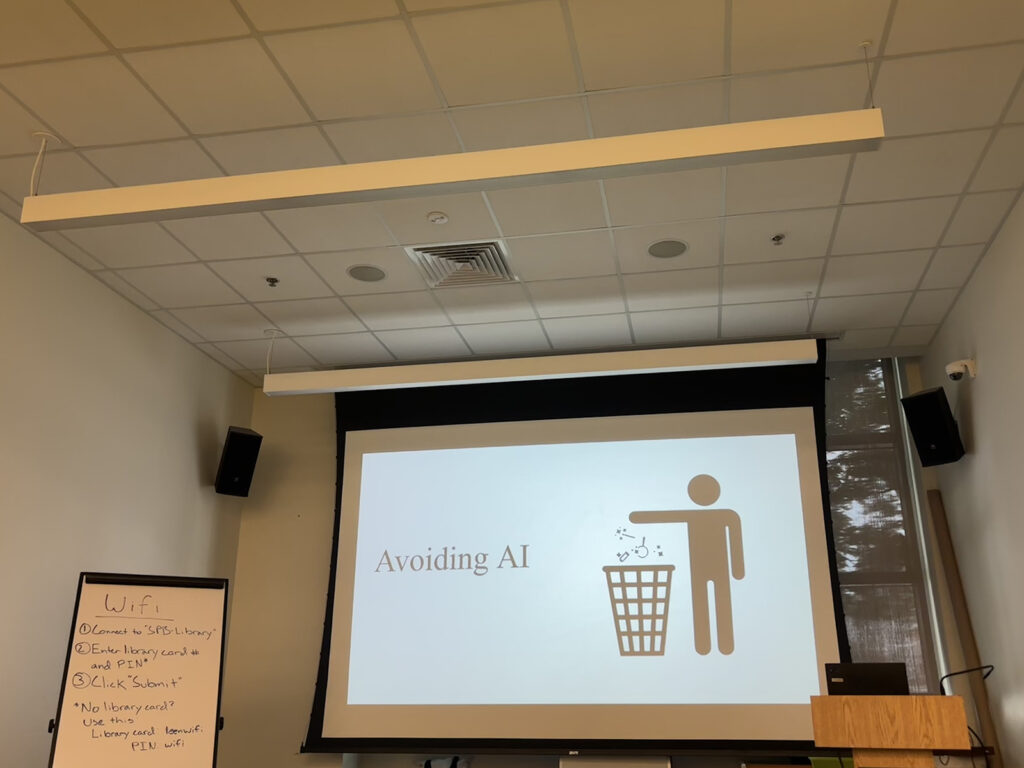
Free Library of Philadelphia expands Critical AI Literacy series with hands-on workshop
The Free Library's Critical AI Literacy series explores the technology, with a focus on disabling unwanted features, spotting scams and understanding AI's impact on the city.
3 months ago
Constant text-messaging and tiered pay
Despite the disadvantages, some therapists find themselves remaining with a platform for years. They don’t want to abandon their old clients, worry about seeing a drop in income or don’t want the hassle of marketing their practice on their own and dealing with billing and insurance.
Morgan Rakay, who is based in Philadelphia’s Roxborough/Manayunk neighborhood, joined BetterHelp in 2017 to supplement her income from a group practice. She didn’t fully leave the platform until 2023, despite her loathing of the constant text messaging.
“A chat-based therapy session should not be therapy,” she said. “If somebody gets to sit and pick their words very carefully, I can’t tell if they’re flat, I can’t tell if they’re manic. I can’t tell if they’re typing poorly because they’re not a great keyboardist, versus maybe they’re a little bit manic or psychotic. It just strips all of the tools that a therapist should really have to be able to be clinically sound. So I hate that.”
The platform also expected her to be available to clients around the clock, she said.
“They say that you set your own hours, but if you don’t answer a client’s text message within an hour or two hours, you started getting these alerts, and within 24 hours they would turn off your access. What if I’m on vacation?” she said. “You would then have to go to their team to say what happened and why, and to have them turn it back on for you.”
“I don’t respond to one client, and now I cannot interact with the 20 others. Suddenly, as a clinician, I have disappeared on my clients. That also feels really unsafe and unethical.”
Another issue was the tiered compensation structure. Therapists report being paid $30 per hour for the first five hours per week, $35 for the next five hours, and so on, creating intense pressure to take on excessive workloads while accepting low earnings.
At the same time, sessions were generally scheduled for only 45 minutes, so Rakay wouldn’t be paid for a full hour, she said. There was a per-word payment for messaging, but she often hit the payment cap if, for example, she had a verbose client.
“It’s so easy to think, I worked six hours today, I’m going to make this much money,” she said. “And the paycheck comes in and it’s significantly less.”
She wanted to leave, but she didn’t want to cut off her clients and was worried about finding a different source of income.
“You get backed into these corners. I was the primary parent for two young kids while my husband was in med school and residency. I needed all of the flexibility that I could get, so in some ways, I felt a little bit stuck with it. I was already in that beast’s jaws a little bit,” she said.
Eventually, Rakay phased out of BetterHelp and into her own private practice, which is thriving. She still uses Grow Therapy, a different type of platform that handles billing, insurance, video and some other functions but doesn’t fully run the practice the way BetterHelp does.
But she said she still dislikes that it pressures clients to use an AI “coach” between meetings, and asks therapists to let AI record and summarize sessions. She expects to eventually leave Grow as well.
Related Content

An existential psychologist on making a meaningful life
Psychologist Clay Routledge explains one downside to our focus on mental health is what he calls the "pathologizing of ordinary life."
Air Date: August 21, 2026 12:00 pm
Listen 50:00Adapting to a changing field
While it appears that many therapists struggle to earn a living on platforms, many others, like Snapp and Rakay, have adapted to the changed counseling world.
Rick Raymond, a clinical psychologist based in Philadelphia’s Rittenhouse Square, said Headway hasn’t raised his payment rate in two years, despite his requests, but he’s glad he doesn’t have to deal with insurance billing himself.
“The more therapists start to use these platforms, the more power the platforms themselves get,” he said. “There’s a tradeoff there, so I reassess periodically what makes sense for my business, and right now staying on one of them does make sense — though I can imagine a time where I feel too squeezed and it’s no longer doable.”

Shira Collings, a 32-year-old therapist in Fishtown, said she’s heard many older clinicians say they fear that private practices are a dying species, like taxi cabs. She said her old private-pay group practice suffered from search engine struggles, falling referrals and plummeting demand for eating disorder therapy connected to rising use of GLP-1 weight-loss drugs.
But Collings said she was able to successfully pivot. She now splits her time between her solo practice and three group practice-type platforms, which she joined because clients increasingly wanted to use insurance. She’s the breadwinner for her family — she and her husband have one child, with another on the way — and earns about $135,000 a year.
She hopes in the future to do more supervisory and consulting work, and to move back toward having only private-pay clients, rather than clients who use insurance.
“It sucks that it’s less accessible to people, but it does give you just so much more autonomy over how you do your work. I feel I show up as a better therapist when I have that,” she said. “Definitely, that’s my ultimate goal.”

Never miss a moment with the WHYY Listen App!


WHYY is your source for fact-based, in-depth journalism and information. As a nonprofit organization, we rely on financial support from readers like you. Please give today.

‘I Could Have Been Lindsay:’ One Woman’s Take on the Clancy Murder Trial
Journalist Katinka Blackford Newman discusses the similarities between the Clancy trial and her own experience with psychosis.
Air Date: September 4, 2026
Listen 40:40
The Body Remembers: Exploring the Invisible Wounds Left by Serious Illness
A look at the lingering effects of serious medical events, and what true healing really means.
Air Date: June 19, 2026
Listen 49:34
Lancaster-based Sun Point Foundation has taken over operations of Council for Relationships. The Philly nonprofit was set to close in May.
5 months ago
Listen 1:11