
The music recording industry was born in Camden. This Berlin museum traces RCA-Victor’s rise and fall
The Victor Museum features hundreds of objects from Camden’s history as a hub of early recorded music.
Listen 3:12
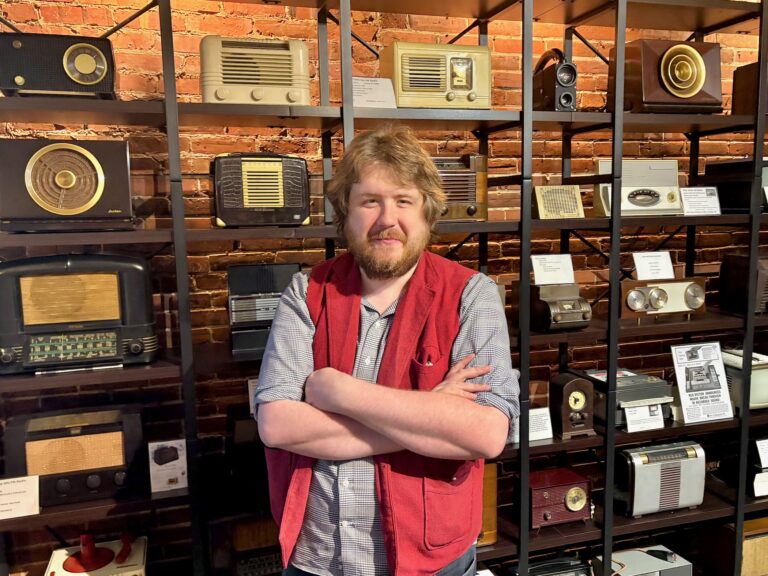
Graham Alexander, the proprietor of the Victor Vault and Victor Museum in Berlin, N.J., stands in front of a wall of historic radios built by the RCA-Victor company in Camden, NJ. (Peter Crimmins/WHYY)
From Philly and the Pa. suburbs to South Jersey and Delaware, what would you like WHYY News to cover? Let us know!
A museum about the RCA-Victor company has opened in Berlin, New Jersey, just a few miles from where the stereo and TV equipment maker was born in Camden.
The Victor Museum, tracing the company from the birth of the Victrola hand-cranked turntable in the 1890s to the collapse of the RCA corporation in the 1980s, has opened in a former office building on White Horse Pike.
It is the latest expansion for entrepreneur Graham Alexander, who bought the rights to the Victor Talking Machine Company name a decade ago with an ambition to bring the music industry back to Camden. Alexander has already opened the Victor Vault, a music performance venue, a recording studio and a record label using the century-old brand name.
“We were there for so long that we had an opportunity to expand and make a greater experience that people could be part of,” he said. “They really seem to like the history of the brand. I don’t think most people know that the recording industry from the 1890s was born in Camden.”
A musical match made in Camden
Victor and RCA were once rival companies on the consumer technology front, one making turntables and the other making radios. In 1929 they merged, like peanut butter and chocolate, to make home stereo units with a record player and a radio packaged together inside some of the finest furniture of its day.
Dozens of original Victrola players, radios and televisions in their original solid-wood consoles are on display in the Victor Museum.
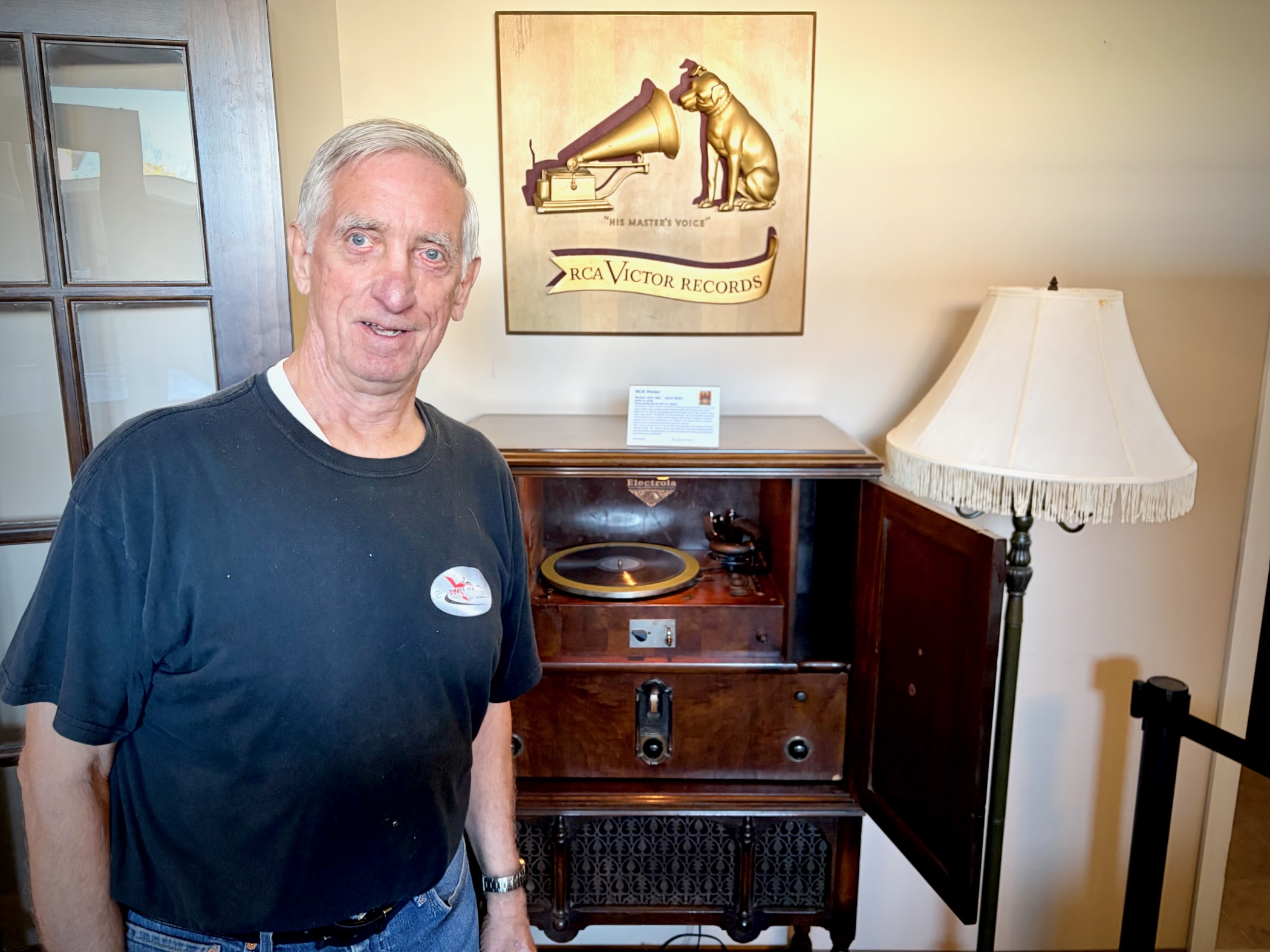
“Camden had the largest woodworking shop on the East Coast,” said Richard Reindl, a former engineer for RCA in Camden from 1973 to 2013.
Reindl has spent his retirement maintaining historic RCA-Victor equipment. Many of the pieces in the Victor Museum came from the former RCA Heritage Program Museum at Rowan University, run mostly by retired RCA employees, including Reindl.
Recently, the university spent $23.4 million to renovate its Campbell Library, where the RCA Heritage Program was based. That renovation pushed the program out.
“They asked us if we would be willing to downsize our facility. They said that we could have 10 to 15% of what they originally had allotted to us to present the museum,” Reindl said. “We decided that there would be a better opportunity for us to take what we had and move it elsewhere.”
Reindl and his colleagues moved their collection to the Victor Museum in Berlin. It is one of three regional museums focused on the local history of Victrolas: The Johnson Victrola Museum in Dover, Delaware, is run by the state of Delaware and currently closed for renovations, and the Sarnoff Collection housed at The College of New Jersey in Ewing.
Related Content

Neshaminy Mall is dead. Long live its historical dioramas
Bensalem Township is pulling seven mechanical dioramas out of the doomed mall to restore and relocate them.
2 weeks ago
The downfall of Camden’s music industry
Most of the original Victrola record players operate, or will soon operate, through the dogged determination of Reindl and his colleagues. The museum also has one of the earliest electric pianos from the 1930s, which sort of works.
“To be honest, I actually haven’t heard it turned on,” Alexander said. “My guess is that it sounds pretty bad.”
The museum has a wall of early- to mid-century radios made from materials like Bakelite plastic and natural walnut. Some of the earliest television sets from the 1940s boast “large” 10-inch screens, and RCA technology used in satellites and space flight in the 1970s and ‘80s.
Along that corporate timeline are high points of the business, such as RCA-Victor developing the first color television for the consumer market. Low points include the 1981 RCA launch of SelectaVision, a vinyl disc whose tiny grooves could hold enough information to play back movies in full color and stereo sound. Its market failure led to the company’s ruin.
“Not a laser disk. It was a vinyl record that could read and playback video and sound. It was genius. The engineering of it is unbelievable,” Alexander said. “They had a great concept which was: ‘What if we could make our record presses make movies? We can get in the movie business.’ It’s a historic failure.”
Despite hundreds of millions of dollars invested in research and development, SelectaVision could not compete with the introduction of VHS tapes from Japan, which would dominate the home video market. It was part of a string of business missteps that made RCA vulnerable to a takeover by General Electric in 1986, which then sold off RCA departments until what remained was little more than a brand name.
The rises and falls of the electronics behemoth are part of the roller coaster of the Victor museum.
“There’s something so neat about seeing a really long legacy have ups and downs, and being able to laugh about it,” Alexander said. “So many things they were ahead of the curve on, and behind the eight ball. They would introduce something, they would research and develop it and, effectively, it took down the whole company.”
-
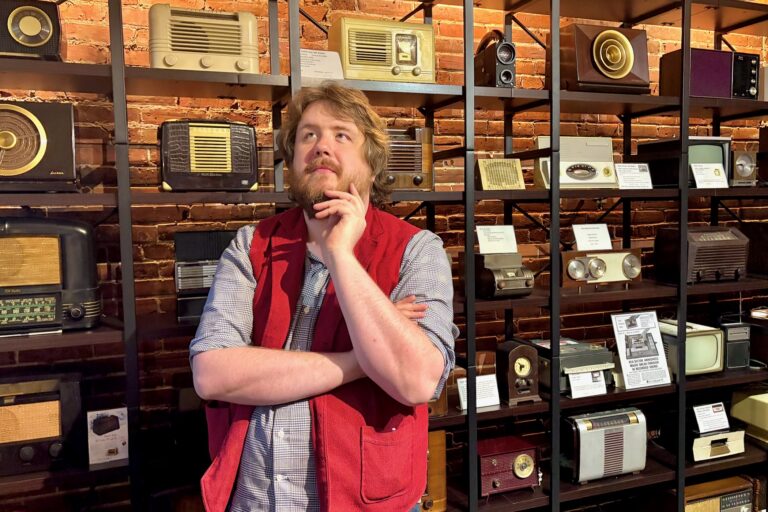
Graham Alexander, the proprietor of the Victor Vault and Victor Museum in Berlin, N.J., stands in front of a wall of historic radios built by the RCA-Victor company in Camden, N.J. (Peter Crimmins/WHYY) -

A collection of toys and figures depicting Nipper, the RCA-Victor brand icon, at the Victor Museum in Berlin, N.J. (Peter Crimmins/WHYY) -
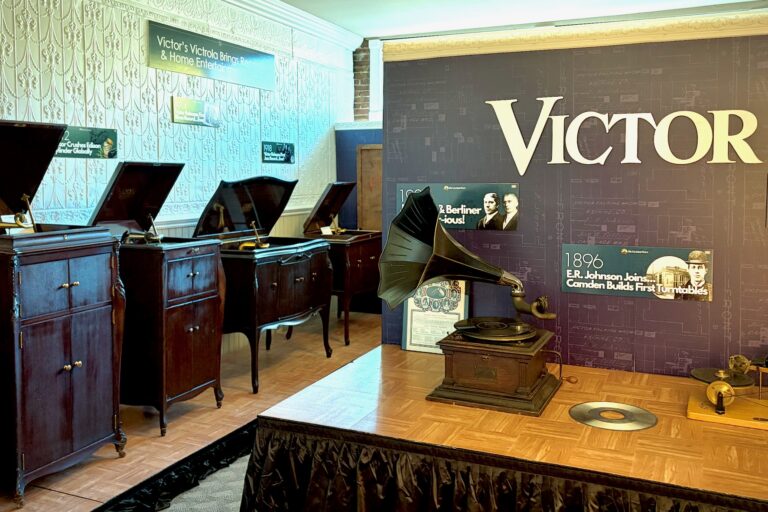
The Victor Museum in Berlin, N.J., features dozens of Victrolas and hundreds of pieces of stereo and electronic testing equipment from the history of the Camden-based RCA-Victor business. (Peter Crimmins/WHYY) -
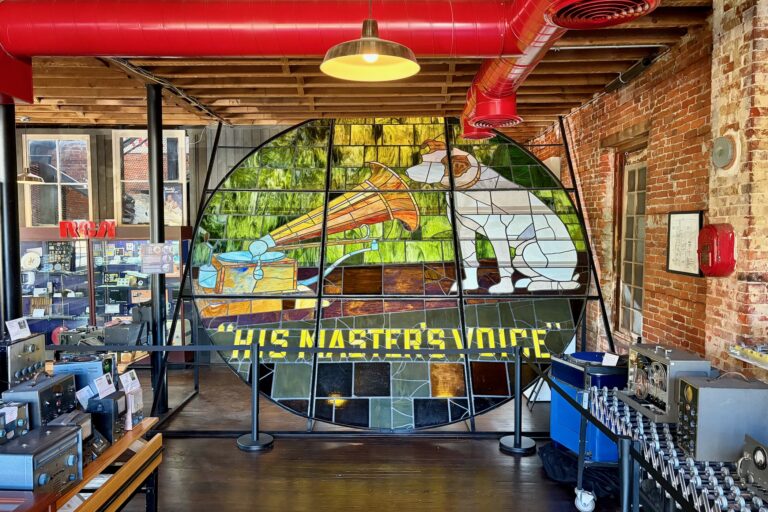
The original stained-glass window of ''His Master's Voice,'' which had been in the tower of the RCA-Victor campus on the Camden waterfront, is on display at the Victor Museum in Berlin, N.J. (Peter Crimmins/WHYY) -
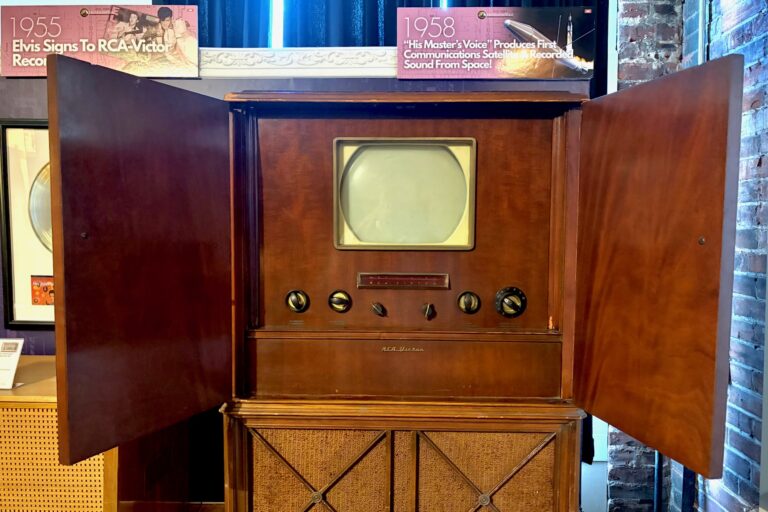
A 1940s RCA-Victor television is housed in a wood cabinet console. The 10-inch screen was considered large. (Peter Crimmins/WHYY)
The day they killed Nipper
One of RCA-Victor’s most enduring images is a terrier named Nipper peering quizzically into the brass horn of a record player. “His Master’s Voice” was painted in 1898 by the British artist Francis Barraud. In 1901, Eldridge Johnson of Camden bought the American rights to the image to be the logo of his Victor Talking Machine Company.
When RCA-Victor developed a sprawling plant in Camden as the base of all its operations, a tower was built with an enormous stained-glass window of the dog. The Nipper tower is still one of the most recognizable features of the Camden waterfront.
The 15-foot window was replaced at least a few times over the last century. The original has been reassembled inside the Victor Museum.
In 1969, RCA decided to rebrand and modernize its logo, replacing the Nipper window with the letters R-C-A in a red block font on a white background. To inform its employees of the beloved terrier’s demise, RCA installed plaques at the entrances to all its factories etched with a poetic ode to the dog.
Alexander has one of those original plaques, and recited its final two couplets:
“You can’t teach an old dog new tricks, they say.
So your time has come to call it a day.
That voice you waited for finally came through.
Only to whisper, ‘We no longer need you.’”
“Not a single person in management thought this would upset anyone,” Alexander said.
The real Nipper had died many years before, in 1895, well before the original painting was made in 1898. The artist used photographs of the deceased dog to create the composition.
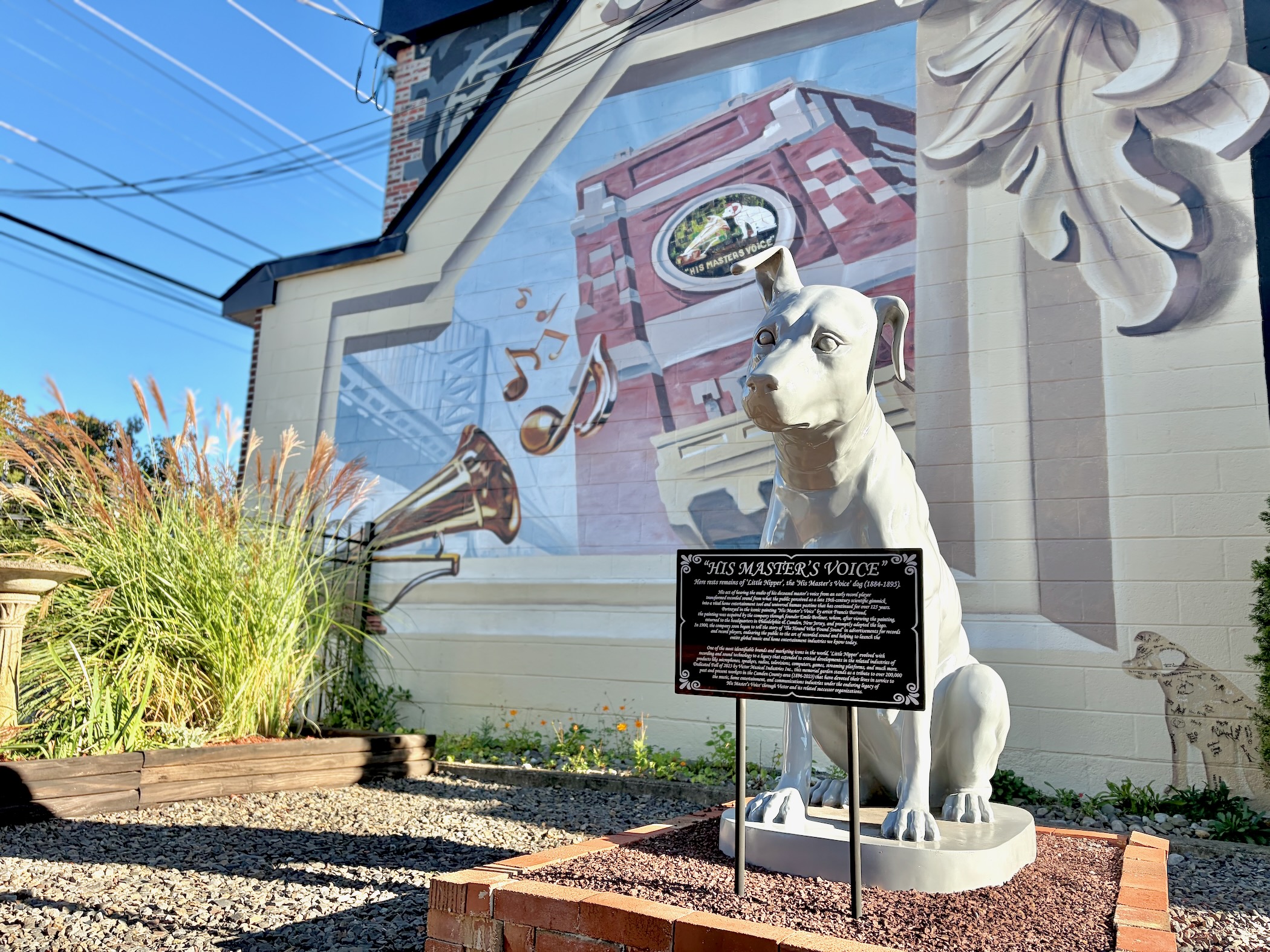
In the 1950s, an excavation of a veterinarian’s yard in Southwest London uncovered what are believed to be Nipper’s bones. In 2022, Alexander acquired those remains and re-interred them in front of his Victor Museum.
Nipper’s bones are now buried under a statue of the dog accompanied by a memorial plaque.
“This memorial garden stands as a tribute to the more than 200,000 past and present workers in the Camden County area (1896-2023) that have devoted their lives in service to the music,” reads an excerpt of the plaque.

Get daily updates from WHYY News!
WHYY is your source for fact-based, in-depth journalism and information. As a nonprofit organization, we rely on financial support from readers like you. Please give today.

Trenton’s Jersey Fresh Jam festival marks 20 years of celebrating hip-hop
The annual festival will feature graffiti, breakdancing, MCing and DJing.
1 year ago
Music never dies: Bruce Springsteen, Terell Stafford, and the industry’s future
We discuss how AI is transforming music, while artists struggle with streaming payouts. Plus, we explore the Boss's influence on our region, and lasting commentary on the US.
Air Date: July 31, 2024 12:00 pm
Listen 52:14
Bruce Springsteen’s “Born in the U.S.A.” anniversary, UArts in Philadelphia closing
The legendary album of the Boss turns 40 and we reflect on the impact of Bruce Springsteen's music and what it says about our region, country, politics and more.
Air Date: June 4, 2024 12:00 pm
Listen 50:03