

Burlington’s headquarters move to Philadelphia puts spotlight on New Jersey’s difficult business climate, experts say
Gov. Mikie Sherrill has defended her growth strategy, but advocates say the state must do more to boost competitiveness.
Listen 1:36
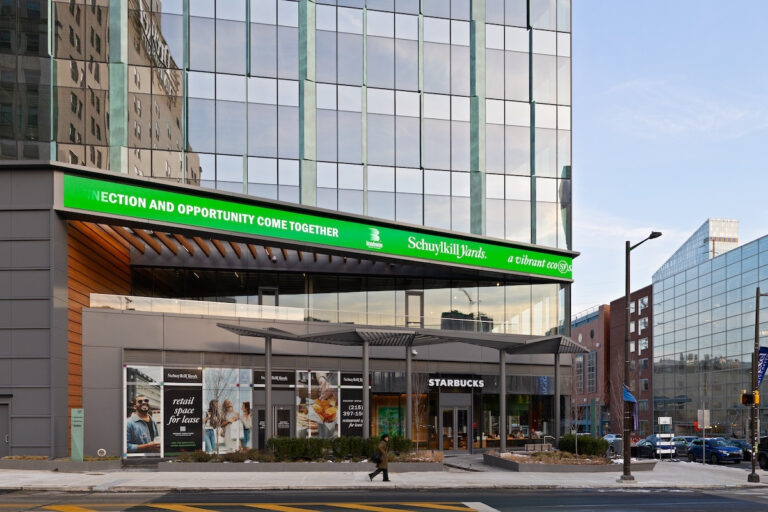
South Jersey-based clothing retailer Burlington plans to move its headquarters to a new building at 3151 Market St. in West Philadelphia. (Burlington Stores)
From Philly and the Pa. suburbs to South Jersey and Delaware, what would you like WHYY News to cover? Let us know!
Earlier this month, Pennsylvania officials celebrated an economic development coup. Across the Delaware River, New Jersey business leaders saw the latest sign of a mounting crisis.
The discount clothing retailer Burlington announced it will move its corporate headquarters — and thousands of employees — from South Jersey to Philadelphia’s University City neighborhood.
During a press conference at the company’s future offices at 3151 Market St., Gov. Josh Shapiro celebrated the prize of an additional Fortune 500 company making its home in the state and riffed on his administration’s broader economic success.
“Moody’s showed that we’ve got the only growing economy in the northeastern part of the United States,” he said. “A big part of that is because of the incredible growth that we’re seeing here in Philadelphia. A big part of that is because of our hard-nosed competitive approach to economic development.”
Gov. Mikie Sherrill did not immediately comment, but New Jersey business groups expressed distress over the loss of another marquee company and the expected economic fallout. They called on policymakers to cut the corporate income tax rate and counter the aggressive courting of companies by Pennsylvania, Texas, Florida and other states.
“This announcement should reinforce the urgency of making our state more affordable and competitive,” said Christina Renna, president of the Chamber of Commerce Southern New Jersey.
New Jersey cannot afford to lose more big employers, she and others said. The state is already routinely listed as having one of the nation’s weaker economies; in the October 2025 Moody’s analysis cited by Shapiro, it’s one of 22 states listed as already being in a recession, and it’s unclear if any new economic stimulus efforts are coming.
Asked last week whether Sherill was working on measures to retain corporations, her office pointed to her efforts to streamline permitting and make government more responsive.
A spokesperson also cited recent expansion announcements by three biopharmaceutical firms — BeOne, Celltrion and Celularity — and a 45% increase in the number of films produced in the state this year.
“While we are disappointed by Burlington’s decision to relocate its headquarters, the company will continue to maintain a significant presence and thousands of jobs here in New Jersey,” the spokesperson told WHYY News. “Gov. Sherrill remains focused on strengthening our business climate, attracting new investment, and creating more opportunities and good-paying jobs for New Jersey workers and families.”
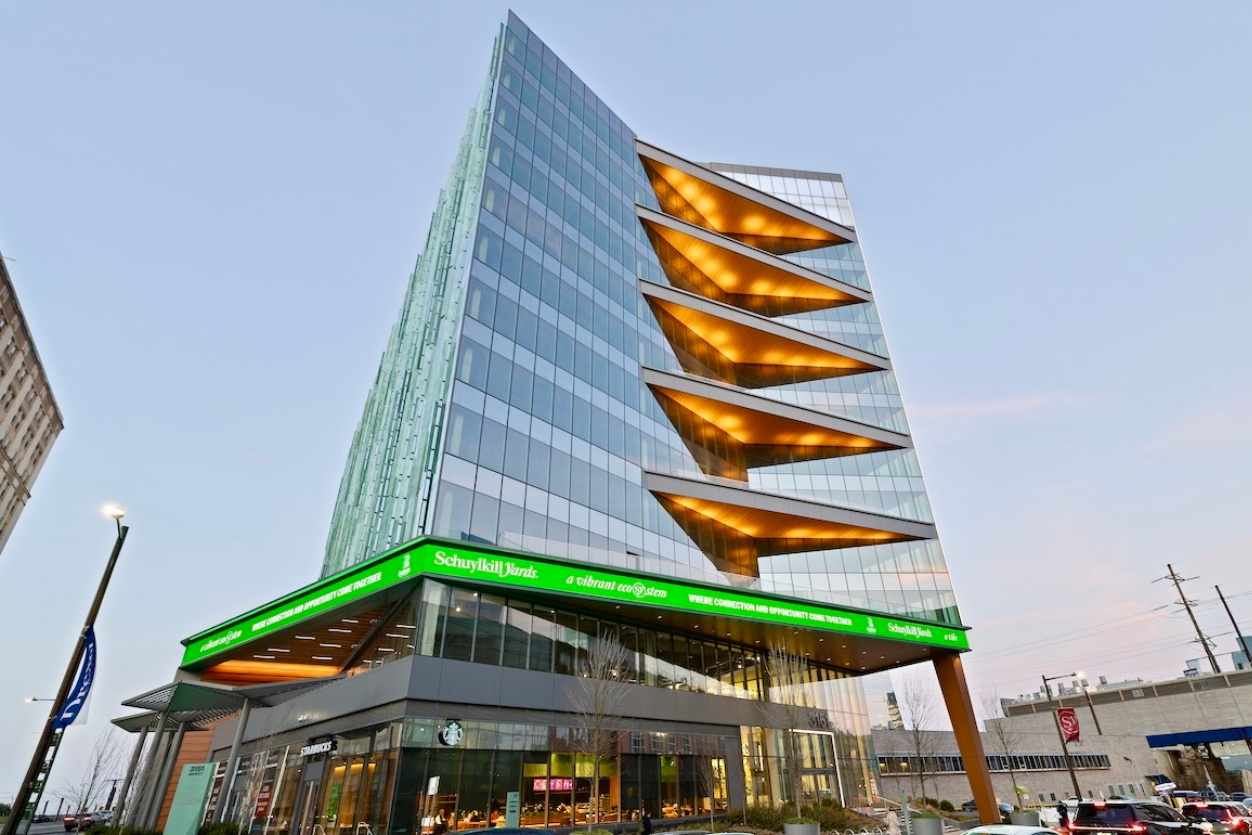
Rebranding as a ‘next-gen player’
Burlington decided to move as part of a post-Covid consolidation of employees who work at three sites in South Jersey, the Philadelphia Business Journal reported.
During the search for a new home, CEO Michael O’Sullivan prioritized buying a space that could accommodate all those workers and provide easy access to the company’s New York offices via train. Burlington ended up spending $240 million to buy the office building in Schuylkill Yards, steps away from Amtrak’s 30th Street Station.
In addition to the brand-new, Class A office space, the dynamism of a big city and the opportunity to draw talent from nearby universities likely made the West Philly site attractive, said John Boyd, a corporate relocation specialist whose company is active in the tri-state region.
Burlington will reportedly move 1,600 employees to the new office and hire another 400 to work there.
“Burlington and so many of its competitors are really becoming high-tech companies with respect to software, incorporating artificial intelligence into optimized buying, optimizing their supply chains,” he said. “Those relationships with universities like Drexel and UPenn and Temple bring a lot to the table.”
The decision also underlines a broad change in how firms approach headquarters relocations in the era of hybrid work, Boyd said. Moves are no longer seen as mere shufflings of real estate and people.
Burlington reportedly explored relocating to towns near Amtrak stations in New Jersey, including Trenton, Princeton and New Brunswick, but ended up opting to cross the river.
“They view the relocation process as an opportunity to rebrand the company, to turn a page in the company’s history,” Boyd said. “This is a company with a storied history in New Jersey, 54 years in New Jersey. This is Burlington becoming a next-gen player in the retail space, and this new Philly headquarters allows them to do that.”
Related Content
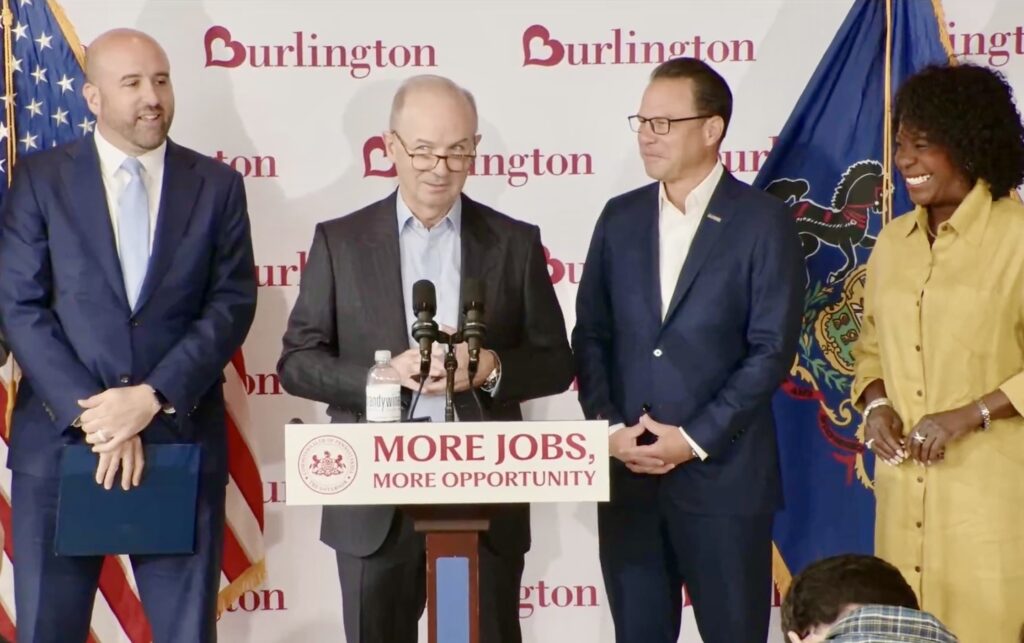
The fast-growing company will spend $370 million on the move and receive nearly $40 million in state and city incentives.
1 month ago
Listen 1:12An ‘indictment’ of N.J.’s business climate
State tax incentives also played a role in the company’s decision, as they have during previous transitions.
In 2012, Burlington was considering relocating its headquarters across the state line to Bensalem, but decided to build a new headquarters in Burlington County after winning $41 million in tax credits. It agreed to stay in New Jersey for 15 years — a term that will soon expire, allowing the company to move.
It will receive a similar sum in incentives for coming to Philadelphia, totaling about $38 million. Pennsylvania will provide a $20 million Redevelopment Assistance Capital Program grant and a $10 million Pennsylvania First grant, while the city will give the company a $7 million forgivable loan and Job Creation Tax Credit that could be worth about $1 million.
The award package was “the icing on the cake,” Boyd said.
Burlington said in a statement that its decision to move was “in no way a reflection of the current business climate in New Jersey,” and noted that it will still have several thousand employees in the state, including a distribution center in Edgewater Park and a facility in Logan.
But Boyd said it’s hard not to conclude that the state’s corporate income tax — the highest in the nation at 11.5% — played a role in the move, along with high property taxes and a stringent regulatory environment.
“There’s this indictment of New Jersey’s very difficult business climate,” Boyd said. “Burlington is the latest in a long wave of major corporate headquarter relocations out of the Garden State over the past decade, most recently Samsung.”
Samsung Electronics announced in June that it was moving its headquarters and about 1,000 jobs from Englewood Cliffs to Plano, Texas. Critics also point to ExxonMobil’s recent decision to move its legal incorporation to Texas after 140 years in New Jersey, as well as past relocations by Honeywell in 2018 and Mercedes-Benz in 2015.
Kristi Howell, president of the Burlington County Regional Chamber of Commerce, noted that her county lost a Dietz & Watson distribution center to Philadelphia in 2014 and an Ocean Spray bottling plant to the Lehigh Valley in 2012.
“There’s a couple of counties in our state that are very vulnerable to Pennsylvania stealing our business and New York stealing our business,” she said. “Not that they’re necessarily stealing our business. We’re kind of letting our businesses walk away.”
New Jersey ranks 49th on the Tax Foundation’s State Tax Competitiveness Index, higher only than New York. Pennsylvania is 36th, while Texas is seventh and Florida is fifth.
New Jersey also ranks near the bottom for job growth, with a non-farm workforce that shrank by 0.4%, or 19,600 workers, over the 12 months ending in July, according to federal government data. In Pennsylvania, meanwhile, the workforce grew by 0.5%, or 31,900 workers.
Related Content
The analysis looked at six factors, including a range of taxes and the minimum wage in seven northeastern and mid-Atlantic states.
4 months ago
A focus on cutting red tape
Sherrill’s office said she’s aware of the problem.
“Gov. Sherrill has been clear that she is committed to making New Jersey the best place to start and grow a business, but right now, it is simply too hard to do business in our state,” her spokesperson said in a statement. “Permitting takes too long, regulations are difficult to navigate, and unnecessary delays stand in the way of investment, expansion, and job creation. That is why the governor is moving quickly to make government more responsive, efficient, and business-friendly by streamlining permitting, increasing accountability, and engaging directly with New Jersey’s business community.”
Shortly after taking office in January, Sherrill ordered a 90-day pause on new regulations “to ensure they make life easier and more affordable.” She later directed the state’s environmental, transportation and community affairs departments to conduct in-depth permitting reviews to reduce delays, and required all state agencies to inventory their permits and approvals to identify outdated and duplicative requirements.
However, business leaders say they’re impatient for more aggressive action to juice the state’s flagging economy.
While Howell blamed former Gov. Phil Murphy and previous administrations for approving “bad policy,” rather than the recently elected Sherrill, she also said there’s no sign of incipient tax changes or programs to retain and attract businesses. “Not that I’m aware of,” she said. “Lots of promises.”
In addition, the state budget the governor signed in June represented a missed opportunity, she said.
Republicans and business groups criticized the budget for effectively increasing taxes by limiting alternative business income adjustments for high earners and temporarily capping a deduction for net operating losses. It also created a new fee on some employers whose workers use Medicaid.
Howell said the state’s revised “ABC test”, which will tighten rules on classifying workers as independent contractors, could stifle the gig economy and further reduce the state’s competitiveness.
“Everything hurts,” she said. “The increase several years ago of paid sick leave, the raising of the minimum wage. Everything just chips away at businesses. I’m not saying that we shouldn’t do it. We need to do things to protect our employees. But we also need to protect the employer, or the employer is not going to be here much longer.”

Get daily updates from WHYY News!
WHYY is your source for fact-based, in-depth journalism and information. As a nonprofit organization, we rely on financial support from readers like you. Please give today.
The analysis looked at six factors, including a range of taxes and the minimum wage in seven northeastern and mid-Atlantic states.
4 months ago

Businesses give thumbs down to N.J. governor’s proposed transit fee
A top Jersey economist says the governor’s corporate transit fee proposal could hurt the state’s business climate. Business groups agree.
3 years ago
Listen 1:17
Philly Council bill would outlaw cashless businesses
Councilman William Greenlee thinks cashless businesses are classist.
8 years ago