

Mazzoni Center to launch its first clinical trial as the health organization brings more LGBTQ+ research options to Philly
The clinical trial is part of the center’s new research division, which aims to expand health care research opportunities in LGBTQ+ communities.
Listen 1:05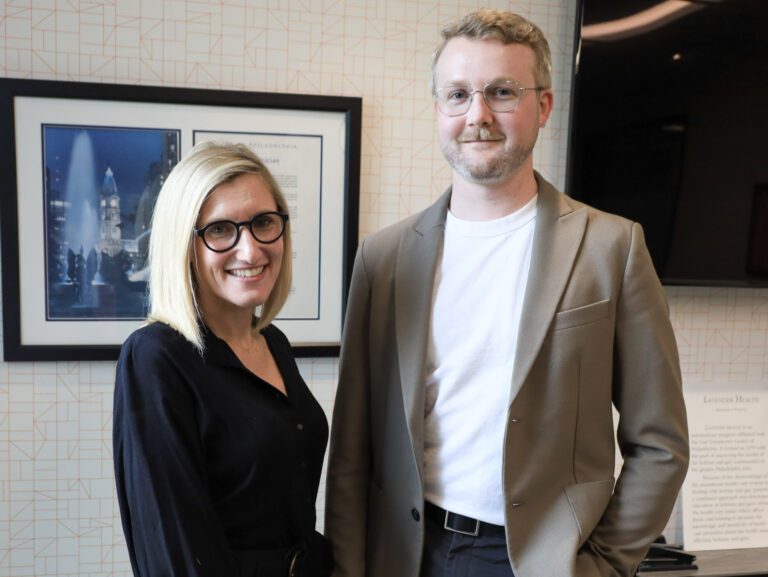
At the Mazzoni Center in Philadelphia, Dr. Stacey Trooskin (left), chief medical officer, and Wil Vickroy, director of clinical research, oversee a new research department focused on health outcomes, treatment options and experiences of patients in LGBTQ+ communities. (Nicole Leonard/WHYY)
From Philly and the Pa. suburbs to South Jersey and Delaware, what would you like WHYY News to cover? Let us know!
Patients at the Mazzoni Center in Philadelphia will soon have access to emerging therapies and medications through a new research initiative at the health care organization.
The center is launching its first clinical trial later this month, which will be open to current and new patients interested in using new kinds of HIV prevention options.
The clinical trial will enroll trans and non-gender-conforming patients and study the use of one type of pre-exposure prophylaxis, or PrEP, medication that is taken orally once a month to prevent HIV infections. The trial will continue to enroll patients through early next year, and data will be collected through the end of 2027.
It’s part of the Mazzoni Center’s new research department, which was created to bring innovative health care choices to its LGBTQ+ patient population at a time when federal funding for similar research has sharply declined.
“I think it’s more important now than ever to make sure that our patients are represented in research,” said Dr. Stacey Trooskin, the center’s chief medical officer. “We want to be able to offer cutting-edge therapies to our patients and prevention as well.”
Research on health outcomes in LGBTQ+ populations generally lags behind studies involving other patient populations, said Wil Vickroy, director of clinical research at the Mazzoni Center.
And even when studies are done in this space, Vickroy said the research doesn’t always include or represent everyone in LGBTQ+ populations.
“There are not enough studies that capture sexual orientation and gender identity information, and so there’s just kind of a big question mark around how many people from the community are represented in these bigger clinical trials that have really steered modern care,” he said.
That can make it challenging for health providers to recommend specific treatments, therapies or prevention tools when they’re unsure how certain patients might use them, Trooskin said.
“It’s so important for providers to not have to generalize or extrapolate data where certain patient populations are not represented, where we’re left having to make our best guess,” she said. “The more firm data that we have, the better decisions we can make for our patients.”
Related Content
Inside Pa.’s measles vaccination efforts as statewide outbreak infects over 1,200
The state pop-up measles vaccine clinics are hosted at small venues in communities with pockets of unvaccinated residents, including in Lancaster County.
3 weeks ago
Listen 2:18Center leaders said that’s one of the main goals in developing a research program at Mazzoni, where their work can start to fill in those research gaps.
Patients already have trusted relationships with health care providers at the center, where they may get their primary care, behavioral health services, sexual and reproductive health care, medications, PrEP, and more, Trooskin said.
“We want to be able to bring clinical trials and research to them that is meaningful, that has the potential to improve their lives and the lives of their community members,” she said. “Part of the reason why we’ve decided to build this program is that we want our patients to be able to access these new therapies and new opportunities in their medical home.”
The first clinical trial will evaluate the safety and efficacy of the PrEP medication, but Vickroy said they’re also interested in capturing the patient experience, or how the medication makes someone feel in relation to their identity and their perceptions of HIV treatment.
“We know that HIV still in 2026 remains a highly stigmatized condition,” he said. “We still need to know more about how these medications may remind someone of their status or maybe make daily life a little bit easier in terms of maybe not having to remember to take a pill every day, having options that just fit a little bit more into people’s day-to-day lives.”
Mazzoni leaders said they’re working to educate health care providers at the organization and make sure they are aware of clinical trials and studies that might become available to their patients.
“When you participate in a trial, you’re potentially accessing things that won’t be available to the general population for many, many years,” Vickroy said. “So, I think there’s a lot of incentive for providers to get to offer that to their patients.”
They said they hope to engage patients and educate them about research participation when they come in for regular care.
“And if someone does decide to enroll, we’ll usually collect medical history, any concomitant medications, things like that and make a plan for what their participation will look like,” Vickroy said.
He said the most important thing they can do is to stress to patients that the center’s research will prioritize long-term health outcomes and novel treatment options for LGBTQ+ communities, for patients today and in the future.
“Bringing that into the community, saying, ‘This is the actual real-world impact of what it is that you’re participating in. This is how the data that we’re getting from you is going to be used to help others in the future and why we’re asking you these questions or why we’re bringing you in to do this,’” he said.
The upcoming clinical trial will be the first of many, Trooskin and Vickroy said. They added that they hope to grow the research program so that more patients can be directly involved in the science behind treatment options and care.


Get daily updates from WHYY News!
WHYY is your source for fact-based, in-depth journalism and information. As a nonprofit organization, we rely on financial support from readers like you. Please give today.

Amid funding threats, Philly’s Mazzoni Center marks World AIDS Day by recommitting to the fight
Public health experts, including Dr. Anthony Fauci, called for continued funding for HIV prevention and treatment programs during a Mazzoni Center event.
11 months ago
Listen 1:21
Looking at gender’s many sides, and keeping kids’ safety and inclusion in mind
Navigating the world as a young transgender person can be challenging. That’s true even in places some might think it’s safe, like the health-care system.
7 years ago
Listen 4:53
LGBTQ-focused therapy center offers scholarships for transpeople of color
Lesbian, gay and bisexual adults are more than twice as likely as their non-identifying peers to experience a mental-health condition.
7 years ago