

Philadelphia Museum of Art’s ‘Marcel Duchamp’ retrospective tries to contain an artist who refused to be contained
More than a joke about a urinal, Duchamp’s museum retrospective traces a shape-shifting artist who defied museums.
From Philly and the Pa. suburbs to South Jersey and Delaware, what would you like WHYY News to cover? Let us know!
The Philadelphia Museum of Art’s comprehensive retrospective “Marcel Duchamp” presents the artist’s work in a chronological timeline.
“Chronology seems like a very simple, straightforward logic for an exhibition,” said co-curator Michelle Kuo, of New York’s Museum of Modern Art. “But as with all things Duchampian, what seems normal actually becomes very strange.”
The exhibition starts with sketches Duchamp made of his sisters when he was a teenager, then proceeds through his impressionist and Cubist phases, his conceptual Readymades and ends with a screentest the 79-year-old artist shot for Andy Warhol in 1966.
The exhibit’s 300 objects are meticulously presented on the timeline. Rather than simplifying the narrative of the artist’s life, the arrangement highlights Duchamp’s complexity: His works looped backward and echoed forward over his lifetime.
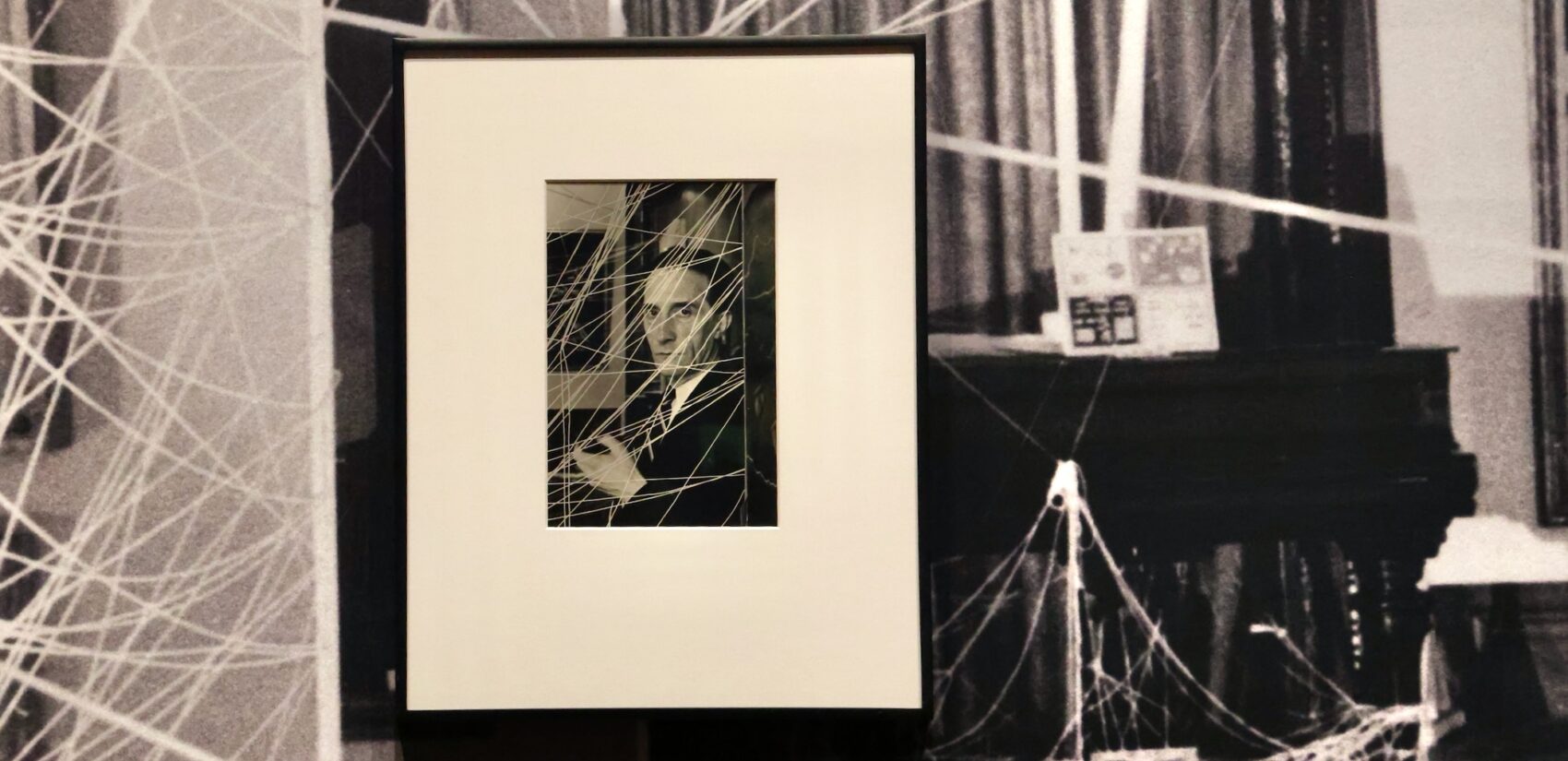
While chronological, the exhibition is not linear.
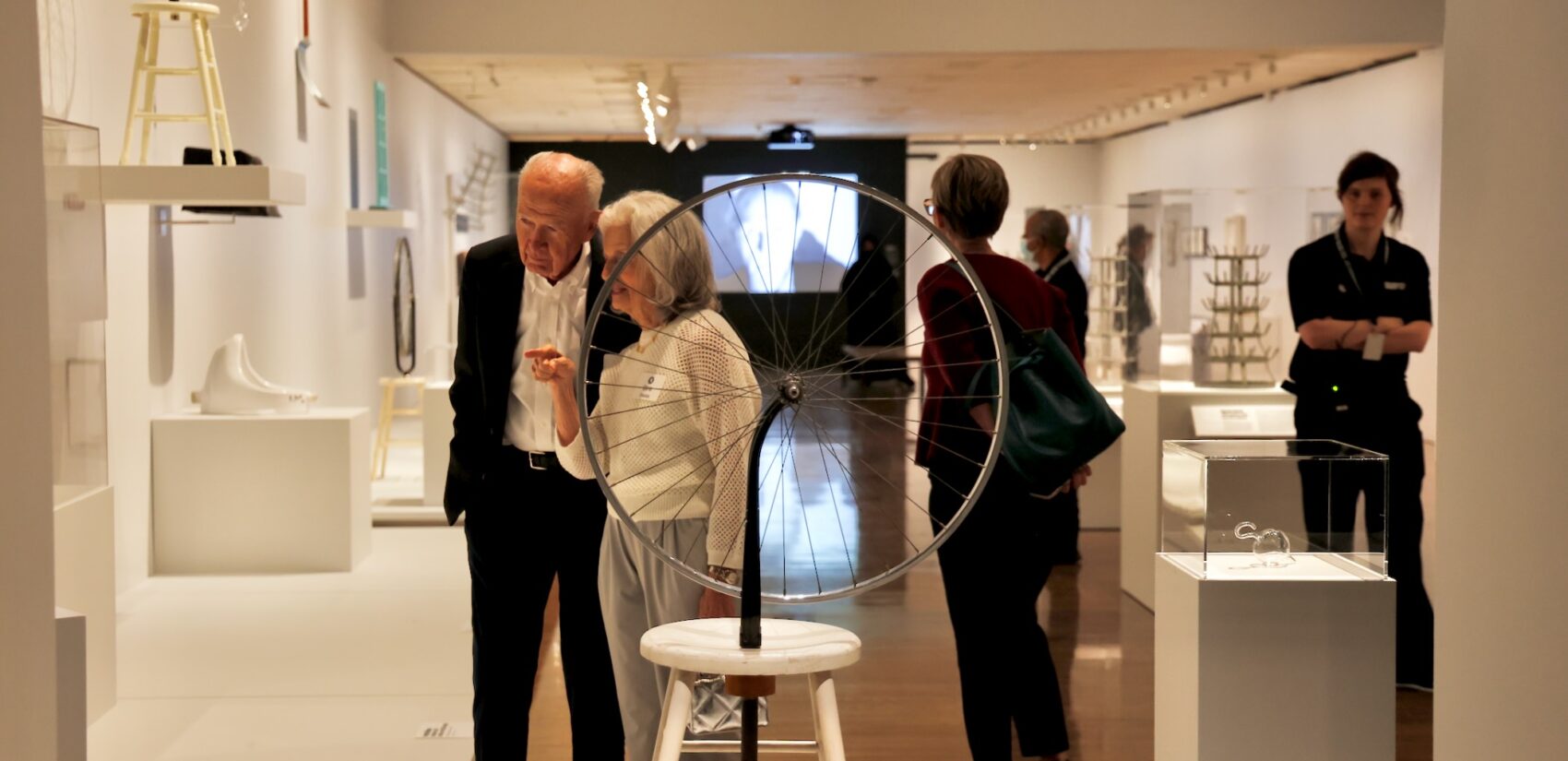
For example: Readymades, commonly fabricated objects such as a mounted bicycle wheel or a urinal that Duchamp presented as art beginning in 1913.
Readymades were more interesting as concepts than as precious objects. Many were discarded immediately after their initial exhibition. The original Readymades no longer exist. Decades later, Duchamp made facsimiles called “Certified Genuine Copies.” They do not appear until late in the exhibition, in a section about the 1950s.
“The linear rhythm of the work is, at the same time, circular,” said co-curator Matthew Affron, of the PMA. “We think that this method of presenting his life’s work has that great advantage. It tells you something very true about the strange and unique shape of his body of work.”
A mercurial artist who defied definition
The exhibition is the first major retrospective of the seminal 20th century avant garde artist in 50 years. “Marcel Duchamp” is a project of the PMA and the MOMA, the same museums that produced a retrospective in 1973, five years after Duchamp’s death.
The Philadelphia Museum of Art is widely considered ground zero for Duchamp, having the largest collection of his work in the world. In 1950, Duchamp and his most fervent collectors, Louis and Walter Arensberg, decided that the PMA would be the recipient of most of the Arensbergs’ modern art collection, including all of their works by Duchamp, which would have their own dedicated gallery.
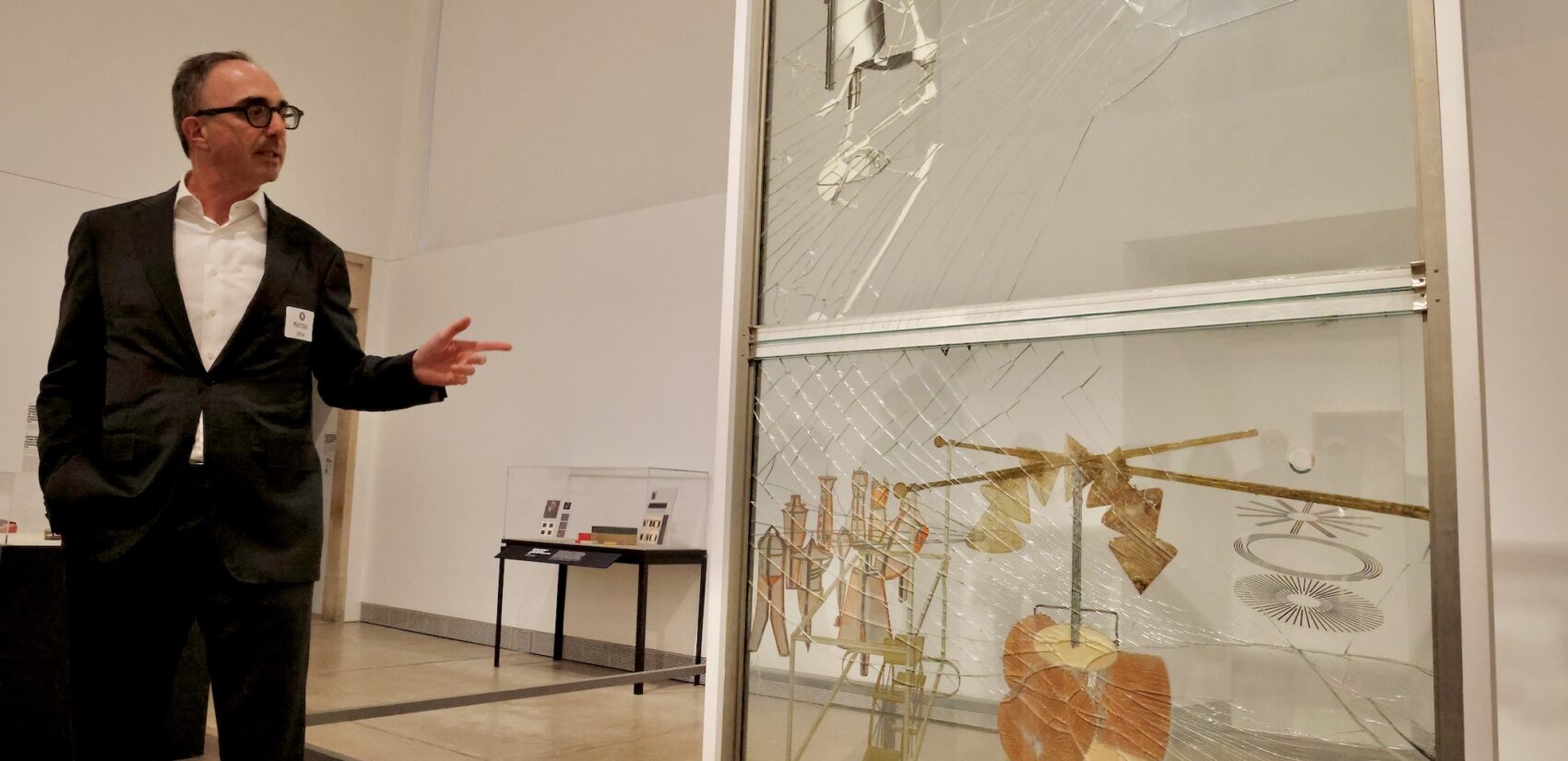
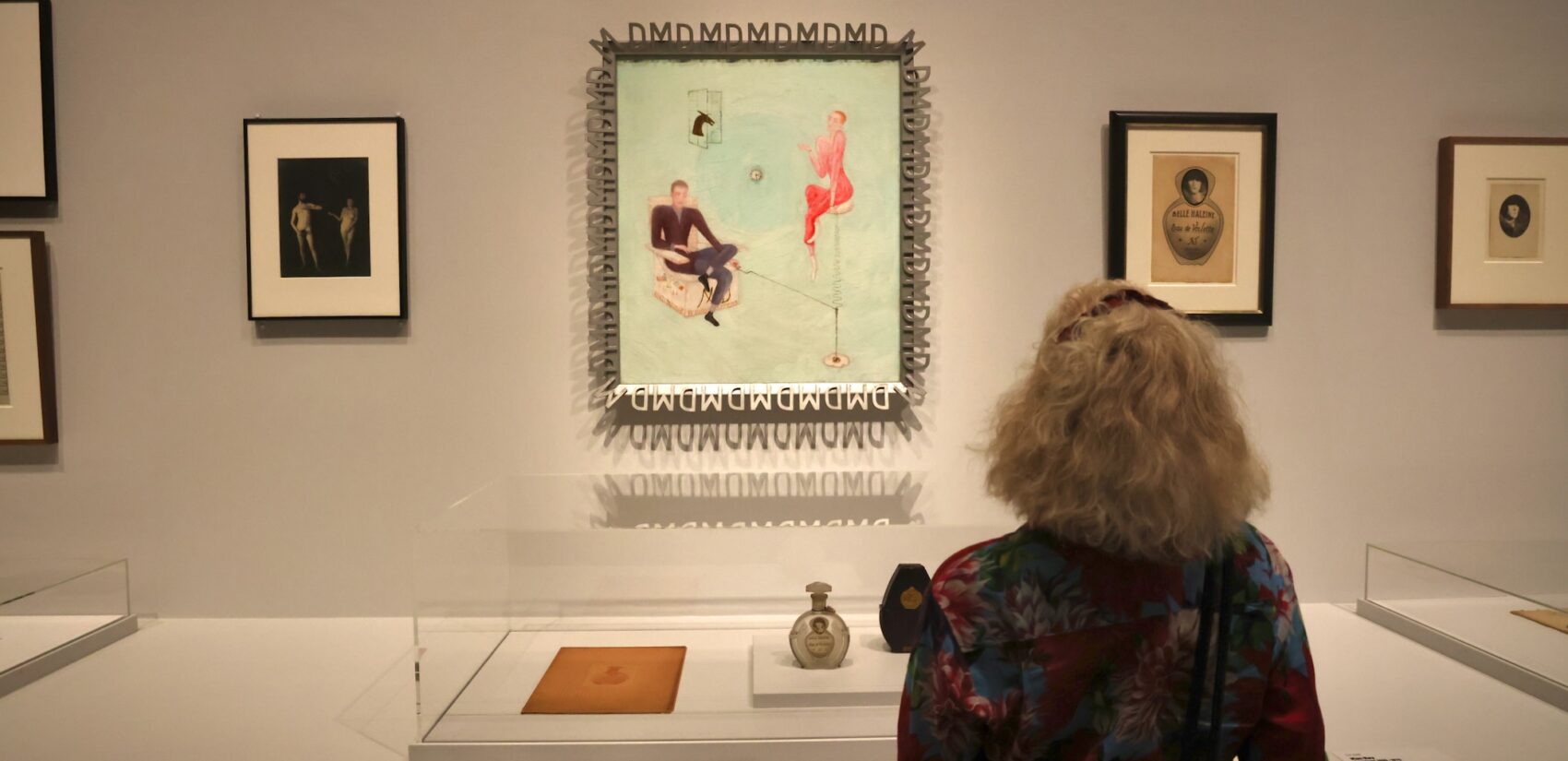
In a televised interview made a few years after the Arensbergs’ donation, Duchamp described how pleased he was that a large body of his work was intact in Philadelphia.
“I always felt that showing one painting in one place, and another place, it’s just like amputating one finger each time,” Duchamp said in the 1956 interview. “Here, I feel at home, my house. I’ve never had such a complete feeling of satisfaction.”
That satisfaction was complicated by an underlying wariness of museums. Affron said Duchamp had qualms about the institutional function of art museums.
“It’s an interesting paradox that Marcel Duchamp said he didn’t really like visiting museums. He was suspicious of their authority. He thought they gave too much weight to what is already in the past,” Affron said. “At the same time, he knew that he needed the institution of the museum to take care of the legacy of his work so that future generations — us — could evaluate it.”
Related Content
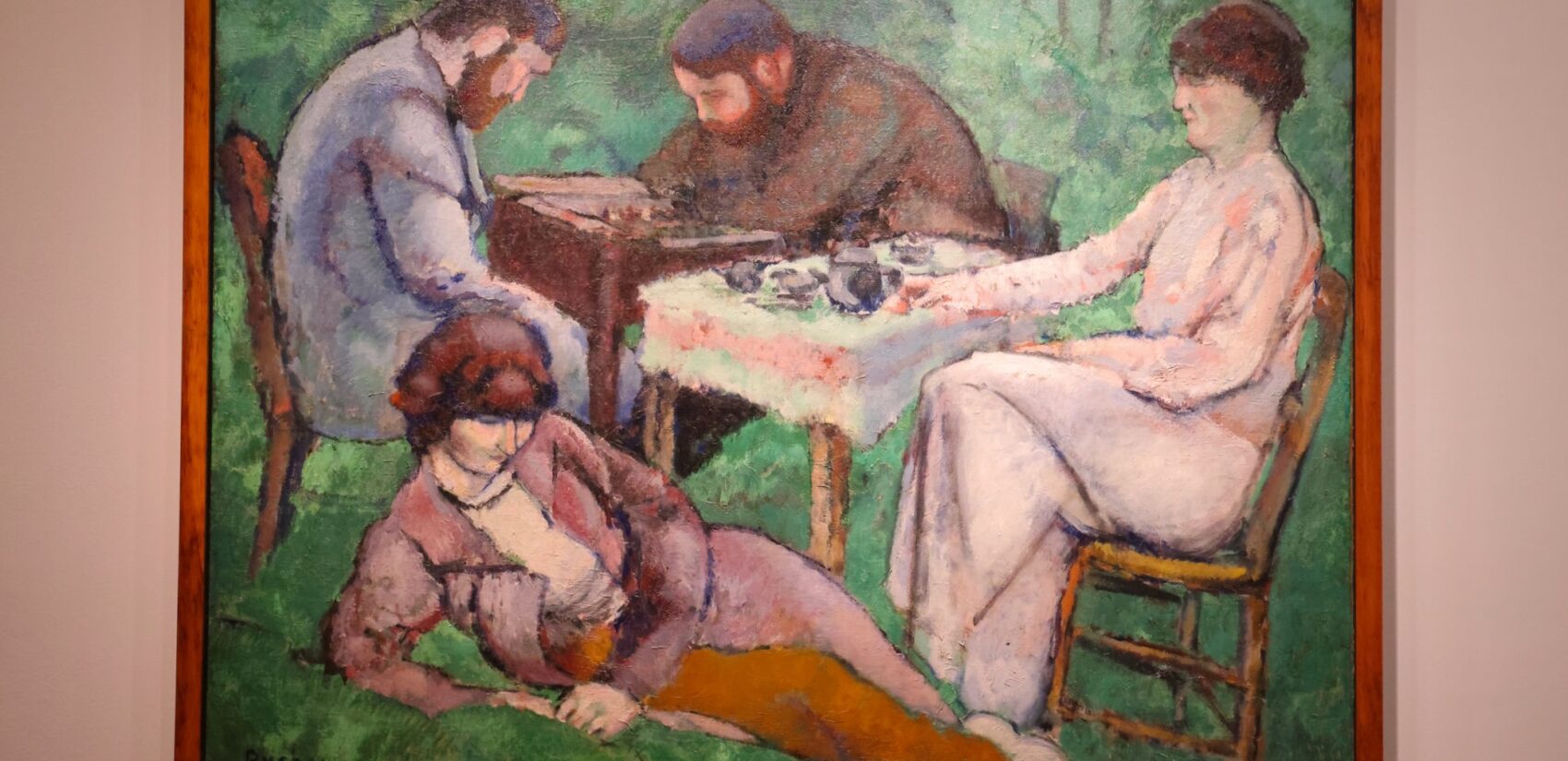
The exhibition “Marcel Duchamp” digs into the artist’s mercurial and contradictory career. His early work was in line with established artistic tastes. “The Chess Game” (1910) depicted one of Duchamp’s lifelong passions, is in an impressionist vein and he quickly adapted other styles, such as Matisse’s Fauvism, like he was trying on shirts.
“What you see in the first couple of galleries is a young person starting to take what he called his ‘swimming lessons,’” Affron said.
Duchamp stepped into the forefront of the artistic vanguard when he began painting in a cubist manner, where he achieved lasting fame with “Nude Descending a Staircase.” The painting was rejected by the gatekeepers of the cubist movement, who did not allow it to be shown in the Paris Salon des Indépendants in 1912 because it did not align with the rules of cubism.
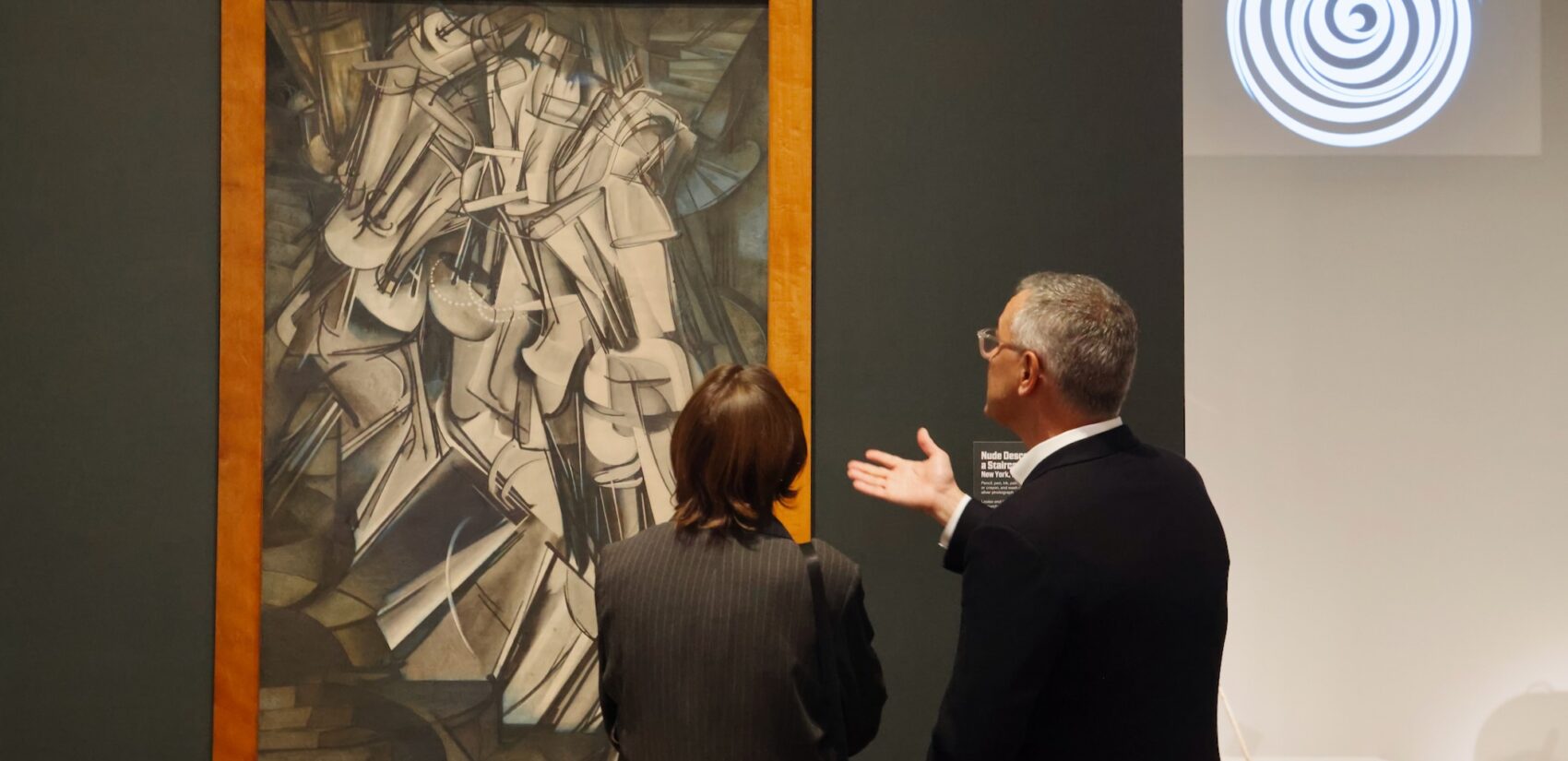
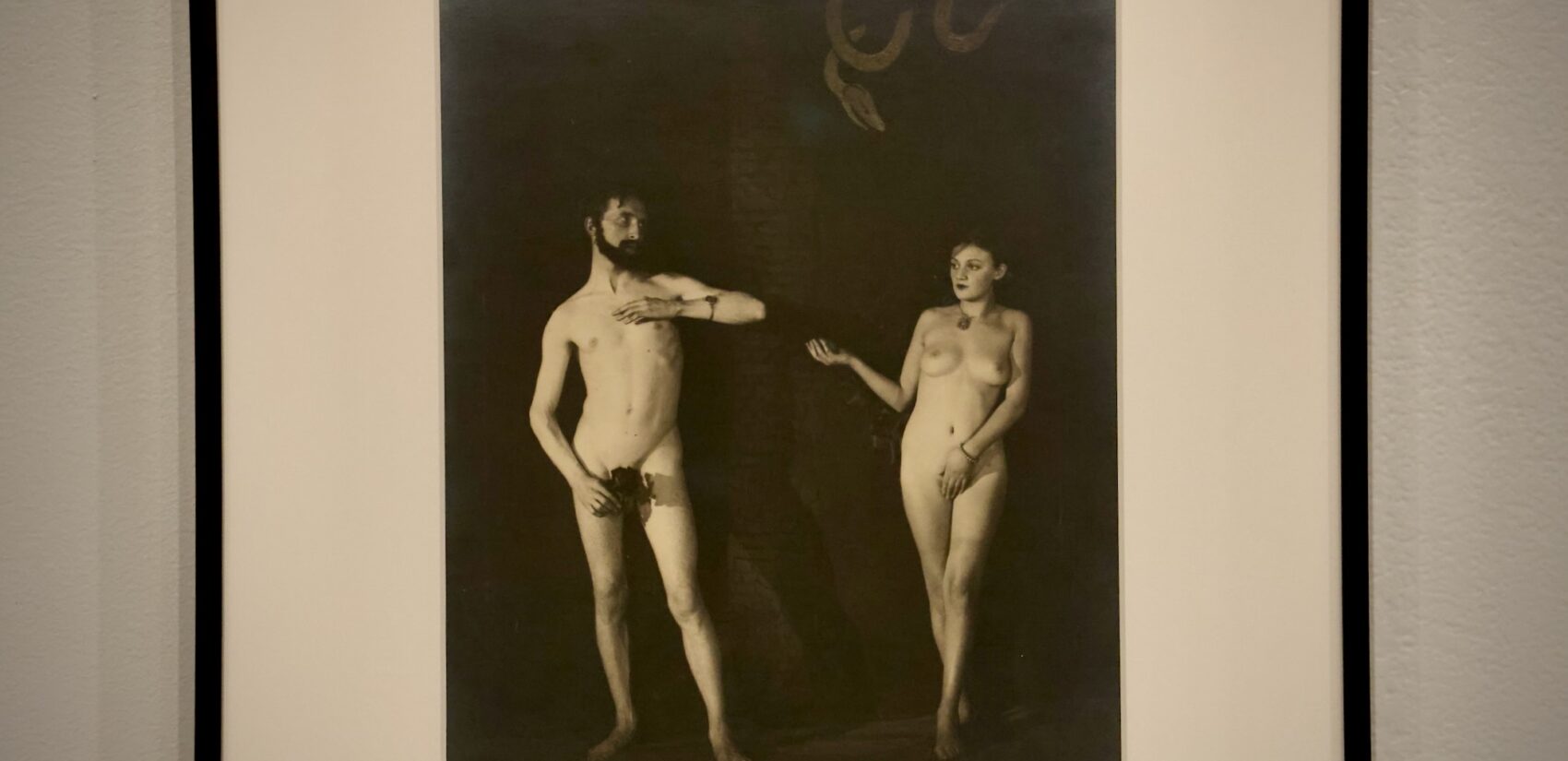
Nevertheless, “Nude Descending” was later displayed at the 1913 Armory show in New York City, where Duchamp was celebrated as the pinnacle of European avant garde.
“Right afterwards, the 25-year-old Duchamp did something I think even more amazing: He decided that he was going to totally change course and not continue being a cubist painter and not continue being an oil painter,” Affron said, “in order to free himself from the expectations of anyone and spend the rest of his life inventing other ways of being an artist.”
A legacy of ideas
After “Nude Descending,” the exhibition starts looking looking less like white-cube galleries and more like a curated attic: an odd sculpture made of twine, an enamel advertisement, a paned window frame, a birdcage filled with marble cubes resembling sugar and a 6-foot tall, motorized optical illusion machine that spins to life for five minutes every day at 11 a.m. and 3:30 p.m.
“These were works that really pushed him as far as he could go away from ordinary definitions of what is originality in art,” Affron said of the works made in the late 1910s and early 1920s. “What is financial value in art? What is the importance of the artists making the thing? Many of the criteria of what we value in a work of art was not thrown away but put into question.”
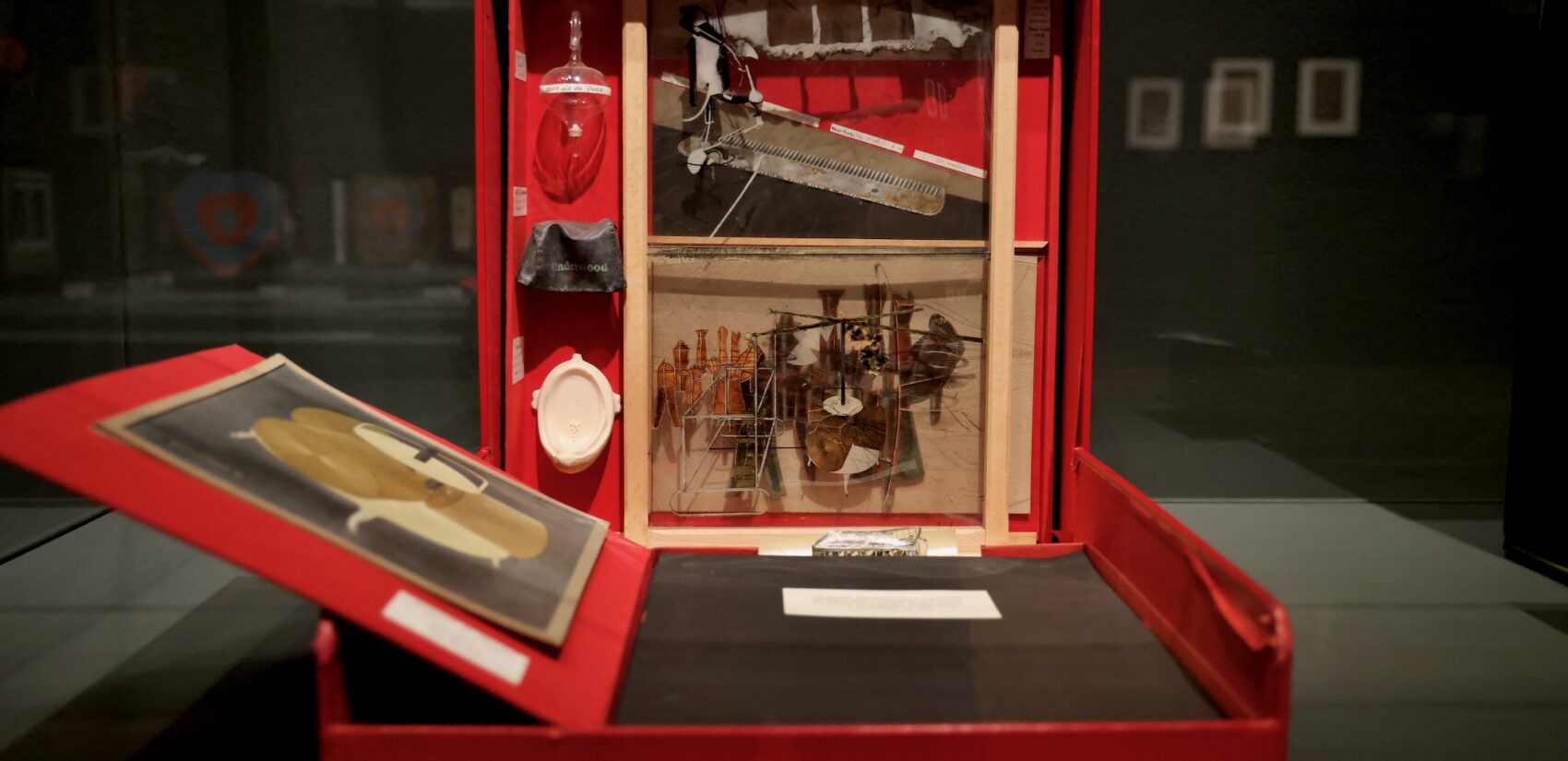
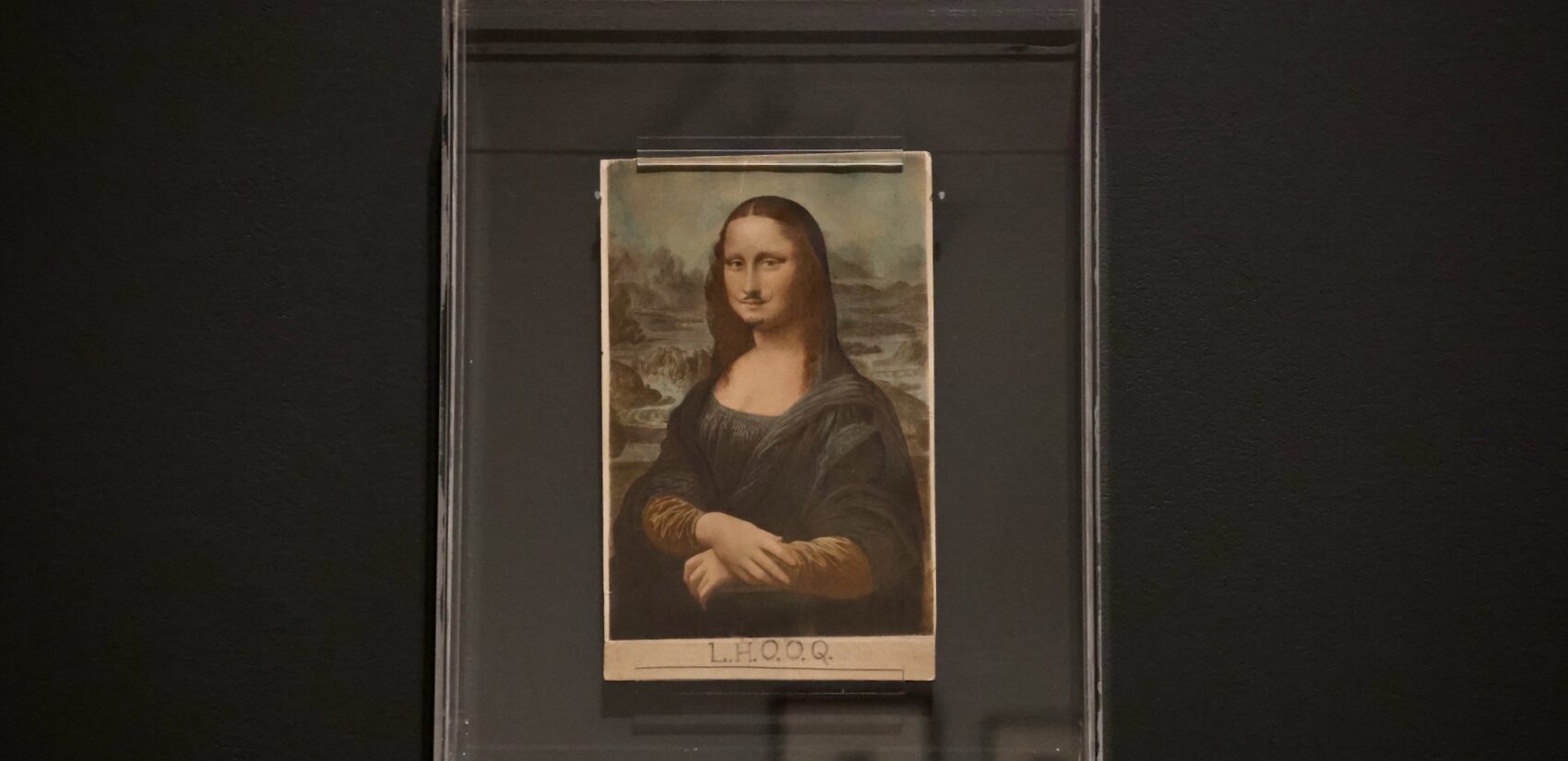
After spending decades disassembling the sanctity of the art objects, in the 1940s, Duchamp began quoting himself in his “Box in a Valise.” He made miniaturized versions of his more well-known pieces and assembled them into carrying cases that he thought of as portable museums. They were mostly given privately to friends and supporters.
There are 10 “Boxes in a Valise” in the exhibition, which Affron says is the most ever assembled in one place.
The PMA is the second of three stops for “Marcel Duchamp.” It has already had a run at MOMA, and a version will be at the Grand Palais in France next year.
Co-curator Ann Temkin said generations of artists who came after Duchamp have been influenced by his ideas, even if they don’t realize it.
“These artists, who could be in their 60s, who could be in their 20s, are like, ‘Oh my god, everything I make and every way in which I approach my work is so focused on the legacy of Duchamp and yet these are things I’m seeing, for the most part, for the first time.’” Temkin said.
“Marcel Duchamp” will be at the PMA until Jan. 31.

Get daily updates from WHYY News!
WHYY is your source for fact-based, in-depth journalism and information. As a nonprofit organization, we rely on financial support from readers like you. Please give today.
Philadelphia’s ‘portal’ is leaving City Hall, searching for a new home
Organizers are looking for a new Philly home for the livestream attraction.
3 months ago
Best of Philly tourism: Off-the-beaten-path edition
We rounded up the coolest spots in Delaware, New Jersey, Philadelphia and the suburbs for food and drink, outdoor activities, attractions worth the cost and free things to do.
Air Date: April 3, 2025 12:00 pm
Listen 37:47
Art rugs put artificial intelligence underfoot in Philly exhibit
The Paradigm Gallery in Old City features rugs fabricated by Tuft the World, but designed by a robot.
3 years ago