

Federal judge refers Philadelphia DA Larry Krasner to U.S. Attorney’s Office over possible crimes
The judge says Krasner and one of his top aides may have committed perjury, obstruction of justice and conspiracy.
Listen 0:55
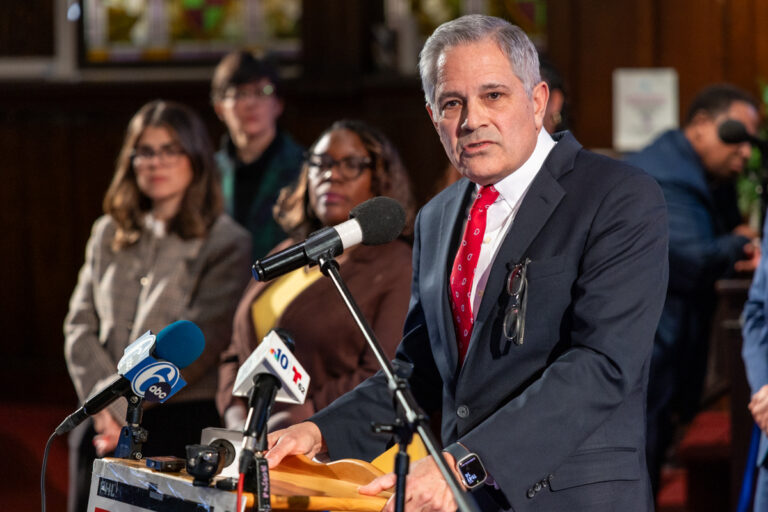
Philadelphia District Attorney Larry Krasner holds a press conference on public safety and ICE activity in the city on Jan. 14, 2026. (Kimberly Paynter/WHYY)
From Philly and the Pa. suburbs to South Jersey and Delaware, what would you like WHYY News to cover? Let us know!
A federal judge says Philadelphia District Attorney Larry Krasner and one of his top deputies may have committed federal crimes, and is referring the case to the U.S. Attorney’s Office.
In a sharply worded 40-page brief, Judge Paul Diamond said the evidence was “tantamount to a prima facie showing” of conduct that could constitute “false statements, false declarations under oath, perjury, obstruction of justice and conspiracy.”
“I have thus reluctantly concluded that Philadelphia’s highest law enforcement official and one of his top assistants may have violated the law,” wrote Diamond, an appointee of President George W. Bush.
The issue centers on the handling of an appeal for Dennis Johnson, who was convicted of second-degree murder in 2009 in the killing of Kenyatta Smith and sentenced to life imprisonment. In 2022, the DA’s office filed a response supporting his request to overturn his murder conviction.
However, in June, prosecutors in Krasner’s office filed a motion to withdraw that filing, acknowledging “material misstatements” and later testified that the DA had a “conflict of interest” in the case.
In the brief, the judge wrote that the DA’s office did not conduct its own investigation and instead followed recommendations made by Johnson’s appellate attorneys.
In a statement, Krasner said he “respectfully and vigorously” disagrees with Diamond’s finding.
“I look forward to appealing to the higher court as soon as the law allows,” he said.
Diamond does not have the authority to charge Krasner or Matthew Stiegler, who headed the DA’s Conviction Integrity Unit when the office was supporting Johnson’s appeal. The U.S. Attorney’s Office will decide whether to seek an indictment.
Related Content
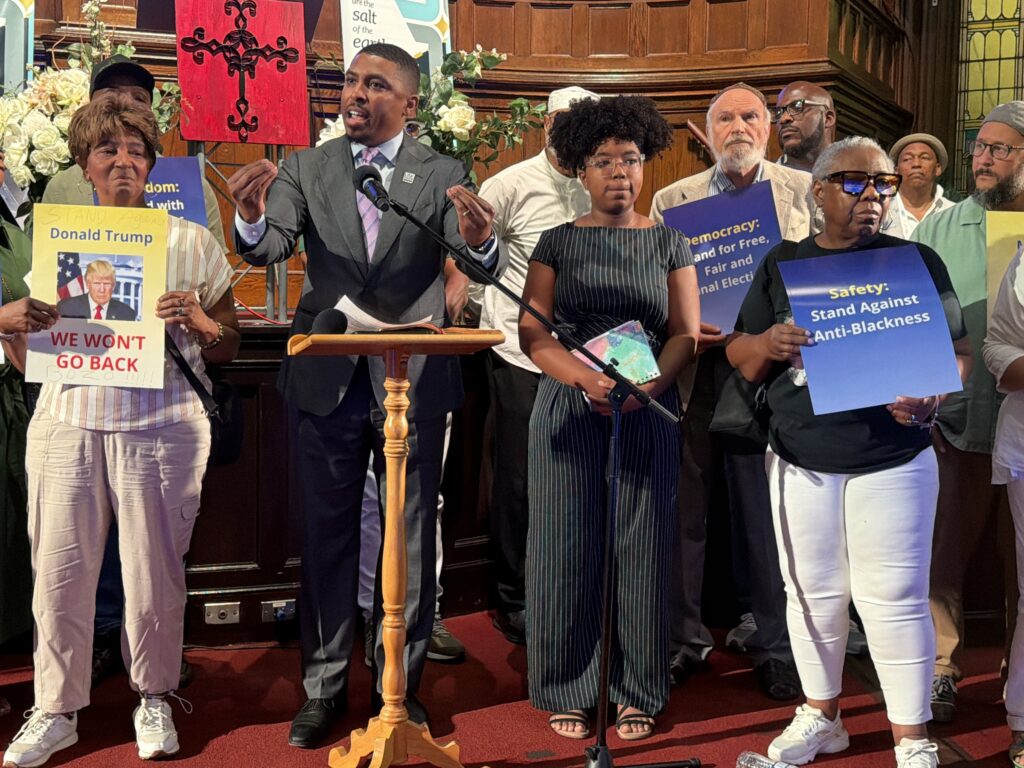
Faith leaders, exonerees and criminal justice advocates say the district attorney is being unfairly targeted for efforts to overturn wrongful convictions.
3 months ago
The case
Smith was shot outside the Lehigh Variety convenience store in North Philly during a robbery. Two witnesses who knew Johnson identified him as the gunman, including the store clerk, Ozzie Clark, who testified that Johnson approached Smith, pointed a gun at him and searched his pockets before firing.
Clark testified he heard Johnson greet him shortly before the shooting and identified him by his face, body and voice. That contradicted Clark’s statements during cross-examination which he said he had not seen the shooter’s face and based his identification on the shooter’s body and speech. When Johnson’s trial attorney, Michael Coard, challenged him, Clark said he initially hesitated to cooperate because he feared for his safety.
A second witness, Curtis Smith, testified that he saw Johnson robbing the victim at gunpoint and fled after hearing the shot. The defense questioned his credibility because police had initially considered him a possible suspect and he did not identify Johnson until nearly two years after the killing, while he was in custody on unrelated matters.
Detective John McDermott, who investigated the killing, testified that a third witness, Amin Vicks, had told investigators that Johnson was the shooter. Vicks did not testify in court, however, leaving Johnson’s lawyers unable to cross-examine him about the alleged identification.
The jury convicted Johnson of second-degree murder, robbery and a firearms offense. He was later sentenced to life in prison for the murder conviction, with concurrent sentences for the remaining charges.
The appeal
Johnson first appealed in state courts arguing that Coard provided ineffective counsel by failing to object to McDermott telling the jury that Vicks — who did not testify — had identified Johnson as the shooter.
The state Superior Court agreed that McDermott’s statement was inadmissible hearsay and violated the Confrontation Clause but denied relief, finding the error did not prejudice Johnson because the two other witnesses, Clark and Curtis Smith, had identified him. The state Supreme Court declined to hear Johnson’s appeal of that decision.
In 2016, Johnson filed his first federal petition for habeas corpus and the case was assigned to Diamond who referred the case to U.S. Magistrate Judge Lynne Sitarski for review and a recommendation. The DA’s office initially opposed Johnson’s petition but changed course after Krasner took office in 2018.
In May 2022, Johnson filed a memorandum calling the credibility of the witness identifications into question. Clark recanted his identification, Vicks said he had never told McDermott that Johnson was the shooter, and two other people submitted statements saying Curtis Smith had confessed to the killing. Coard also sent the DA a letter, as Diamond put it, “confessing to his own incompetence” for “failing to object to Detective McDermott’s hearsay testimony.”
That November, Assistant District Attorney Jaclyn Mason filed the DA’s response to Johnson’s petition in which they cited “ineffective counsel” and other factors that may have affected the verdict and agreed Johnson was entitled to relief. A few months later, Sitarski recommended that Johnson’s petition for appeal be approved.
Related Content
Man convicted in 2012 Philly cop killing gets new trial, but DA Krasner vows to keep him behind bars
More than a decade after being convicted for the murder of off-duty officer Moses Walker, Rafael Jones’ case was overturned this week.
2 months ago
Fallout
Mason, who Diamond said “had no experience as a criminal litigator” before joining the DA’s office, reported to Stiegler. According to Diamond’s findings, Stiegler dictated the content of Mason’s brief under the guidance of the Innocence Project.
Stiegler told Mason, “if it’s good enough for the Innocence Project, it’s good enough for me,” according to Diamond’s memorandum.
In May, Diamond ordered an evidentiary hearing so he could hear live testimony from witnesses who identified Johnson. Given the DA’s office support for Johnson’s petition, Diamond invited the state Attorney General’s Office to participate as a friend of the court.
While preparing for the hearing, four supervisors in the DA’s Law Division — Katherine Ernst, Steven Wildberger, David Napiorski and Peter Andrews — reviewed the trial record and discovered what they considered material errors in Mason’s 2022 response and filed a motion to withdraw it.
They cited that the response said Clark did not visually identify Johnson and that a hat obstructed his view, though the supervisors conclude that Clark repeatedly testified at trial that he saw Johnson’s face and knew him from the neighborhood. They also disputed the weight the response gave to Vicks’ alleged identification because it “was not repeated or relied on by the prosecution.”
Diamond also found that Mason and Stiegler did not conduct an independent investigation, interview witnesses, consult the original prosecutors or adequately review the trial record before supporting Johnson’s petition. Diamond found that Stiegler had effectively decided to concede relief before assigning the case to Mason.
Krasner and ‘conviction integrity’
Since his first election in 2017, Krasner has made the review of potentially wrongful convictions a central part of his criminal justice agenda. Soon after taking office in 2018, he expanded the Philadelphia District Attorney’s Office’s Conviction Integrity Unit, which investigates claims of innocence, prosecutorial misconduct and other problems with past convictions.
The office says its work has helped exonerate or secure relief for dozens of people, many of whom spent decades in prison. Supporters view the efforts as an essential safeguard against wrongful convictions, efforts that helped him win a third term last year with 76% of the final vote.
However, critics have assailed his record, such as President Donald Trump, who called him the “worst district attorney,” and Republican nominee for governor, Stacy Garrity, who blamed him for crime levels and drugs in the city.
Krasner has recently touted Philadelphia’s record drops in violent crime.

Get daily updates from WHYY News!
WHYY is your source for fact-based, in-depth journalism and information. As a nonprofit organization, we rely on financial support from readers like you. Please give today.
Krasner asks City Council for more funding to keep his DA staff from becoming ambulance chasers
Philadelphia’s district attorney visited a city budget hearing to ask for more than $2 million to expand initiatives to deter “big-time criminals.”
10 months ago
Listen 1:12
Trump’s new energy order puts states’ climate laws in the crosshairs of the Department of Justice
Meanwhile, Pennsylvania's governor wants to make power plant owners pay for emissions, and New Jersey is considering charging polluting companies to fund toxic cleanups.
1 year ago
Philadelphia man charged with threatening a political representative recruiting poll watchers
Officials say 62-year-old John Pollard threatened to kill a member of a state political party trying to recruit poll watchers.
2 years ago