

A Bucks County company makes jet fuel out of ‘air.’ The military wants to make it anywhere
U.S. Rep. Brian Fitzpatrick came off the campaign trail to praise Airco’s role in the “future of American innovation.”
Listen 1:17
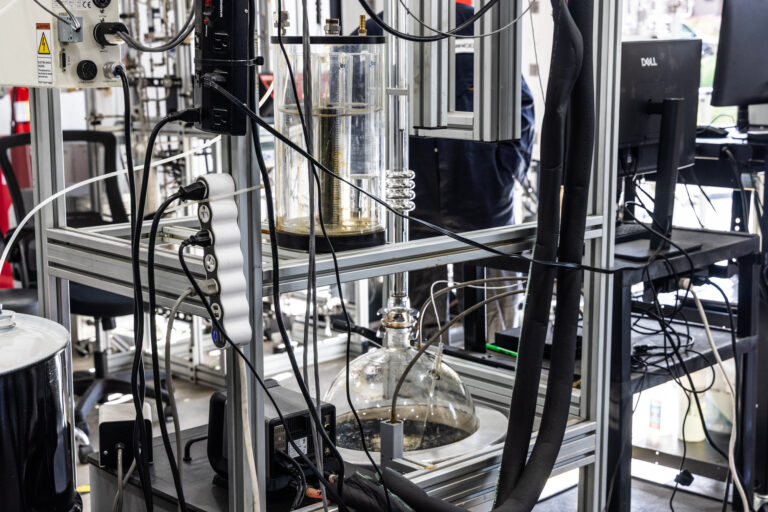
AIRCO fuel in the process of refinement at the company’s new manufacturing facility in Bucks County, Pa. (Kimberly Paynter/WHYY)
From Philly and the Pa. suburbs to South Jersey and Delaware, what would you like WHYY News to cover? Let us know!
Greg Constantine says his Bucks County company can turn air and water into fuel for jet planes, boats and military vehicles — and with far less impact on the climate than conventional fossil fuel production.
Constantine and his team at Airco unveiled their new manufacturing plant at a New Britain industrial park Wednesday. The facility has a system that combines carbon dioxide and hydrogen to generate synthetic fuels, which the company plans to produce in compact, mobile units that the U.S. military can install anywhere in the world.
“A long as we’ve had fuel, it’s always worked the same way: You find it in the ground and you refine it somewhere far away, and then you transport it, and every stop along that transportation piece adds costs and adds vulnerability,” he said, referring to attacks on military supply lines. “What if you didn’t have to move that fuel at all? What if you could produce it exactly where it is needed?”
The U.S. government is supporting the 9-year-old firm with $80 million in contracts and funding, and Airco reports $110 million in additional backing from airlines, Toyota Ventures and other investors. Constantine said the Air Force, Navy and Army have tested the fuels, and that Airco expects to see its first deployment on a government site next year.
-
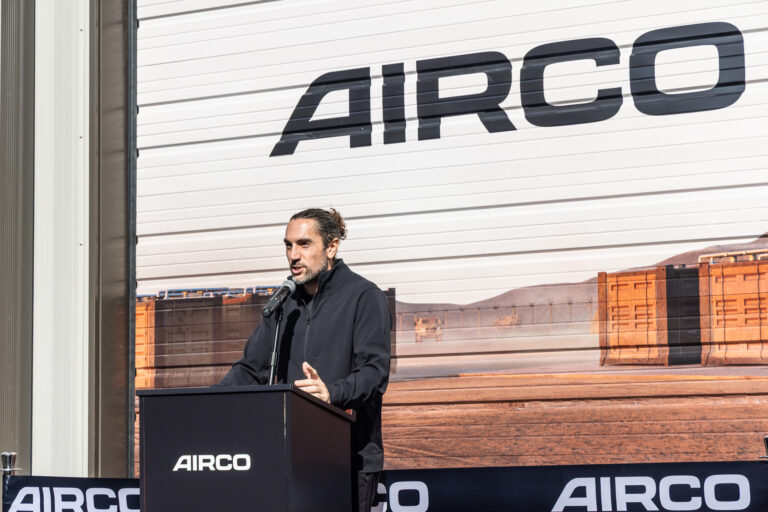
Gregory Constantine, AIRCO CEO, celebrated the opening of the company’s Pa. manufacturing facility in New Britain on Oct. 28, 2026. (Kimberly Paynter/WHYY) -

Gregory Constantine, AIRCO CEO, drove the company’s humvee to celebrate their new manufacturing facility in Bucks County on Oct. 28, 2026. (Kimberly Paynter/WHYY) -
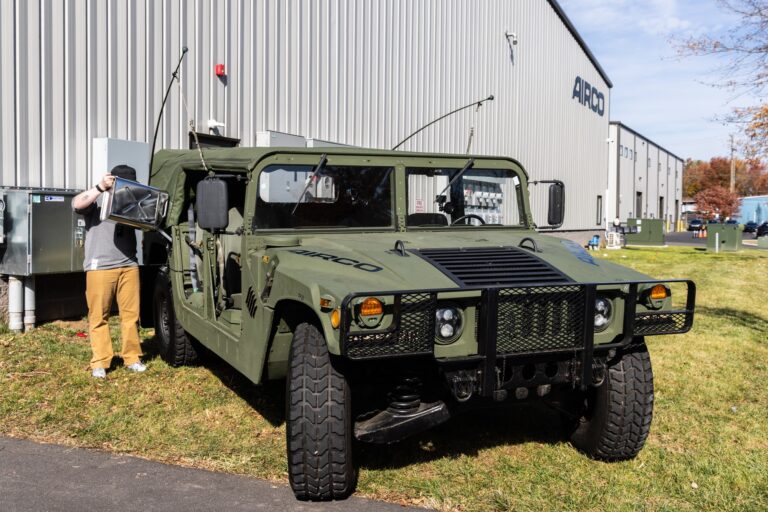
Nicholas Steinke, AIRCO’s director of government defense programs, fills the company’s humvee with their fuel at their celebration of their Bucks County manufacturing facility in Bucks County on Oct. 28, 2026. (Kimberly Paynter/WHYY) -
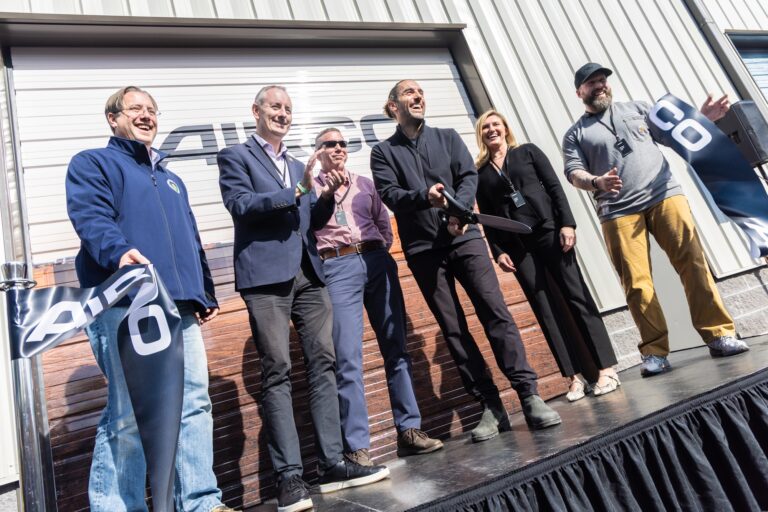
Gregory Constantine, AIRCO CEO, was joined by U.S. Congressman Brian Fitzpatrick and other company executives at the ceremonial ribbon cutting of their new manufacturing facility in Bucks County, Pa., on Oct. 28, 2026. (Kimberly Paynter/WHYY)
U.S. Rep. Brian Fitzpatrick helped cut the ribbon on the facility off U.S. 202, stepping away momentarily from the campaign trail.
Fitzpatrick, who is in a tight race to hold his seat in next week’s election, praised Airco and the Australian-born Constantine for helping “shape the future of American innovation.”
“What you’re pioneering right here has the potential to change how we meet one of our military’s most critical needs, and that is reducing vulnerabilities, strengthening our defense industrial base, and giving our service members greater flexibility and security wherever their mission may take them,” he said.
He faces a challenge from Democrat Bob Harvie, who a recent poll put slightly ahead in the race for Pennsylvania’s 1st Congressional District. Fitzpatrick did not take questions from the press following his remarks.
Related Content

A futuristic, hybrid-electric aircraft took flight at a test demo in Philadelphia
As a next-generation aircraft is tested at the Tioga Marine Terminal in Port Richmond, entrepreneurs and elected officials hope to reap economic benefits.
3 months ago
Listen 2:19Aiming for 1,000 gallons per month
Airco was founded in Brooklyn and moved to Bucks County over the past year. It is one of several companies using a variety of methods to turn carbon dioxide, or CO2, into fuel. Others include Infinium, whose Texas plant makes fuel for Amazon delivery trucks, and Twelve, which generates jet fuel for commercial airlines.
At the New Britain facility, Airco uses purchased carbon dioxide in tanks and hydrogen produced on site by electrolysis of water. They’re combined with a patented metal catalyst the company developed that drives the chemical reaction, generating a crude, dark-colored liquid.
“That dark, actually kind of root beer, color, that ends up getting purified and becomes nice and clear, and that’s on this distillation system over here,” said Nicholas Steinke, Airco’s director of government defense programs, as he pointed to a rack of equipment during a tour Wednesday.
“This does the final distillation cut — it gets your jet or diesel range, your heavier components, and your lighter components,” he said. “The lights are like gasoline, and the heavies are like your 2D diesel, your heavier diesel, non-winter diesel, but still very usable for products.”
-
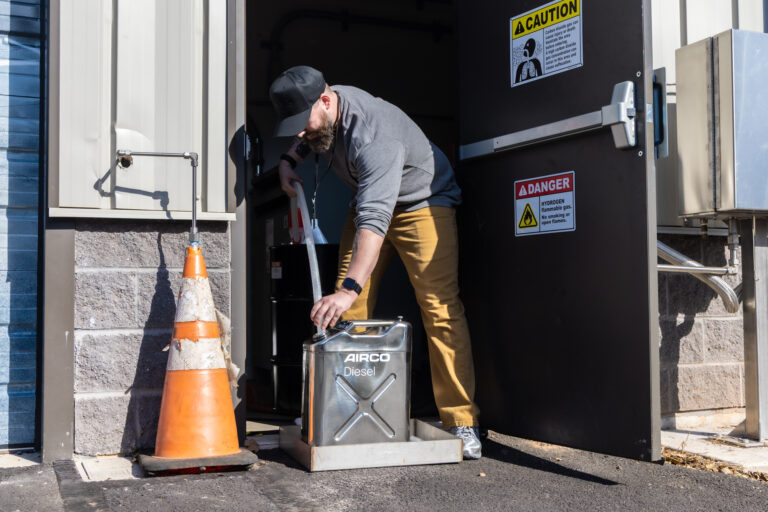
Nicholas Steinke, AIRCO’s director of government defense programs, fills a canister with the company’s fuel at their celebration of their Bucks County manufacturing facility. (Kimberly Paynter/WHYY) -

Attendees to the AIRCO ceremonial ribbon cutting of their new manufacturing facility in Bucks County, Pa., received a small vile of the company’s jet fuel. (Kimberly Paynter/WHYY) -
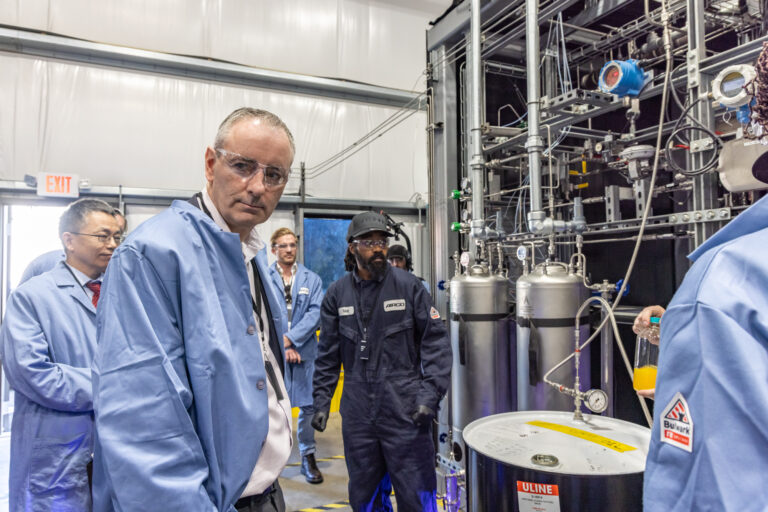
U.S. Congressman Brian Fitzpatrick toured AIRCO’s new manufacturing facility in Bucks County, Pa., on Oct. 28, 2026. (Kimberly Paynter/WHYY) -
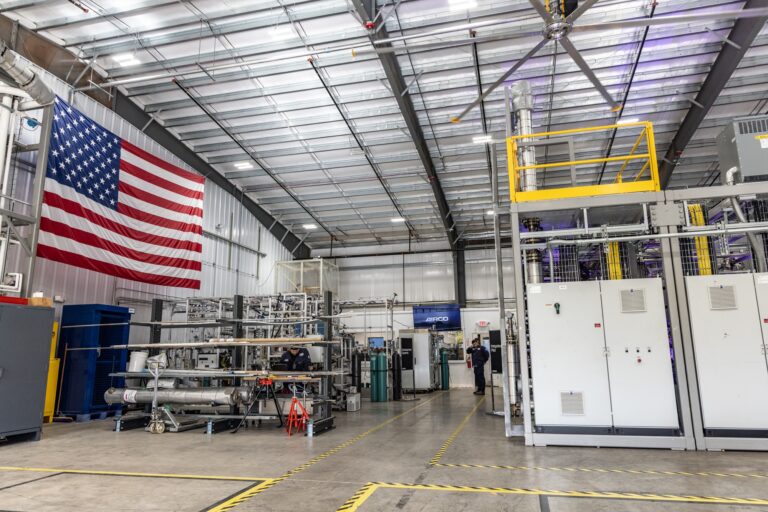
Inside AIRCO’s manufacturing facility in Bucks County, Pa., attendees to the opening celebration toured the facility and learned about the equipment used to make jet fuel from carbon dioxide, hydrogen and electricity. (Kimberly Paynter/WHYY) -
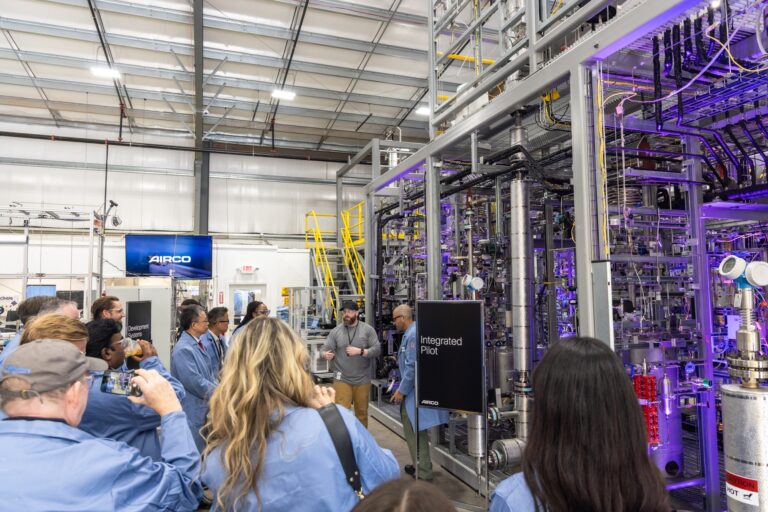
Inside AIRCO’s manufacturing facility in Bucks County, Pa., attendees to the opening celebration toured the facility and learned about the equipment used to make jet fuel from carbon dioxide, hydrogen and electricity. (Kimberly Paynter/WHYY)
Airco will essentially pack a factory into four or five shipping containers that can be installed anywhere, Constantine said. The system can run on any electricity source, such as solar, geothermal or, for example, the nuclear reactors on aircraft carriers.
“We’re not tied to a single type of power. We can use any of it. It allows us to be very flexible with our deployments,” Steinke said.
The New Britain plant makes about 90 gallons of crude liquid per month, which is finished into 40 gallons of diesel. Once the company installs its first commercial unit on the site, it will produce about 1,000 finished gallons monthly, he said.
Related Content
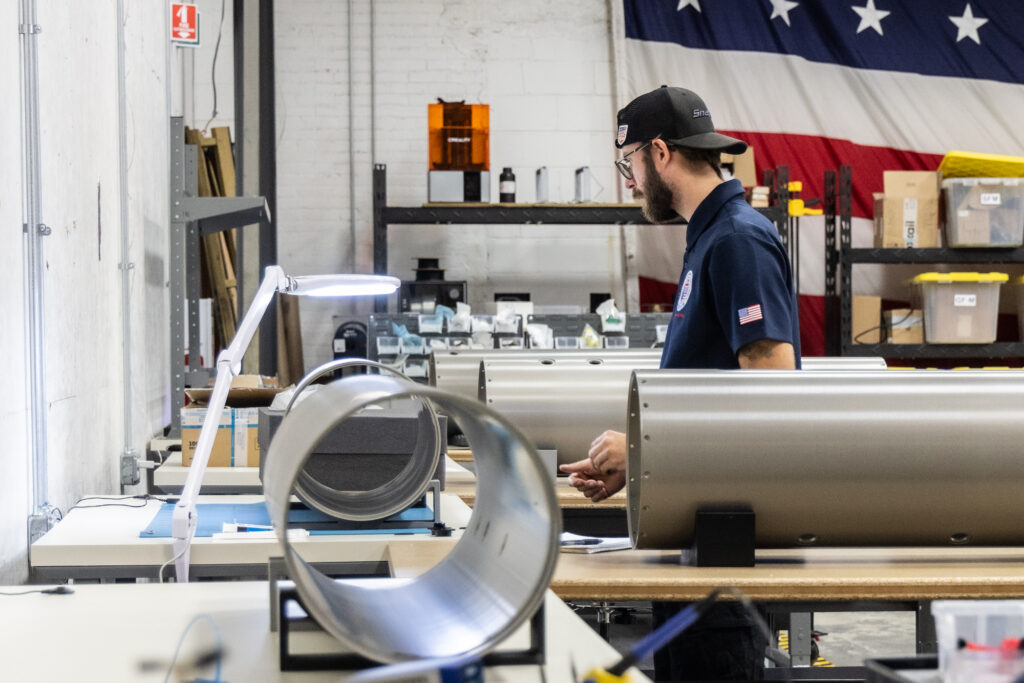
Less than two years after a Wharton dropout co-founded it, Albacore has $10 million in investments and a contract to supply the U.S. Navy.
3 months ago
Listen 1:18Questions about energy sources
Constantine contended that the company’s technology is “inherently a climate solution.” That’s in part because it can use carbon dioxide from the air or left over from industrial processes, rather than extracting it from under the ground as fossil fuel producers do, and in part because it does not generate excess CO2.
“We are using more CO2 in our production process to make the fuel than we are putting out in the entire process, and so for us, the actual production process of the fuel is carbon negative,” he said. “However, once you put the fuel in an engine and then burn it, because we’re using so much CO2, our specific fuel is then carbon neutral, even once it’s been burnt.”
The company developed its own efficient, compact system for extracting carbon dioxide from the air using a solid sorbent, a material that attracts and holds CO2, he said. CO2 can also be captured directly from the emissions of cement plants and other industrial sites.
However, direct-air carbon capture, or DAC, is generally an energy-intensive process, and large-scale DAC projects often use so much power that they are carbon-positive, resulting in more new emissions than they absorbed, said Sarah Gleeson, a materials scientist at Project Drawdown, a nonprofit that studies science-based climate solutions.
The overall impact of Airco’s mobile units on greenhouse gas emissions and climate change will likely depend on the source of the electricity used to power their carbon capture, electrolysis, catalytic reaction, and other systems in the various places it is installed, Gleeson said.
“The technology seems like it holds a lot of promise, especially on the fuel-conversion side, but the part that I have a lot of questions about is, where are you getting the carbon from?” she said. “Because if they’re saying that there’s some kind of direct air capture functionality in this really mobile device, I would be skeptical at the capacity and efficiency of it.”
Related Content
PGW agreed to hold public meetings on reducing its carbon footprint. At the first meeting, there were lots of questions from the public but no answers from the utility.
5 months ago
Listen 1:23Coming down the cost curve
Airco has nearly 100 employees, and about 80% are in New Britain, Constantine said.
“We’re really looking to grow over the course of not just the next 12 months, but the years to come, as well. Hopefully we start to really bring not just tens of employees, but hundreds of employees, here,” he said.
The company hopes to expand rapidly as it produces more mobile units for the military, and eventually for a host of airlines that are its investors or partners, he said. They include Alaska Airlines, JetBlue and Air Canada.
“Outside of the U.S., there are a lot of countries or regions, like Europe, where it’s mandated that they have to purchase fuel that’s made synthetically, so they have to go out and find groups that are producing fuel or technology like this,” he said.
European Union rules require airlines to use a certain amount of synthetic fuels made from renewable energy or fuels with biologically based sources like used cooking oil.
Luc Decker, the consul general for Luxembourg in New York, attended the factory opening to get a better understanding of the technology and to look for transatlantic trade opportunities, he said. Luxembourg is home to Cargolux, one of the world’s largest cargo airlines.
“There might be interest from Airco to work with Cargolux,” Decker said. “We’ll see what the outcome is. It’s a little bit early to know what will come out of this, but it’s definitely a great technology.”
Constantine said Airco’s product is currently more expensive than fuel produced by a traditional oil refinery. However, its mobile system ends up making fuel that is cheaper for the military because it eliminates the need to use and defend a complex logistics chain, he said.
“As we continue to mass produce these units, we come down the cost curve in our production of these units, which then ultimately allows us to start servicing these other markets,” he said. “And that’s when we start to get towards aviation and others.”

Never miss a moment with the WHYY Listen App!


WHYY is your source for fact-based, in-depth journalism and information. As a nonprofit organization, we rely on financial support from readers like you. Please give today.
Philadelphia releases toolkit to help neighbors talk about climate change
The digital toolkit is meant to help residents get to know each other and prepare their neighborhoods for extreme heat, flooding and more.
7 days ago

The Ghost in the Machine: When Tech Seems to Have a Mind of Its Own
Can technology be haunted? We hear about the long history of tech in horror and an AI agent gone rogue.
Air Date: October 29, 2026
Listen 49:22
How the way we eliminate toxic PFAS from water also takes an environmental toll
Granular activated carbon is most effective at absorbing PFAS, but it contributes to the carbon footprint — a conundrum scientists want to solve.
5 years ago