
‘It’s going to be a genocide’: HIV activists from N.Y. and Philadelphia rally at City Hall
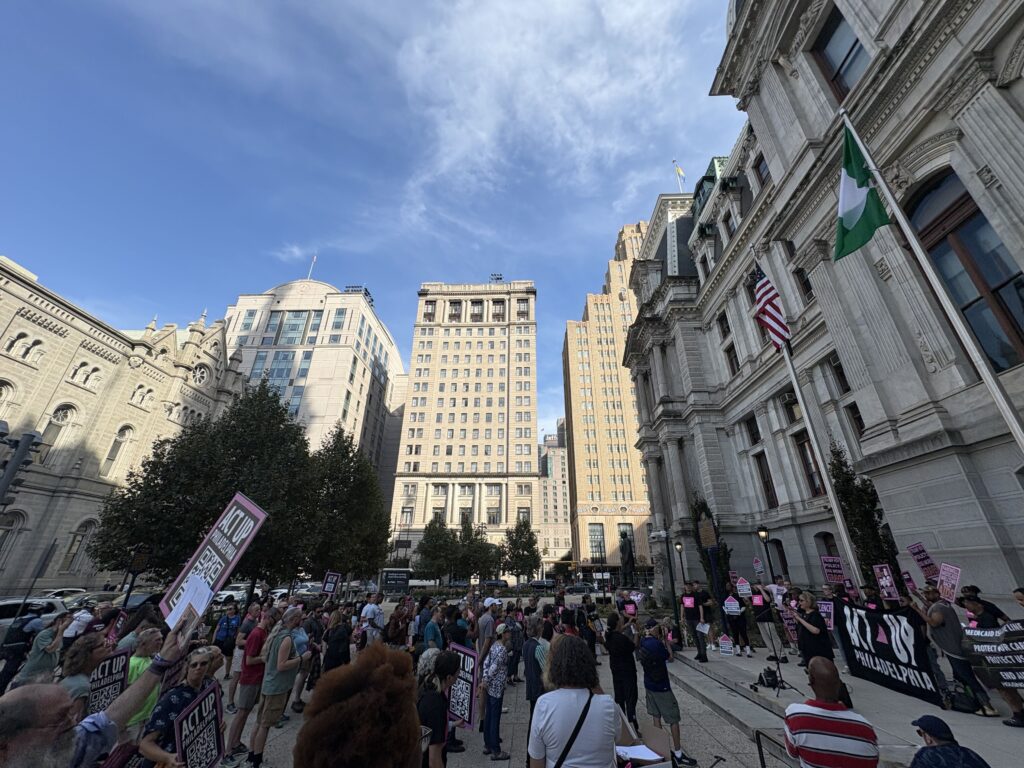
Over 100 HIV activists, nonprofit leaders and a city council member took to City Hall this afternoon to demand a reversal of President Donald Trump’s Medicaid cuts.
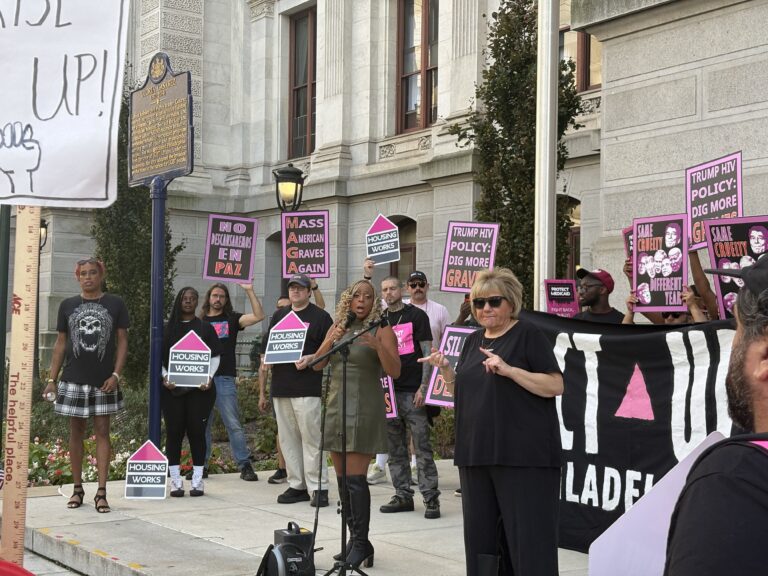
Philadelphia City Councilmember Jamie Gauthier addresses HIV/AIDS activists outside City Hall. (Andrew McGurl/WHYY)
From Philly and the Pa. suburbs to South Jersey and Delaware, what would you like WHYY News to cover? Let us know!
Around 100 HIV/AIDS activists, many of whom arrived from New York by bus, massed around the north side of City Hall in Philly on Friday to demand an immediate reversal of federal cuts to Medicaid.
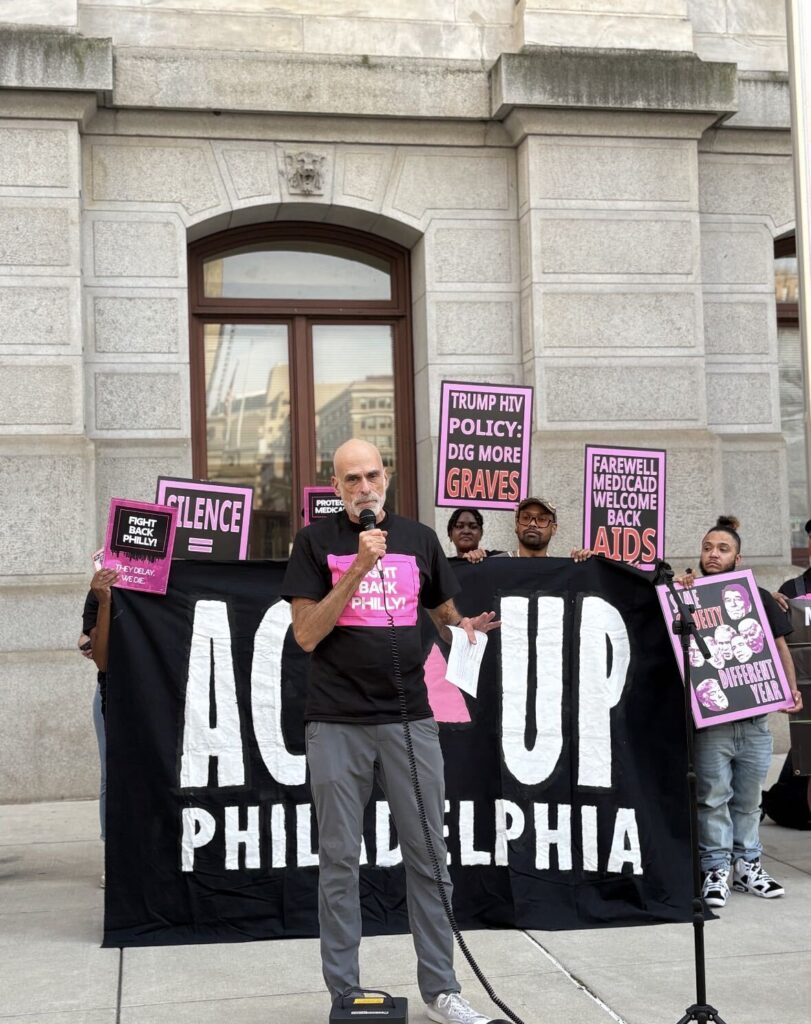
“It’s going to be a genocide,” said José Demarco, an almost 30-year member of the AIDS Coalition to Unleash Power’s Philadelphia chapter.
The organization, also known as ACT UP,, was formed in New York City in 1987 in response to lack of action by President Ronald Reagan’s administration regarding what was then a still-worsening AIDS epidemic.
Unlike other queer advocacy groups before it, ACT UP focused on radical, direct action. The immediacy of the AIDS epidemic, Demarco said, necessitated unprecedented activism.
Philadelphia’s chapter, formed in 1988, has remained particularly relevant while HIV/AIDS advocacy has faded from mainstream discourse.
Prevention Point Philadelphia, a Kensington-based needle exchange, was formed by ACT UP members in 1991 — at a time when the possession of syringes was a crime.
HIV-positive individuals today still face many of the same barriers as their late 20th-century counterparts, Demarco said.
“I’d love to see a return to serious direct action,” he said. “[At our last meeting,] we talked about how to get people to pay attention again, especially young people.”
Charles King, the CEO of HousingWorks, a New York nonprofit founded in 1990 to address homelessness among HIV-positive individuals with a housing-first model, reaffirmed the need for direct action.
“I’ve been arrested six times in Washington, D.C. [since Trump’s re-election.] I’d have been arrested more if D.C. police didn’t also hate the guy,” King said.
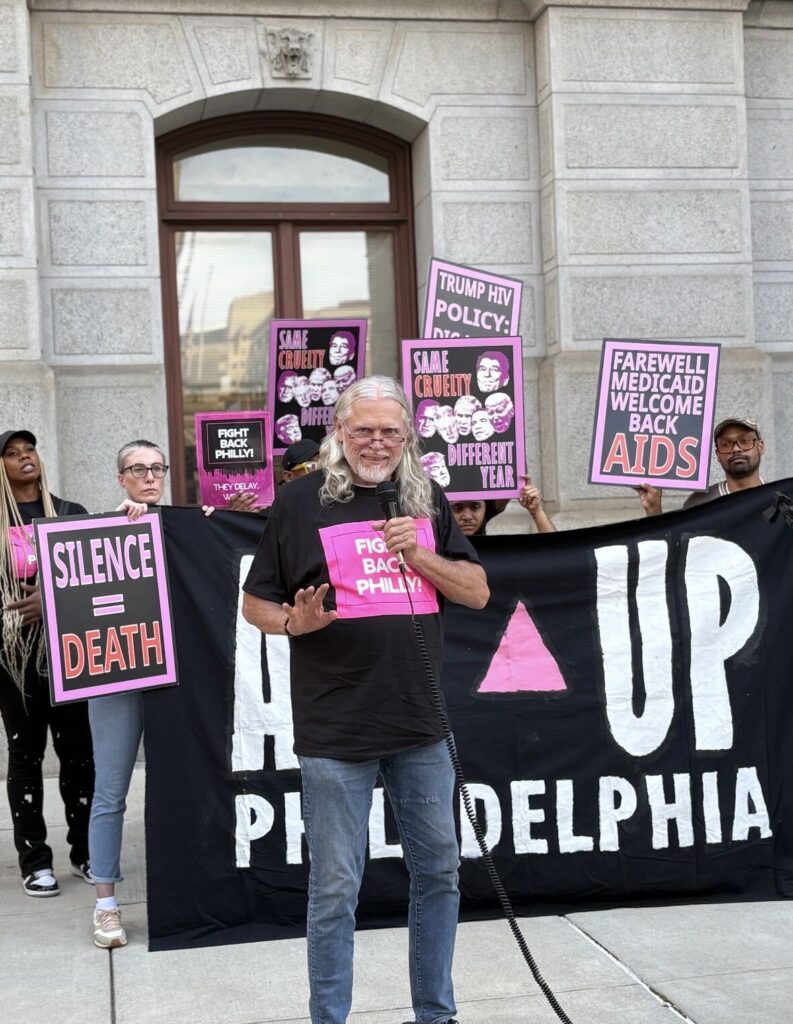
King, a fixture of HIV/AIDS activism since its earliest days, was one of the more than 1,000 ACT UP members who stormed the National Institutes of Health in 1990 in response to the slow pace of HIV research.
What’s been cut?
“The Big Beautiful Bill Act” passed by Congress earlier this year substantially altered existing Medicaid policies.
The bill cuts nearly $1 trillion from Medicaid over 10 years; expands work requirements, including for HIV-positive individuals, excludes most legal noncitizen immigrants from coverage and requires recipients to reverify their eligibility every six months.
“Medicare, housing opportunities, research, they’re all being taken away,” Demarco said.
Related Content
Hundreds of thousands of Garden State residents covered by NJ FamilyCare will need to fill out paperwork on a new reporting schedule starting Jan. 1.
1 week ago
Listen 1:15Many clinics that perform abortions, like Planned Parenthood, serve as major providers of HIV testing. The bill strips those clinics of all federal funding.
Additionally, the federal government has altogether eliminated the Centers for Disease Control existing Comprehensive High-Impact HIV Prevention Programs for Community-Based Organizations.
This initiative, which began under President Donald Trump’s first administration, has provided well over $200 million in funding to local service providers in 32 states, including Pennsylvania, Washington, D.C., and Puerto Rico over its five-year history.
The CDC’s initial 2020 proposal specifically notes the importance of community-based care.
“Since the late 1980s, CDC has formally partnered with CBOs… because of their accessibility, history, and credibility in the community,” the proposal stated. “Building individual competencies, organizational capacities, and supportive structural environments among these partners are key strategies… particularly for …Blacks/AfricanAmericans; Hispanics/Latinos; all races/ethnicities of gay, bisexual, and other men who have sex with men (MSM); people who inject drugs (PWIDs); and transgender persons.”
Demarco said that initial proposal makes the CDC’s current reversal feel even more malicious and targeted.
In modern HIV management, undetectable equals untransmissible. Without adequate medical care, HIV-positive patients can become a public health risk, said C. Michael Robinson, the former borough manager of Collingdale in Delaware County and Pennsylvania’s first openly HIV-positive public official.
Regular monitoring, a sustained regimen of antiretrovirals and general medical treatment are necessary to keep a patient’s infection from spreading.
“We’re on the brink of another full-blown AIDS epidemic,” Robinson said. “It’s what they want — [to] make [LGBT people] a boogeyman again.”
Intentional and avoidable
For Demarco, like most gay men who survived the AIDS epidemic’s early years, this fight is deeply personal.
In 1991, he was diagnosed with HIV.
In 1994, his life partner died of complications related to HIV/AIDS.
“Those deaths were avoidable; my partner died four months before there were drugs to save him,” he said.”I’m confident [the federal government] knows hundreds of thousands could die. That’s what they’ve wanted for decades.”
“The most devastating part of it all is that it’s intentional; it’s unspeakably cruel,” said Philadelphia City Councilmember Jamie Gauthier, who had earlier addressed the crowd, and used what she referred to as Trump’s failure to succeed militarily in Iran as an example to convey his ineptitude and cruelty in all administrative decisions.
“We’ve got all these treatments; we’re at the point where you can have a normal life,” she said. “But now, they’re going to take us back.”
International repercussions
Protestors also targeted the now-defunct Department of Government Efficiency, or DOGE, in particular, saying its austerity efforts were cruel by design.
The department, helmed by South Africa-born billionaire Elon Musk, oversaw the complete dismantling of the U.S. Agency for International Development, a half-century-old executive branch agency focused on distributing foreign aid. It has been estimated the USAID cuts have directly led to the deaths of hundreds of thousands.
“It risks the lives of millions,” said Tom Hennes, a longtime AIDS activist and founder of New York design firm ThincDesign.
“[Due to USAID’s dismantling] there will be 2 million unnecessary AIDS deaths by 2030; 3.5 million orphans …14 million new deaths in all,” he said.
“They say it’s economical. It’s cynical.”

Never miss a moment with the WHYY Listen App!


WHYY is your source for fact-based, in-depth journalism and information. As a nonprofit organization, we rely on financial support from readers like you. Please give today.
Philly health department notifies Center City dental patients of possible exposure to hepatitis, HIV
City health officials are recommending disease testing for some patients of Smiles at Rittenhouse Square following “unsanitary practices.”
5 months ago
Listen 1:06
Health leaders say between 73,000 and 90,000 people could lose Medicaid next year due to new federal work requirements and eligibility paperwork.
5 months ago
Listen 1:11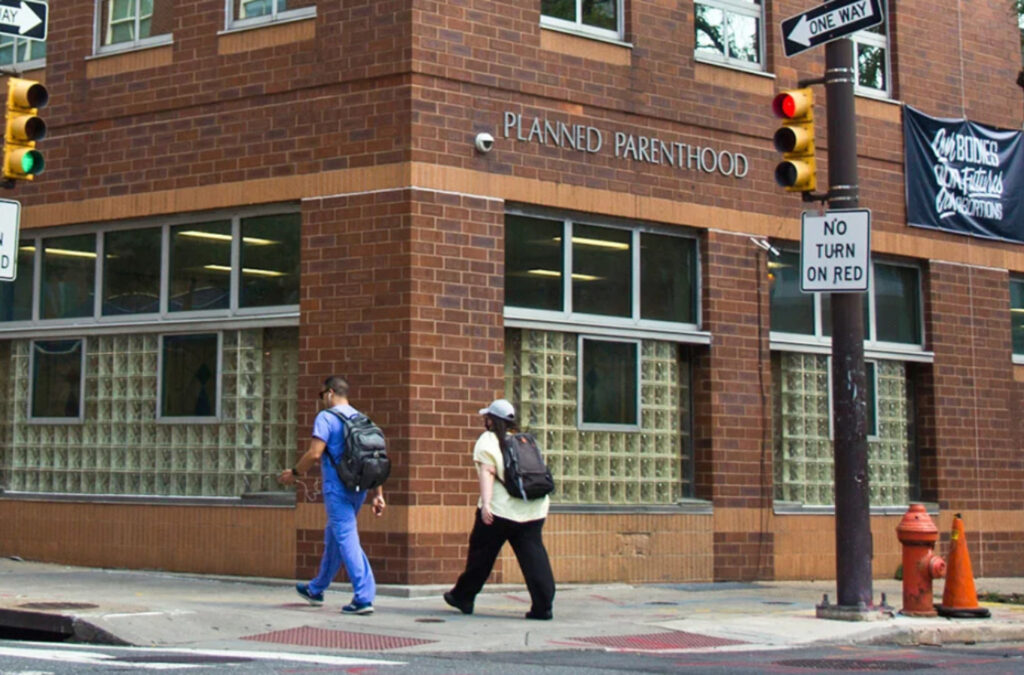
Philadelphia Planned Parenthood centers say services are at risk following Medicaid cuts
The federal “One Big Beautiful Bill Act,” signed into law last July, blocks Medicaid funding to facilities that perform abortions.
7 months ago