

How will the EPA excavate 68,000 cubic yards of toxic material from a contaminated site in Port Richmond?
After 26 years beneath a tarp, the Franklin Slag Pile has been uncovered for excavation. The EPA will monitor air quality during removal.
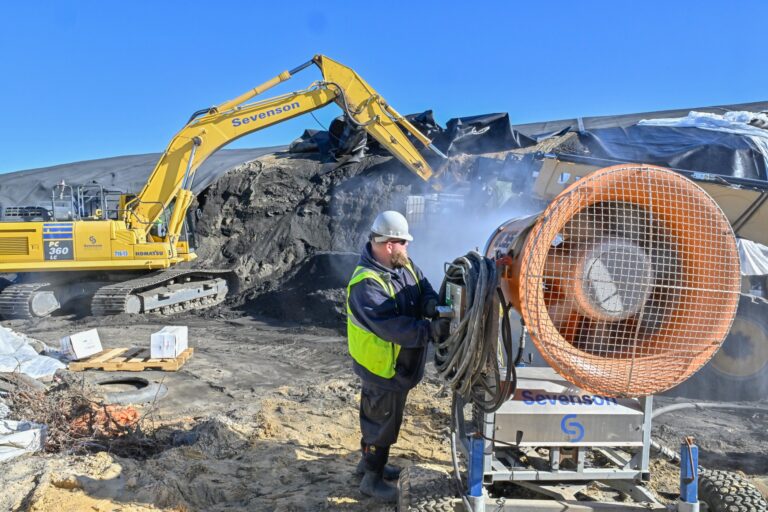
To suppress toxic dust, a worker turns on a blower that sprays a mist of water over an excavation area at the Franklin Slag Pile EPA site in the Port Richmond section of Philadelphia, Oct. 22, 2026. (Jonathan Wilson for WHYY)
From Philly and the Pa. suburbs to South Jersey and Delaware, what would you like WHYY News to cover? Let us know!
Many residents of Philadelphia’s Port Richmond neighborhood learned about its toxic pile of rubble only after the U.S. Environmental Protection Agency started planning to remove it.
That may be because the Franklin Slag Pile, a Superfund site at the intersection of Delaware and Castor avenues, is tucked away and has been covered by a large tarp for the past 26 years.
“Even after being part of the neighborhood for [my entire life], I didn’t have a clue,” said Doris Lynch, president of Port Richmond Neighborhood Action. “When you hear about it and you learn about it, it’s like, wow. I didn’t even know it was there.”
Superfund sites are areas that have been identified by the EPA as especially contaminated and polluted.
The Franklin Slag Pile sits on a 4-acre parcel and contains about 68,000 cubic yards of slag — a stony byproduct of metal smelting — enough to fill over 20 Olympic swimming pools. The cleanup process began in July after years of designing and planning. But treating, excavating and removing the hazardous material without exposing the area to contaminants will require a carefully executed cleanup process, as the site is just blocks from the Delaware River on one side and residents on the other.
Smelting is the process by which a usable metal is obtained from heating ore to a certain melting point. From 1950 to 1999, MDC Industries operated the site, processing slag from the neighboring Franklin Smelting and Refining Corp. and selling it for use in sandblasting and construction materials.
Before the EPA became involved with the site in 2000, slag frequently migrated off-site and coated sidewalks, roadways and storm drains, which empty directly into the Delaware River. In 2000, sampling revealed high concentrations of various metals in the air near the pile, including lead. The site was added to the Superfund list in 2002 and is owned by Franco Realty, based in New Jersey, according to Andrew Haneiko, EPA remedial project manager.
“For more than 20 years, the priority was keeping this contaminated material contained,” Haneiko said in a statement. “Now, we’re taking the next step by removing it for good.”
-
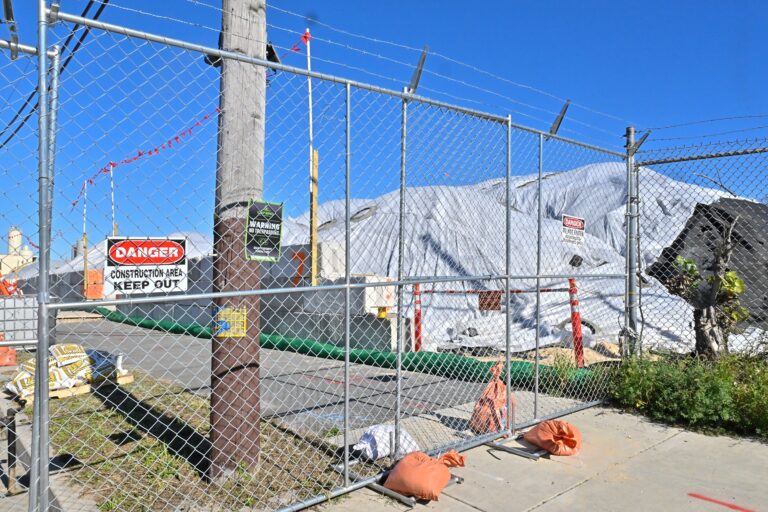
A view of the EPA Superfund site in Port Richmond viewed from Castor and North Delaware avenues, Oct. 22, 2026. (Jonathan Wilson for WHYY) -
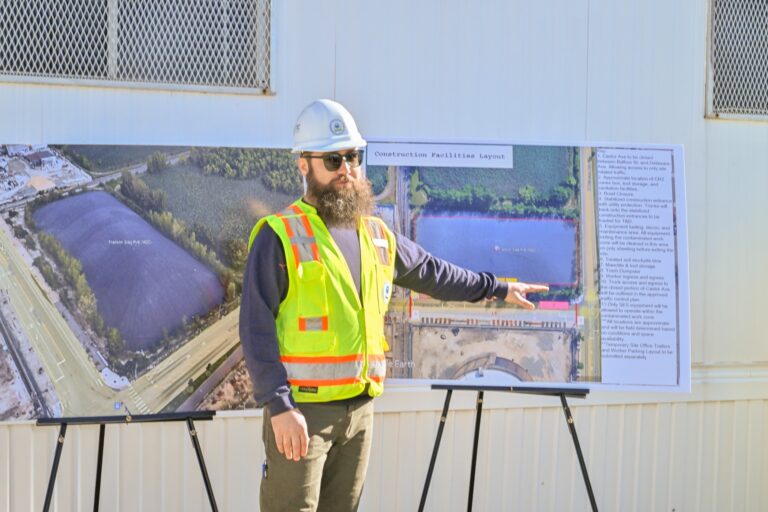
EPA Mid-Atlantic Remedial Project Manager Andrew Haneiko explains to reporters the scope of the Franklin Slag Pile remediation, Oct. 22, 2026. (Jonathan Wilson for WHYY) -
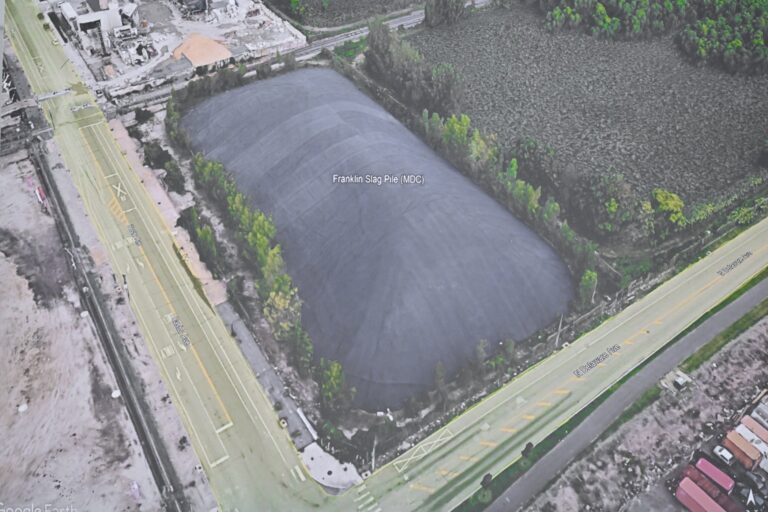
An aerial view of the Superfund site at the Franklin Slag Pile from a photo provided by the EPA.
The companies responsible for the contamination are legally required to fund the cleanup. The EPA is working alongside the Army Corps of Engineers, as well as Sevenson, the environmental remediation company contracted to clean the site. Slag excavation started at the beginning of October.
Kristen Scalise, a Philadelphia native who moved to Port Richmond in 2021, said many in the community do not seem to be bothered by the site, even if they are aware that it is there.
“This is a very Philadelphia thing — the pride of the struggle,” Scalise said. “It’s like, ‘I grew up playing on that pile. I’m fine.’ It’s not really talked about. If you didn’t grow up playing in the heap of lead, you probably don’t know about it.”
Related Content
Philadelphia Gas Commission rejects PGW’s expanded Port Richmond LNG plant until further study
The Philadelphia Gas Commission tabled the $182 million proposal but agreed to fund $5 million for engineering and environmental studies.
6 months ago
Listen 1:25Air monitoring and safety
Kris Zierold, a professor in the Department of Public Health at the University of Mississippi, said it is crucial to ensure slag does not become airborne during excavation or transport, because it could be inhaled or travel to roadways or storm drains.
To prevent dust from spreading, the EPA dampens the slag as it is uncovered to keep it stationary. Large cannon-shaped misters spray the rubble with water as it is removed from the pile.
“If you go to the beach, pick up dry sand and toss it up in the air, it blows away,” Haneiko said. “But if you go to where the sand is wet, pick it up and throw it in the air, it drops right down. That’s the idea here.”
-
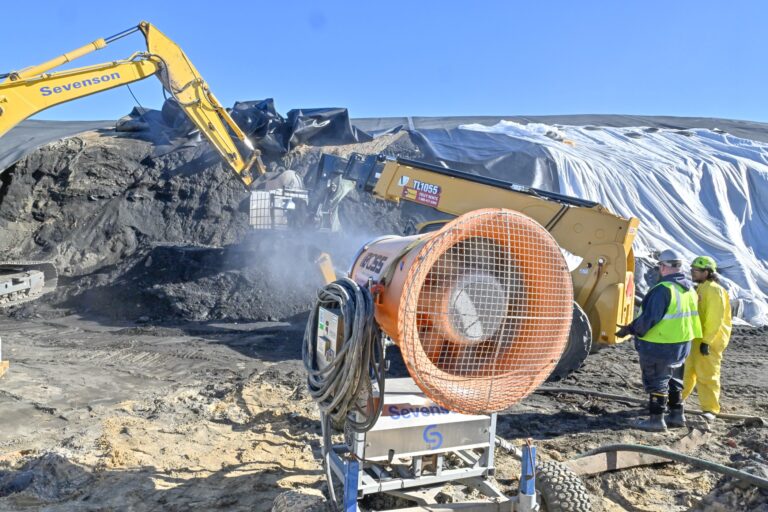
To mitigate toxic dust, a blower blows a mist of water over an excavation area at the Franklin Slag EPA Superfund site in Port Richmond, Oct. 22, 2026. (Jonathan Wilson for WHYY) -
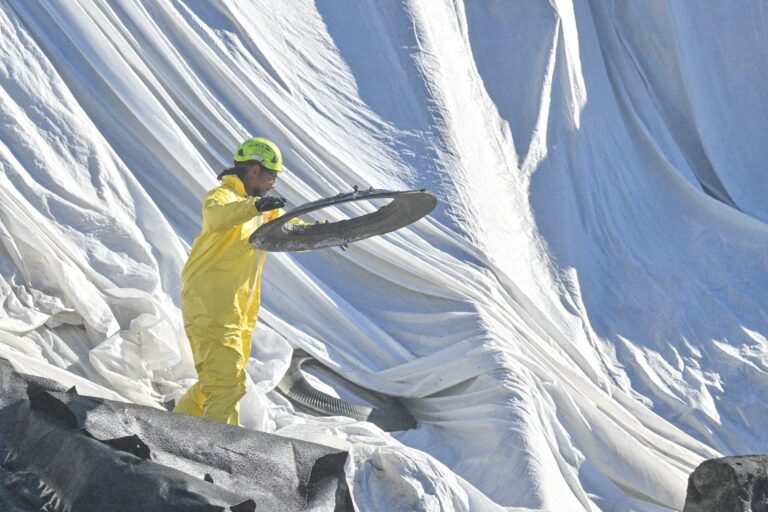
In preparation for remediation, a worker removes tires used to weigh down a portion of the tarp covering the Franklin Slag Pile at the EPA Superfund site in Port Richmond, Oct. 22, 2026. (Jonathan Wilson for WHYY) -
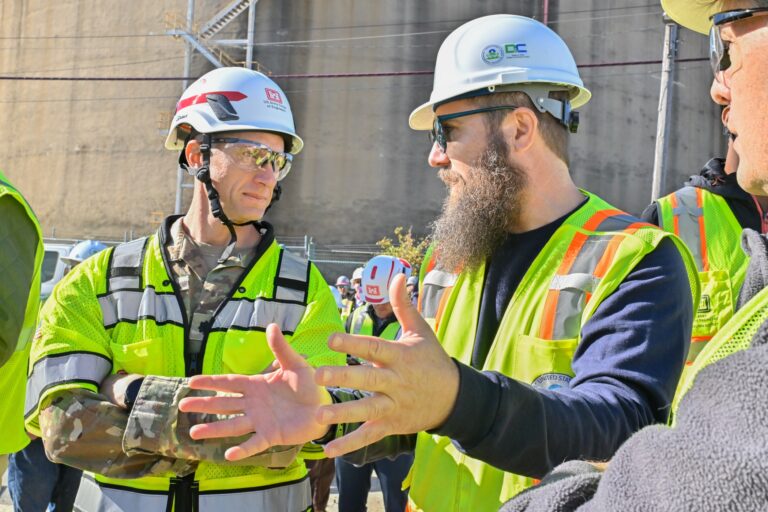
Lieutenant Colonel Ryan Baum, Philadelphia district commander of the Army Corps of Engineers, left, discusses the Franklin Pile remediation with EPA Mid-Atlantic Remedial Project Manager Andrew Haneiko. (Jonathan Wilson for WHYY)
There are four air monitors around the site and a fifth in a lot next to the nearest residential property on Castor Avenue. If the monitors record dust or airborne particles over 150 micrograms per cubic meter, all workers immediately receive notifications to their phones and must stop operations, said Haneiko. Workers are also required to wear personal air monitors during excavation and treatment.
The air monitors test for dust particles with a diameter less than or equal to 10 micrometers, but Zierold said it is important to test for smaller particles, as well. The average human hair is about 100 micrometers. Particles with a diameter less than or equal to 2.5 micrometers can be more dangerous, as their smaller size allows them to be inhaled deep into the lungs.
“What I’d be concerned about as a community person would be those smaller particles,” Zierold said. “The smaller particles are what do more damage to our body.”
Before the slag is taken off-site, it is treated with a chemical solution that reduces its ability to leach into the environment. Excavators remove slag from the larger pile in 50-cubic-yard sections, dig a hole in the smaller pile and fill it with the detoxifying solution.
The treated slag is sampled and tested off-site by a third party to ensure it is no longer hazardous. If the test comes back negative, the slag is loaded in trucks and contained in a sealable bag to reduce the potential of exposure during transport. The slag is disposed of in a landfill.
To stop slag from running off-site during rainfall, woodchip-filled fabric cylinders line the storm drains and fencing around the slag pile. Justin Richardson, a biogeochemist at the University of Virginia, said this is particularly important, given the site’s proximity to the Delaware River.
Related Content
Deal reached to clean up toxic Bishop Tube site in Chester County
The site’s former operators will pay $11.4 million to pay for the cleanup. Plans to build townhomes on the site remain in limbo.
8 months ago
Listen 1:22Community outreach and communication
Lynch said that after she and other residents learned about the site, they were concerned and wanted to know more. She said she tries to keep her neighbors informed by posting on social media through Port Richmond Neighborhood Action.
“People work two jobs, and they’re just struggling to keep food on their table,” Lynch said. “To be able to understand what’s happening, if it’s not being shown to them — they’re just busy.”
The EPA has been communicating with the community through online updates and in-person and virtual meetings. The next public meeting will be held virtually Nov 18. Community members can sign up for an EPA email list to receive Franklin Slag Pile updates.
Lynch said she has been happy with the level of communication from the EPA and thinks the community felt reassured by the agency’s willingness to answer questions at public meetings.
Scalise said at the meeting she attended, residents seemed primarily concerned about how the EPA would inform the community if the air became unsafe to breathe.
“We want a Paul Revere running through the streets saying, ‘Close your windows. The air is not safe,’” she said.
Related Content
Temple researchers hope to remove PFAS, microplastics with sustainable treatment method
Water providers are removing toxic PFAS chemicals from drinking water, but current methods are energy intensive. Temple researchers are looking at alternative technologies.
10 months ago
Listen 1:12Looking forward
Richardson said the full environmental impact of the slag pile will likely not be known until all the material is removed and the EPA is able to see beneath the pile to determine how far the contaminants traveled. EPA data shows that contamination of soil deeper than 2 feet below ground does not exceed their cleanup threshold. Once the contractor reaches that depth, the soil will be tested again, and more will be excavated if necessary.
Haneiko said Sevenson is moving on an aggressive timeline and estimates the slag will be removed by fall of next year, ahead of schedule. He hopes the cleanup process will eventually lead to the site transformed into something useful.
“The ultimate goal of the Superfund process is to ready this parcel for development,” he said. “We encourage redevelopment and we help people try to reuse these properties.”

Get daily updates from WHYY News!
WHYY is your source for fact-based, in-depth journalism and information. As a nonprofit organization, we rely on financial support from readers like you. Please give today.
Philadelphia launches ‘Alleygators’ program to help residents clear trash and vegetation from alleys
The new program will help residents keep their alleys clear with a once-a-year cleaning by request.
6 months ago
Listen 0:57
As summer approaches, Bartram’s Mile Trail still closed more than a year after chemical spill
Bartram’s Garden says it’s waiting for a green light from the city to reopen the trail. The city says the decision lies with the state Department of Environmental Protection.
1 year ago
Listen 1:15
Pa., N.J., Del. receive millions of federal dollars for water quality upgrades
The states will use the funding to remove toxic chemicals, remove lead pipes and upgrade sewer and stormwater infrastructure.
2 years ago
Listen 1:08