Election 2026: Where do Philly-area congressional candidates stand on the arts?
From the President’s House controversy to federal arts funding, candidates weighed in on cultural issues shaping the midterms.
Listen 1:13
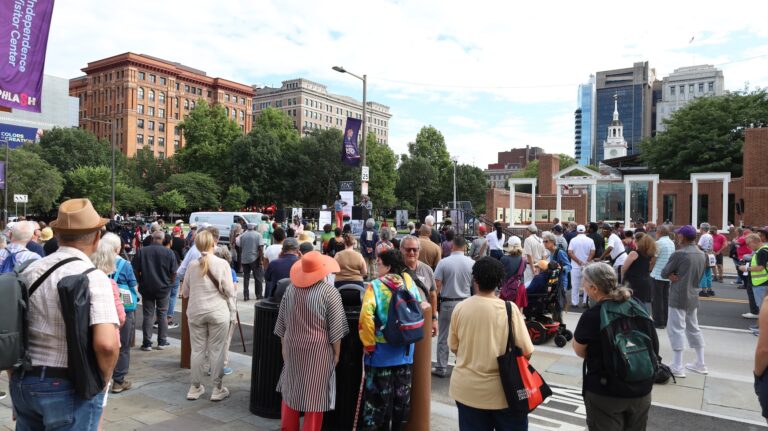
Roughly 100 people gathered next to the President's House Site at 6th and Market streets in Philadelphia on Aug. 25, 2026, for an event in remembrance of the 407th anniversary of first documented enslaved Africans arriving in America. (Cory Sharber/WHYY)
What questions do you have about the 2026 elections? What major issues do you want candidates to address? Let us know.
It is not very often the arts and culture sector plays such a heightened role in politics as the 2026 midterm election cycle.
The President’s House in Philadelphia became ground zero for new federal guidelines for how National Parks are interpreted. The renaming and renovation of the Kennedy Center in Washington D.C., has become a legal battleground. Cuts to the National Endowment for the Arts in 2024 have put into question who deserves federal funding.
Could arts and culture issues impact the way people vote?
The Greater Philadelphia Cultural Alliance released an Arts Voter Guide which asked several candidates running for Congress in the Philadelphia region for their stance on six arts questions.
The guide features responses from six candidates in three races for the U.S. House of Representatives: Democrat Bob Harvie and Republican Brian Fitzpatrick in Pennsylvania’s 1st Congressional District, Democrat Chris Rabb and independent candidate Dennis Mahoney in Pennsylvania’s 2nd Congressional District, and Democrat Mary Gay Scanlon and Republican Nick Manganaro in Pennsylvania’s 5th Congressional District.
Two candidates, Mahoney and Manganaro, did not respond. GPCA sent questions to gubernatorial candidates John Shapiro and Stacy Garrity, neither of whom responded.
The candidates were asked about federal funding for arts and humanities, investment and policies for National Parks, historic preservation protections and the creative economy.
The GPCA surveyed audience members at a 2023 Philadelphia mayoral debate and found that most consider the arts in determining how they vote.
“We did a survey and 99% of the respondents were active registered voters,” said Patricia Wilson Aden, president and CEO of the GPCA, who added that “72% indicated a candidate’s position on arts and culture issues would influence their votes.”
A chorus of arts support
All responding candidates said they support funding for the National Endowment for the Arts, the National Endowment for the Humanities and the Institute of Museum and Library Services.
Fitzpatrick said he supports NEA funding to “ensure more local, targeted priorities.” His challenger, Harvie, touted his previous support for the creation of an African American Museum of Bucks County during his time as a county commissioner.
Rabb said he would reverse recent cuts at the NEA. Scanlon said, “It’s more important than ever that Americans have resources that do not hide the parts [of our history] we don’t like to acknowledge.”
“The fact that they responded tells us that they understand the importance of arts and culture,” Aden said. “What we see, in some ways, is perhaps various levels of familiarity with some of the details of arts and culture legislation. That is not necessarily a measure of how supportive a candidate may be.”
Related Content
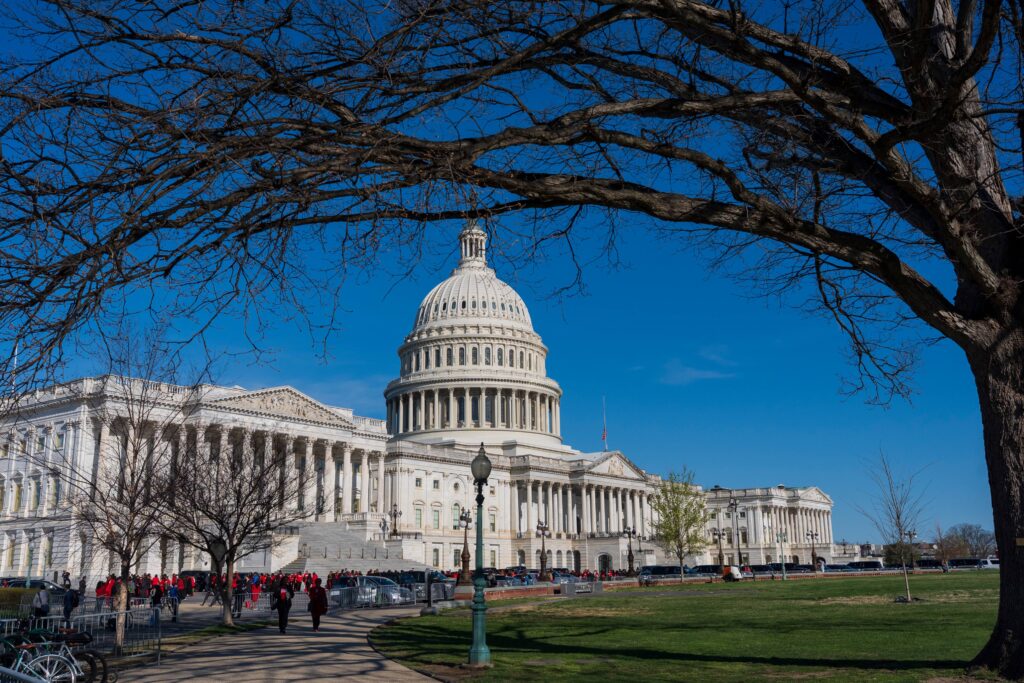
Democrats need to gain three seats in the U.S. House to win a majority in that chamber. Pennsylvania can make or break their plans.
3 weeks ago
Finding differences among the candidates
There was not a great deal of difference in the candidates’ positions on issues raised by the GPCA.
Scanlon went right to the local controversy at Independence National Historic Park when asked about federal policies administered by the Department of the Interior and National Park Service: “We need to leave politics out of the interpretation of historic and cultural resources like we are seeing with the President’s House in Philadelphia,” she said.
Fitzpatrick stressed the need for public-private partnerships at national parks to contribute to local economies. Harvie said federal investment “should protect these irreplaceable resources.” Rabb said, “We must tell the whole American story, including the parts that are hard to hear.”
The candidates were asked about recent efforts to change the 1966 National Historic Preservation Act that, if enacted, would loosen regulations for federal projects at or near historic sites. Candidates were asked about Section 106, which requires federal projects to mitigate impacts on historically protected resources.
Proposed changes to Section 106 would ease the Trump administration’s effort to build a triumphal arch near Arlington National Cemetery.
All responding candidates said they support maintaining Section 106, while stressing the need to balance community development with historic preservation.
Where the candidates differed was on naming specific arts programs that are top-of-mind.
Fitzpatrick and Rabb both championed the Creative Relief and Expensing for Artistic Entertainment bill (CREATE), which if passed would create tax incentives for certain creative industries. Fitzpatrick also voiced his support of the Performing Artist Tax Parity Act and Federal Historic Tax Credit.
Scanlon voiced support for expanding arts funding in schools, and Harvie generally endorsed federal funding for arts and education.
The voter guide included Mahoney and Manganaro, running against Rabb and Scanlon, respectively, and noted that they did not respond.
“We worked pretty diligently to reach out to the campaigns. We even extended our internal deadline to offer a little bit more time for candidates should they choose to respond,” Aden said. “We certainly cannot mandate a response. We also can’t guess at why they chose not to. But we certainly want to elevate the importance of our culture and the humanities. They are part of our civic infrastructure.”
Pa. election 2026: What to know
- 🤔 Voter FAQs: WHYY News’ Pa. voter guide has the answers you need.
- 🗳️ Governor’s race: Here’s what to know about the race between Josh Shapiro and Stacy Garrity.
- 💰 On the issues: Here’s where Shapiro and Garrity stand on the economy, health care and more.
- 📬 Voting by mail: Here’s what to know about filling out and returning your ballot, plus how to fix a defective mail ballot.
- 📱 Your go-to coverage: As election developments unfold, follow WHYY News on WHYY.org and the WHYY App.

Get daily updates from WHYY News!
WHYY is your source for fact-based, in-depth journalism and information. As a nonprofit organization, we rely on financial support from readers like you. Please give today.
Part of the series
Philadelphia voters decide: Should City Hall always have an office of arts and culture?
“Imagine what would be possible if our organizations were not constantly bracing for the next challenge, but planning for the next opportunity,” said one advocate.
4 weeks ago
Big Ramp gallery scratches at politicized pet memes in ‘The Sublime Is Meow’
More than 40 Philly artists contributed work to an exhibition at Big Ramp in Kensington honoring the pets of so-called “childless cat ladies.”
2 years ago
Listen 1:08
Philly’s first permanent mural about voting is all about hope
“Legacy in Bloom” in West Philadelphia is for future generations to celebrate civic engagement.
2 years ago
Listen 1:05