

Southern Delaware hospitals oppose ChristianaCare’s proposed campuses, arguing they don’t meet state requirements
If approved, the two “neighborhood hospitals” proposed for Camden and Georgetown would open in 2028. Other hospital systems question if they actually comply with state law.
Listen 0:45

ChristianaCare plans to expand their services in southern Delaware with an emergency room and an array of special services. (Courtesy of ChristianaCare)
What are journalists missing from the state of Delaware? What would you most like WHYY News to cover? Let us know.
As ChristianaCare plans to build two new campuses in Kent and Sussex counties, the proposed projects are facing opposition from existing hospital systems.
Bayhealth, TidalHealth and Beebe Healthcare have all submitted letters to the Delaware Health Resources Board, the regulatory body that approves hospital construction. All three groups questioned whether the campuses comply with Delaware law. The letters ask regulators to either reconsider ChristianaCare’s submitted applications for the Camden and Georgetown campuses or to deny them outright.
ChristianaCare offers services in both counties, but does not operate hospitals downstate. Historically, its hospital service region has been designated to New Castle County. However, ChristianaCare representatives said in 2025 it would invest $865 million to increase their presence throughout Delaware over three years.
The three opposing hospital systems provide services throughout Sussex County, with Bayhealth also working in Kent County, meaning the ChristianaCare campuses would encroach on their service region.
In a written statement to WHYY News, a ChristianaCare spokesperson said that the hospital system was aware of the comments submitted to regulators, and that they will continue to “work collaboratively and transparently” with the board.
“We remain confident that the proposed campuses will expand access to care, provide additional options for patients and help meet the growing health care needs of residents in Kent and Sussex counties,” the statement read.
The proposed hospitals
In February, ChristianaCare announced plans to build its Georgetown campus. It would house a health center offering primary care, specialty care, behavioral health and other services. Additionally, the campus would have a “neighborhood hospital” or “microhospital” with eight emergency and eight inpatient beds.
According to officials, the campus would be designed to increase care for Sussex County residents, whose population has grown significantly amid gaps in health services.
“This new campus will help close gaps in access by bringing high-quality, equitable and more convenient care directly into the community that needs it most,” ChristianaCare President and CEO Janice E. Nevin said in a February statement. “Our goal is simple: ensure that every Delawarean can access the care they need, in the right place at the right time.”
By 2030, Sussex and Kent counties could see their population grow by 8%, with a large portion of that growth being aged 65 or older.
ChristianaCare officials said in April that they also had plans to build a similar health center and neighborhood hospital in Camden in Kent County to boost access to health care in the region.
“The proposed Georgetown and Camden campuses are part of ChristianaCare’s long-term commitment to expanding access to primary, specialty, behavioral health, diagnostic, emergency and inpatient services in growing communities across Delaware,” the ChristianaCare statement read.
The Camden campus is estimated to cost about $58 million, while the Georgetown campus project is estimated at more than $65 million. Both proposed campuses, if approved, are expected to open in late 2028.
Both projects have submitted applications for a Certificate of Public Review to the Delaware Health Resources Board. The Certificate of Public Review process determines whether the hospital is approved based on whether it has a negative impact on health care or threatens other health care facilities’ services.
Projects that cost more than $5.8 million are required to receive a Certificate of Public Review.
Related Content

Health system leaders say they hope the new collaboration brings pediatric speciality care services closer to Delaware and local communities.
6 months ago
Listen 1:11What’s in the letters?
Bayhealth officials sent the first letter mid-August to the state’s health resource board, followed by TidalHealth days later and Beebe Healthcare earlier this month.
“We have significant questions regarding the additional proposed Georgetown and Camden hospitals, and we are not an outlier in our opposition,” a Bayhealth spokesperson said in a written statement to WHYY News. “Bayhealth will continue to address these issues through the appropriate regulatory process, with a focus on responsible, sustainable healthcare planning for Delaware.”
Bayhealth Executive Vice President and Chief Operating Officer Kyle Benoit wrote the initial letter. It was set to be reviewed by the state Health Resources Board at its August 25 meeting but was tabled. The board is not set to meet again until October.
The letter did not directly ask the board to deny the two applications, but it took issue with them using the term “microhospital” to describe the projects.
In the ChristianaCare statement to WHYY News, a spokesperson said that microhospitals are “an emerging model of care delivery designed to provide the right level of care, in the right place, at the right time.”
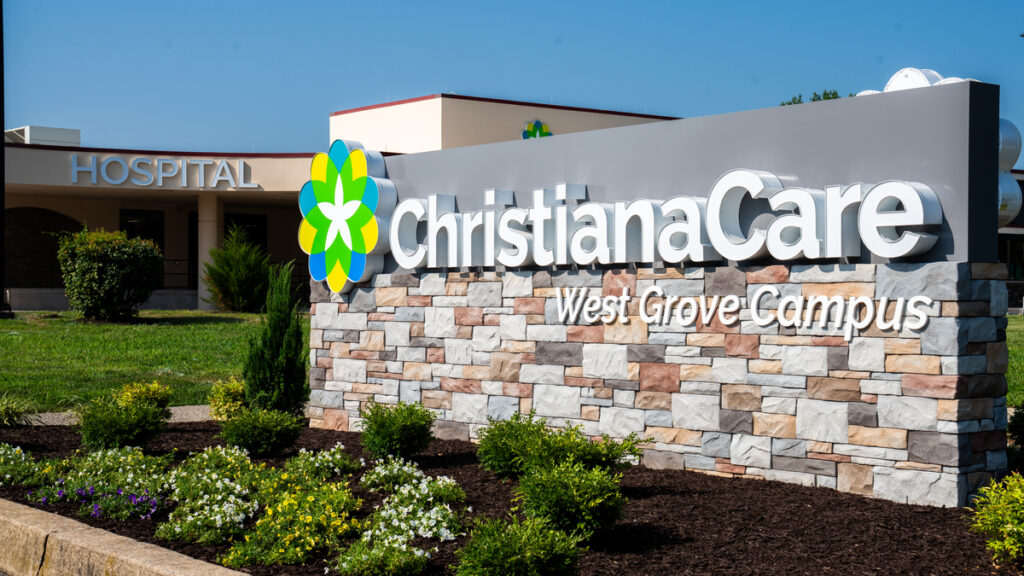
ChristianaCare has already worked with the model, opening a neighborhood hospital at its West Grove campus in Chester County, Pennsylvania last year.
Benoit wrote that Delaware law does not define a microhospital or recognize it as a model. He said that ChristianaCare would not be able to meet regulatory requirements since they don’t exist.
The TidalHealth letter, written by CEO Steven Leonard, also stated that the neighborhood or microhospital designation “does not meet the threshold definition of a ‘hospital.’”
The letter specifically opposes the Georgetown campus, which Leonard said will focus largely on emergency-based care and won’t be “primarily engaged in providing inpatient services,” as hospitals are defined in state code. Moreover, he wrote that if a microhospital category is not created under state code, then the application would be considered premature.
Unlike the Bayhealth letter, the TidalHealth letter does request the board to deny ChristianaCare’s Georgetown application. The letter states that TidalHealth supports expanding care in Sussex County and does not oppose the health center aspects of the applications.
TidalHealth officials did not respond to a request for comment by WHYY News.
The letter submitted by Beebe Healthcare also said that the Georgetown campus should be denied unless ChristianaCare complies with state law.
David Tam, the president and CEO of Beebe Healthcare, wrote in his letter that the Georgetown neighborhood hospital does not meet requirements to be considered a general hospital. Under state law, a general hospital must have X-ray, clinical laboratory, operating room and emergency department services. According to Tam, the application indicates that the campus won’t have a clinical laboratory or operating room.
Additionally, all three letters noted that the ownership and structure of the hospitals conflict with recently adopted state law.
Gov. Matt Meyer signed Senate Bill 313 into law earlier this summer, establishing a two-year moratorium that keeps the state’s nonprofit hospitals from being purchased by private equity firms.
ChristianaCare plans to partner with the for-profit entity Emerus Holdings, a developer of neighborhood hospitals, on both campuses. Benoit said that Emerus will have almost 50% ownership interest and governance rights for the two campuses.
“If the governing agreements provide a for-profit participant with rights that constitute prohibited ownership, control, or operational authority, the applications are not legally eligible for approval,” Benoit wrote in the Bayhealth letter.
Tam noted that under the new law, for-profit entities are not able to submit an application to the regulators, and the board cannot accept any application that violates that law.
“The issue is not whether a microhospital model may offer certain benefits, but whether the specific project proposed complies with Delaware law governing acute care hospitals and [Certificate of Public Review] applications,” Tam wrote.
Beebe Healthcare officials declined to comment further when contacted by WHYY News.

Get daily updates from WHYY News!
WHYY is your source for fact-based, in-depth journalism and information. As a nonprofit organization, we rely on financial support from readers like you. Please give today.

ChristianaCare’s proposed health campus in Georgetown would include an ER and outpatient care to serve Sussex County’s growing population.
8 months ago
These new 2026 health care laws are taking effect in Pa., N.J. and Del.
Bills on diagnostic breast cancer testing, GLP-1 medications, lead paint and breastfeeding were signed into law.
10 months ago
ChristianaCare to open West Grove ‘neighborhood hospital’ in August
The site of the former Jennersville Hospital in Chester County will soon be home to ChristianaCare’s first neighborhood hospital.
1 year ago
Listen 0:43