‘Handing out the pens’: Delaware Education Secretary Cindy Marten seeks feedback on proposed school accountability plan
The draft plan includes a possible state takeover of schools. Marten talked with WHYY News about the proposal.

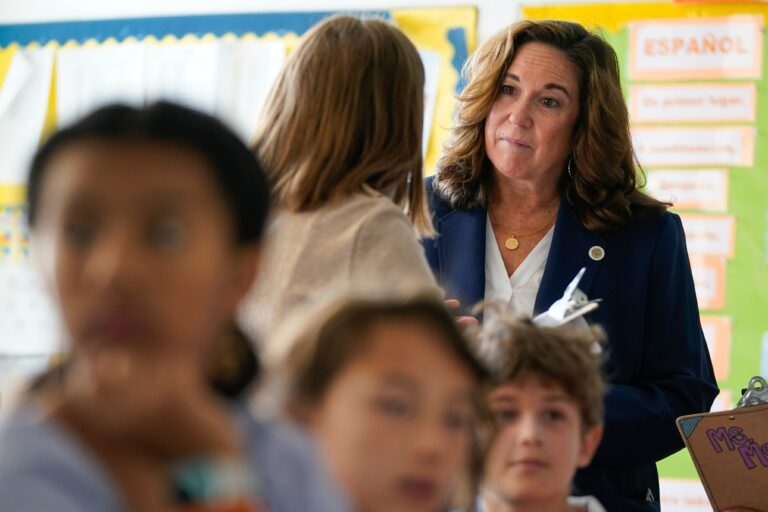
File - Delaware Secretary of Education Cynthia "Cindy" Marten, formerly the U.S. deputy secretary, meets with a student while visiting a classroom in Washington, Thursday, May 25, 2023. (AP Photo/Pablo Martinez Monsivais)
What are journalists missing from the state of Delaware? What would you most like WHYY News to cover? Let us know.
Delaware Education Secretary Cindy Marten is seeking feedback on a draft school accountability plan through October.
It includes a five-tiered system where schools would receive increasing levels of state support, and Delaware education officials could take over a low-performing school as a last resort.
The proposal has drawn backlash from some educators who say it’s too similar to a previous unsuccessful effort — known as the priority schools initiative — to turnaround low-performing schools in the Christina and Red Clay Consolidated school districts.
WHYY News sat down with Marten to talk about the draft plan. The conversation has been condensed and edited for clarity.
Related Content
Legal scholars question who would be liable for an artificial intelligence agent’s bad behavior under the state’s proposal.
1 month ago
Listen 1:09WHYY News: Would you start by talking about the motivation for the plan and how it was developed?
Marten: I’m going to start where I always start, which is with students. Every morning, our kids walk into our schools and these are schools that have struggled. Some of them are schools that have struggled for years and their parents trust us to educate them.
I’m not interested in repeating mistakes of top-down reforms that have not worked. I’m not interested in blaming teachers or schools or communities. I’m interested in what we, collectively, are prepared to do differently for children.
We’re just about to make a generational change in how we fund our schools. That’s essential. But I’ve always said money alone is not going to guarantee better outcomes. We need to make sure that the resources actually reach the students intended, it strengthens instruction and it produces progress that we can report and that people can understand.
WHYY News: Why is the plan being rolled out now, when many say there is still hundreds of millions of dollars that is needed to be invested in a new school funding formula?
Marten: I think Delaware is at a very important turning point. We’re making this generational change in how we fund public education and we’re directing more resources to students with the greatest need. We’re strengthening early literacy.
We can’t make these historic investments without being equally serious about whether those investments are improving outcomes for children. That’s why it’s a statewide conversation.
There’s another reason — our existing school improvement system is due for renewal next year. That gives us an opportunity to look at what’s working, what’s not, [and] build a more coherent approach with teachers’ voices and principals’ voices, community support, rather than continuing to layer one disconnected initiative on top of another.
I want to support an accountability framework on the page that we all understand and there’s not a black box around what school improvement looks like. Identifying a struggling school year after year without a clear plan isn’t enough. We have the data. We’re changing the funding. We know what strong instruction looks like. Now we need the follow through. And the urgency to me is simple. Children are in the classrooms every day. They do not need to wait for us to get every condition perfect before we ask, before we take action.
WHYY News: Was the school accountability plan developed with teachers? I think one of the criticisms is that the Delaware Department of Education created it internally and then presented it.
Marten: This is a draft. We wanted to put something out into Delaware for people to respond to. The ink is not dry yet. We want to be engaged in robust conversation and dialogue around what this looks like.
Teachers understand what works, what doesn’t and what needs to change. Teachers should not be the recipients of any reform, they should be the architects of the improvement. That is how I’ve always led. That is what I believe in. That is the way real change happens.
I want teachers to shape the solutions and then evaluate whether those solutions are working or not. And DOE is accountable. We will write this together, make it really concrete.
WHYY News: Some teachers have expressed concern that the proposal looks too much like the failed priority schools initiative that was funded with the Race to the Top federal grant program. What do you say to people who are concerned about that?
Marten: Look, I understand why people are raising that concern and actually take it very seriously. We’ve seen what happens. I’ve lived it myself as a teacher and a principal. When reform becomes top-down mandates, a bunch of outside consultants, a bunch of compliance requirements, teachers end up feeling blamed instead of supported. I do not want to repeat that history and that is not what is proposed in the draft that is circulating right now.
But then, here’s where we can challenge ourselves. The mistake of past reforms is not a reason to accept the status quo now. We continue to have schools that have struggled for years. Our teachers know it and they are working hard in some of our most challenging schools. They are really wanting real support, not a plan on a piece of paper in Dover.
So I think here’s what should be different this time. Take the lessons from before. We’re not interested in bringing in consultants to tell teachers how to do their jobs. We’re interested in strengthening the conditions that allow teachers to succeed.
WHYY News: What is the timeline for receiving feedback and then making decisions after that?
Marten: The feedback is open until Nov. 1, and that’s for our first draft. This turns into a very much of a “we project.” There’s a QR code, there’s a website to go to.
We really want to hear from people and it doesn’t have to just be on the form. There’s a lot of ways to do this. So, I definitely am hearing what people have to say and I’m passing out the pens.

Never miss a moment with the WHYY Listen App!


WHYY is your source for fact-based, in-depth journalism and information. As a nonprofit organization, we rely on financial support from readers like you. Please give today.

A new report shows multilingual learners make up nearly 19,000 of Delaware's students, but teacher shortages and outdated systems leave key gaps.
1 year ago
Listen 1:23
‘Struggling to read’: Delaware implements early literacy plan to boost student learning outcomes
Delaware is funding efforts to boost early literacy efforts, but income and racial disparities remain.
1 year ago
Listen 3:22
Delaware launches a new program to boost middle schoolers' careers awareness and exploration, as well as their high and postsecondary school readiness.
4 years ago