

Atlantic City’s Sheraton is essential to conventions. So why can’t it make money?
The developer behind a proposed $100 million overhaul says partial residential conversion is the only way to keep it viable without a state subsidy.
Listen 1:34
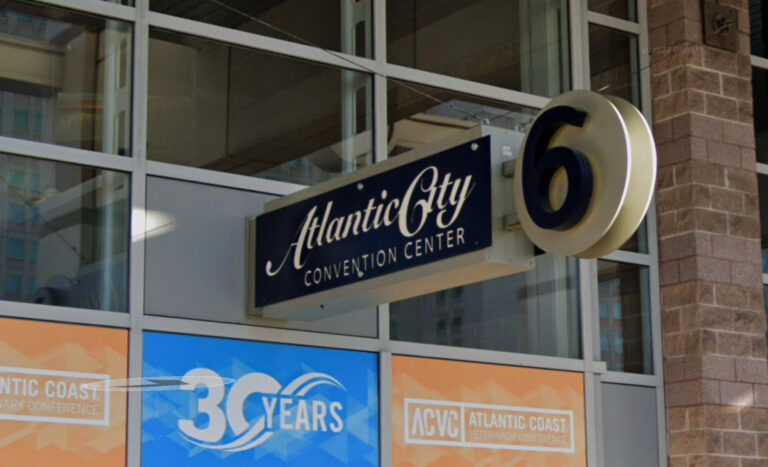
File - The Atlantic City Convention Center, adjacent to a Sheraton hotel (Google Maps)
From Camden and Cherry Hill to Trenton and the Jersey Shore, what about life in New Jersey do you want WHYY News to cover? Let us know.
For years, developer Tom Scannapieco wanted the state of New Jersey to buy the hotel at the Atlantic City Convention Center.
The logic seemed clear. With casino gambling in a long decline, conventions and events have become increasingly important for the city’s economy. While the Sheraton Atlantic City Convention Center Hotel is a longtime money-loser and hasn’t been renovated since it opened in 1998, political and business leaders believe it’s essential to the Convention Center’s success.
Scannapieco noted that in dozens of cities, from Chicago to Dallas to Denver, convention center hotels are publicly owned, based on the recognition that they provide an important economic benefit, even if they aren’t profitable themselves.
In Atlantic City in particular, where casinos often provide rooms at below-cost prices to entice gamblers, the hotel business is “a difficult market for a private sector property,” he said, “which is why this hotel maybe should be owned by the public sector.”
So after the Sheraton’s then-owners fell behind on their debt payments and Scannapieco’s investor group acquired the distressed senior debt in 2020, he said he reached out to the Casino Reinvestment Development Authority.
“We said, ‘Look, you guys really should own this hotel,’” he recalled. “We even hired a consultant to put together some materials to try to make them see the opportunity — and that didn’t work. They didn’t want to own it.”
The CRDA contested that account.
“Although CRDA and Mr. Scannapieco have had conversations regarding the Sheraton over the years, including its longstanding deteriorating conditions, CRDA was never approached with any substantive offer to sell the Sheraton,” spokesperson Michael Chait said.
Ultimately, Scannapieco’s group, LINY Investor LLC, bought the 502-room facility itself. But Scannapieco said the same economic problem remained: While the Sheraton is essential to attracting conferences, the Convention Center does not host enough large, multiday events to make a hotel of that size profitable.
To overcome that challenge, the investor group hired hotel experts and architects, and came up with a $100 million renovation plan that Scannapieco says will save the building while creating a new, reliable source of revenue.
They would spruce up about half of the rooms, create an art-filled lobby with an upscale design, and convert the rest of the building into 130 high-end apartments for residents 55 and older, with a private swimming pool and other amenities.
“The message to me was very clear: We had to find a solution that did not involve a continuing annual public subsidy, and that’s what we did,” Scannapieco said.
The plan received a mixed reaction. While Atlantic City Mayor Marty Small supports the renovation, it has been criticized by casino and tourism officials who say the remaining 252 hotel rooms would be too few to support a viable convention center hotel.
In addition, the New Jersey Economic Development Agency has so far declined to help advance the plan. For almost a year, the agency has declined to make a decision on LINY Investor’s application for tens of millions of dollars in state tax credits. Without that funding, Scannapieco said that construction can’t begin.
Meanwhile, Marriott International, which runs the hotel, has decided it can no longer keep taking losses and recently announced it will lay off all 180 employees by mid-December, he said. If the tax credits aren’t approved soon, he’ll have to close the hotel.
“It’s a shame that it comes down to deadlines and ultimatums,” he said. “It’s the worst possible way to approach a problem, but we’ve had four years of conversations, and it’s just absolutely clear to us that they want a private-sector solution. And this is the only solution that the team could come up with that makes economic sense.”
Related Content

A report says 5,100 jobs could be lost over the next decade. That number could surpass 8,000 if two additional casinos open elsewhere in New Jersey.
1 month ago
‘Imagine the devastation’
The struggle to save the Sheraton comes amid broader uncertainty over the city’s future, its place in the state’s tourism economy and Gov. Mikie Sherrill’s economic development strategy.
Atlantic City’s casinos have been battered for years by a succession of crises, including the opening of casinos in Pennsylvania, the COVID-19 pandemic and the massive growth of online gambling and sports wagering. New York City got its first full-scale casino in April and two more are planned, denting Atlantic City’s attractiveness as the region’s main gambling resort.
Employment at its casinos and hotels fell to 21,172 earlier this year, the lowest figure in at least nine years. The city’s unemployment rate averaged 8.6% in the first six months of 2026, double the national rate, and the Atlantic County Economic Alliance said in a recent analysis that the area could lose another 5,100 jobs by 2035 as more New York casinos open.
While the likelihood of a long-term or permanent closure of the Sheraton is unclear, the prospect of losing even more jobs and a key convention asset has alarmed local officials.
Small said the city “can’t afford” to lose the hotel, and CRDA board member Frank Formica said last week that if the Sheraton closes, “we’re done as far as conventions are concerned,” the Press of Atlantic City reported.
“It is difficult to comprehend how much more difficult it will be to attract visitors and conventions to Atlantic City without a sister hotel,” Atlantic County Executive Dennis Levinson wrote in a letter to Sherrill.
Sherrill declined to comment specifically on the Sheraton or Scannepieco’s request for tax credits.
“Tourism and hospitality are vital to Atlantic City, and Gov. Sherrill cares deeply about this city’s future and the workers who make it run,” her spokesperson, Jameel J. Muhammad, said Thursday. “The administration is in contact with stakeholders and will continue doing what is right for Atlantic City and Atlantic County.”
As state officials consider whether to help finance the Sheraton renovation, they are being criticized for supporting projects elsewhere that compete with Atlantic City for conventions or could in the future.
Levinson called it “disturbing” that the state recently awarded $75 million in tax credits to the developer renovating the Asbury Park Convention Center, and that the state “appears to be actively pursuing” construction of a proposed 300,000-square-foot convention facility in the Meadowlands.
“Imagine the devastation that would result from a new state-funded convention center in the Meadowlands,” he wrote to Sherrill. “We don’t need to spend our own taxpayers’ dollars to create more competition within New Jersey. I cannot imagine the state … wants to bear responsibility for the closing of the Sheraton Hotel coupled with a lack of support for the Atlantic City Convention Center.”
Saying that the state is ultimately responsible for oversight and fiscal management of Atlantic City, he wrote, “I am at a loss to identify [the state’s] end game objective.”
Related Content
Gov. Mikie Sherrill has defended her growth strategy, but advocates say the state must do more to boost competitiveness.
3 weeks ago
Listen 1:36Facing economic realities
Scannepieco has worked in Atlantic City for decades. His company, Philadelphia-based Scannepieco Development Corporation, built the Sheraton in the late 1990s and was part of the original ownership group.
He assembled the site for the Revel casino, now Ocean Casino Resort, worked on an infrastructure project for the Tropicana and built two high-rises and six blocks of homes in the city, he said.
“I’ve been around the city a long time, and I’ve seen some of the changes,” he said.
He has watched the city work to diversify its entertainment offerings beyond gambling to try to attract a broader range of tourists. Visit Atlantic City, the organization that runs the Convention Center and other tourism facilities, is doing a “better and better” job at bringing in more events, he said.
But there’s no evidence the center will ever be able to support a profitable, 500-room convention hotel, he said.
The Convention Center “doesn’t have the right type of business and enough of it,” he said. “They have boat shows, tattoo shows, beer festivals, car shows. … People drive in, they go for a day and they drive home. It’s not like a citywide convention where people come in for four days and they have annual luncheons and honorees and speeches and meals for 1,000 people.”
The facility also has competition right in town from Harrah’s Waterfront Conference Center, which opened in 2015 after receiving $45 million in assistance from the CRDA, he noted.
His planned renovation of the Sheraton takes into account the decline of gambling and the limits of the convention business, he said.
The city is “gravitating to a residential shore town that has more entertainment and restaurants and excitement than other shore towns. It’s going to be a ‘residential’ shore town first, in the description,” he added.
To take advantage of that shift, the residential portion of the renovated Sheraton will have amenities that will be “second to none,” he said.
“We’ll have an indoor swimming pool. We’ll have a 1200-square-foot gym only for the residents. We’ll have a golf simulator. We’ll have a hot tub. We’ll have barbecue pits outside. This is going to be a highly amenitized project with hotel services next to it,” he said. “It’s the right mix of hospitality and residential to address the direction that the city is going.”
The private financing for the renovation is nearly all in place, and he just needs the NJEDA to approve $79 million in tax credits from its Aspire program, he said. After his costs to borrow against the promised subsidy, and a discount required by the eventual buyers of the credits, they’ll provide about half that sum toward construction costs.
“But look, it’s a great program,” he said. “Because when you have a hotel project that doesn’t pencil, even 50% of that amount — it’s the difference between a project that can get done and a project that can’t get done.”

Get daily updates from WHYY News!
WHYY is your source for fact-based, in-depth journalism and information. As a nonprofit organization, we rely on financial support from readers like you. Please give today.
A report says 5,100 jobs could be lost over the next decade. That number could surpass 8,000 if two additional casinos open elsewhere in New Jersey.
1 month ago
The Battery in Fishtown is getting a 62-unit boutique hotel
The new Fishtown hotel known as Riversuites is expected to open by the end of the year.
3 years ago

Workers at Golden Nugget and Resorts vote to authorize a strike
About 1,000 workers at the Golden Nugget and Resorts casinos have authorized a strike. One will happen if a new labor deal is not reached.
4 years ago